
I SAW WHAT I SAW: On this island, a Yale professor sexually harassed a Yale student. Did the University do enough?

I SAW WHAT I SAW: On this island, a Yale professor sexually harassed a Yale student. Did the University do enough?

Published on March 5, 2019

A Yale student endured serial sexual harassment during a summer internship. The perpetrator — a School of Medicine professor — retired quietly. Five months later, the University announced an investigation — but did Yale do enough?

Editor’s Note: This article contains sexually graphic descriptions of misconduct. The student who experienced the misconduct requested the pseudonym Blair to protect their privacy.

On a chilly January evening, Blair received an unexpected call from their dean.

The dean told Blair, a gender nonbinary Yale senior who uses they/them/their pronouns, that Yale had launched an independent investigation into sexual misconduct complaints against retired School of Medicine professor Eugene Redmond. Blair was shocked. Seven months earlier, the University-Wide Committee on Sexual Misconduct had found Redmond responsible for sexually harassing them. But Redmond had retired before the University imposed disciplinary sanctions. It had seemed like the University’s hands were tied. Blair wondered: What had changed?

Later that night, in a Jan. 28, 2019 statement announcing the investigation, Yale said it was responding to a new complaint against Redmond. The University made a striking admission: Yale had investigated Redmond before. In 1994, former interns alleged that Redmond had sexually harassed them at a research facility on the Caribbean island St. Kitts where he ran an internship program — the same facility where he harassed Blair in 2017. At that time, Redmond promised to end the program, which he did for a few years. But since at least 2011, he had reopened it to Yale undergraduates, seemingly without Yale’s knowledge.  
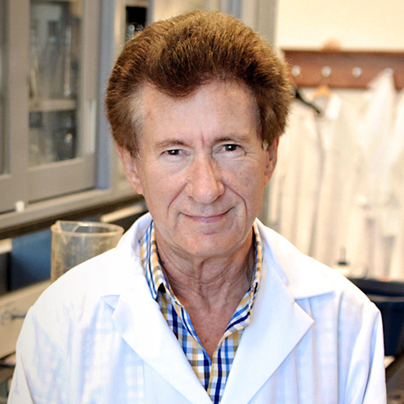
Eugene Redmond (YaleNews)

For a university that rarely — if ever — acknowledges cases of misconduct committed by faculty members, Yale’s announcement was unprecedented. It also seemed impressive: Yale hired a former U.S. district attorney as an outside investigator and named Redmond publicly. It looked like the University was doing the right thing.

“I am committed to the investigation that will shine more light on it: a university dedicated to the pursuit of truth can ask no less of itself,” University President Peter Salovey said in Yale’s statement.

But a five-month investigation by the News exposes Yale’s inability to effectively discipline faculty members found to have violated the University’s sexual misconduct policy. When the UWC found Redmond responsible for sexual harassment, it sent a report to the administrator with authority to sanction faculty — Provost Ben Polak. After receiving the UWC’s findings and all follow-up reports and responses — a normal part of the UWC’s adjudication process — the provost usually makes a disciplinary decision “within seven days,” according to the UWC’s website.

Polak had all of the follow-up reports and responses he had requested by July 9, but he did not issue a decision within seven days. Thirty-eight days passed before Blair received an update from the UWC: Redmond had retired without Polak having issued a decision. Another five months passed before the University announced its independent investigation in January.

In a signed letter to the News, Redmond categorically denied sexually harassing Blair. After Yale announced its investigation, he denied the allegations that motivated it in an email to the News, calling them “slanderous and defamatory.”

Fearing the disciplinary and legal action outlined in the UWC’s confidentiality policy, Blair decided not to publish any documentation from their UWC hearing. The News corroborated their story with email exchanges between Blair and University officials, as well as with the accounts of another St. Kitts intern, professors and Redmond himself.

The case against Redmond reveals an inability by the UWC — a highly bureaucratic system, considered a model among Yale’s peer institutions — to accommodate nuance in the cases it adjudicates. At nearly every stage, the University’s response to Blair’s experiences did not uphold its commitment to preventing and addressing cases of sexual misconduct. From the burden imposed on student complainants, particularly those who are nonbinary, to its stringent yet vague confidentiality policy, the UWC’s process can leave survivors feeling powerless and silenced. And even when the UWC rules in a complainant’s favor, the University is not always able or willing to hold its faculty members accountable.

Polak’s delay in disciplining Redmond and the University’s decision to launch an investigation months after Redmond’s retirement raise the question: Can Yale protect its students?

“I saw what I saw”

During the spring of their sophomore year, Blair, a biology major, began searching for internship opportunities for the upcoming summer. They found Redmond’s internship program listed on Yale Career Link — an online job portal run by Yale’s Office of Career Strategy — and decided to apply.

In March, Redmond interviewed Blair in Morse College, where he served as an adviser for at least 20 years. Eager to build a relationship with their new mentor, Blair invited Redmond to a performance by their spoken word group, which he attended.

Two days after the performance, Redmond told Blair over dinner that they would have to share a room with two beds over the summer. Blair found the idea of sharing a room with a professor “a little weird,” but ultimately agreed. There didn’t seem to be other options.

Despite the sleeping arrangements, Blair was thrilled by the opportunity to conduct research with Redmond, an esteemed scientist and pioneer of stem cell treatments for Parkinson’s disease. In the weeks after their dinner, Blair and Redmond emailed back and forth planning a joint research paper, which Blair knew would stand out on future medical school applications.

The night of June 11, 2017, Blair and two female interns — also Yale undergraduates — flew into St. Kitts and drove to Redmond’s research facility, roughly a mile from the coastline. The humid Caribbean air hit them as they walked to the main house with their suitcases, ready to sleep after a long day traveling.

Railroad tracks on St. Kitts. (Courtesy of Blair)

After saying goodnight to the other interns, Redmond and Blair retired to their shared room. Without warning, Redmond undressed, Blair said, and stood completely naked in front of them. Blair told the News that Redmond then put on loose boxers and got into his bed, which was situated just a few feet from Blair’s own.

According to both Redmond and Blair, the professor also offered to apply lotion or aloe onto their back regularly that summer.

“I offered to put sunscreen or lotion on the student’s back before going out into sun or at night. In the tropics, unprotected sun exposure can be dangerous,” Redmond wrote in his letter to the News.

Every morning, Blair woke with the other interns and walked across the facility grounds — past Dobermans that roamed the campus and cages of monkeys — to conduct their research. When their workday ended, the students often biked around the island or explored the nearby beach. Night after night, Blair and Redmond retired to their shared room.

On one of those nights, Blair encountered the professor “holding his penis with his hand and moving his hand up and down,” they told the News. A few days later, Blair saw Redmond masturbating in the bedroom for a second time.

“You can’t do this again,” Blair told him that night before leaving the room.

Blair recalled confronting the professor the next day.

In response, Redmond denied masturbating.

“I saw what I saw,” Blair told Redmond.

“It’s one of life’s little pleasures,” he responded.

In his letter to the News, Redmond denied “any occurrence of masturbation (or any explicit sexual behavior) in the presence of this student on any occasion in any place.” When asked about this alleged conversation with Blair, Redmond’s attorney did not address it directly but denied any misconduct.

One of the female interns living with Blair and Redmond — who requested anonymity because she did not want to be associated with the case — told the News that Blair confided in her about the second alleged masturbation incident that same night.

A day after the confrontation, Redmond asked to speak with Blair alone after work, according to Blair, and inquired about their sexual fantasies. When Blair responded that they felt uncomfortable discussing such topics, Redmond asked whether they masturbate. Blair said “not often,” hoping to end the conversation.

But the conversation did not stop there. According to Blair, Redmond responded, “As someone who cares about you, I am going to prescribe an orgasm a day.” From that day until the end of the summer he continued to ask Blair whether they were following his “prescription.”

In his letter to the News, Redmond defended all of his interactions with Blair during the internship, insisting that conversations about “gender and life experience […] were intended to be supportive and always guided by what the student brought up and seemed comfortable discussing.”

During the UWC hearing, Redmond confirmed that he said that Blair “should have more sex,” according to Blair. In addition, Redmond acknowledged that he had engaged in multiple conversations about Blair’s sexual fantasies, sexuality and sexual history, according to Blair. Blair added that during the UWC hearing, Redmond also admitted to talking about masturbation and sexual fantasies with previous interns.

Halfway into the internship, Blair missed a day of work after experiencing “terrifying” stomach pain and constipation for several days.

When Redmond entered the shared bedroom to check on Blair, he asked them to describe their medical condition, Blair recalled.

“Why don’t I do a rectal exam on you?” Blair remembered Redmond asking.

“I’d rather not,” Blair responded.

While Blair was reluctant to allow the rectal exam, they felt coerced to agree after Redmond insisted that it would be medically prudent to do so. Until that moment, Blair had never had a penetrative rectal examination.  

“He feigned giving me a medical exam I didn’t need, and sexually assaulted me,” Blair told the News.  

Redmond told the News that he conducted the rectal exam to test for appendicitis. Redmond added that the student “cooperated fully” after he explained the need for a rectal exam. The medical decision was “made for ‘watchful waiting,’” Redmond wrote in his letter.

At the UWC hearing, according to Blair,  Redmond told the panel that before he administered the exam, Blair did not show symptoms of appendicitis, and that he had not been involved in diagnosing appendicitis in over 30 years. According to Blair, the UWC panel ultimately confirmed what they already knew: The rectal exam was coercive.

In his letter to the News, Redmond said that the rectal exam “did not reveal any signs of appendicitis.” After the exam, Redmond gave Blair a laxative, and the student recovered fully.

“I do want to emphasize that even the behaviors that Dr. Redmond does admit to in his account — giving me a rectal exam, telling me to have more sex, offering me massages — are not behaviors that should exist in a student/professor relationship,” Blair wrote in their opening statement for the UWC hearing. “As faculty members at this university who interact with students, I respectfully ask that you consider whether you would behave with a student you were mentoring and supervising in this way.”  

Even as Redmond engaged in repeated sexual behaviors, Blair increasingly felt beholden to him, particularly as a low-income student. When two other interns attended a concert on the island that Blair could not afford, Redmond offered to pay for it and future excursions, provided Blair kept it a secret.

“That created this coercive environment where I felt very thankful to him and wanted to be extra nice to him because he was paying for things for me, and I felt very uncomfortable about it,” Blair said. “I felt like I owed him something.”

Redmond did not see these subsidies as problems. In his letter to the News, he wrote that, “It is odd that this generosity was interpreted by the Yale Committee as ‘harassment.’”

Blair wasn’t the only intern uncomfortable with the power dynamics on St. Kitts. “He took us everywhere,” one of the female interns told the News. “We were pretty much subject to his entire will throughout the summer.” Redmond controlled all of the internship funding —  including money for stipends, groceries and travel. Interns also depended on the professor to drive them around the island.

Adding to Blair’s discomfort, they said Redmond disregarded their gender identity on several occasions. Blair told Redmond their preferred pronouns when the two first reached St. Kitts in June. At the time, Redmond told Blair that they should not use they/them/their pronouns on the island since, “not everyone will understand.” Blair added that Redmond said he did not believe in transgender identities.

In his letter to the News, Redmond claimed that Blair had never indicated that “non-traditional pronouns (THEY, THEM, THEIR) were preferred.” But in an earlier paragraph in the same letter, Redmond said that over the course of the internship, he had several conversations with Blair about gender.

“I guess he perceived me as a gay male, which is another way that a lot of people perceive me,” Blair told the News. “But simultaneously, in this process of feeling violated, I felt like I was being [romantically] pursued … for someone I wasn’t, someone he thought of me as that wasn’t even the real version of me.”

“He could literally ruin my life”

After 64 days on the island, on Aug. 14, 2017, Blair returned to the U.S.

“The moment I stepped foot in Florida for the layover, I just cried my eyes out,” Blair said.

Blair returned to Yale that fall to start their junior year. Though Blair had left St. Kitts behind, nightmares from the island persisted. They would lie awake, unable to sleep, as disturbing moments from the summer “kept playing over and over again” in their head.

About two weeks after leaving the island, Blair decided to abandon their nearly finished research paper with Redmond — they wanted to cut ties with him completely. Soon after, Blair sought help processing the summer’s trauma at Yale’s Sexual Harassment and Assault Response & Education Center and confided in School of Medicine professor Joanna Radin, Blair’s former professor and a trusted adviser.

In Radin’s office, Blair broke down as their story “just sort of spilled out.”

As a mandatory reporter, Radin notified the University Title IX coordinator of Blair’s experience without naming them. Radin’s response made Blair feel reaffirmed. Blair considered taking the next step — filing a formal UWC complaint, which would launch an investigation into their allegation against Redmond.

The decision kept them up at night. If Redmond — a powerful researcher — decided to retaliate, “he could literally ruin my life,” Blair explained. They worried that if the UWC were to rule against them, Redmond would undermine their chances of getting into medical school. Blair also feared they would repeatedly have to explain their gender identity, as they had done on the island with Redmond. They did not want to relive that discomfort.
Yale School of Medicine (Marisa Peryer)

“I always felt like I was wrong,” Blair said. “I always felt I hadn’t experienced what I had. … It took me so long to realize that even though I felt so violated, it was valid. Because [Redmond] did a really great job the whole time of gaslighting me. Every time I confronted him, he pretended it hadn’t happened or it was coincidental.

After months of indecision, Blair filed a formal UWC complaint on March 9, 2018. Later in March, the UWC appointed an impartial fact-finder who began investigating their complaint.

While Blair was determined to hold Redmond accountable, their daily routine was overwhelmed by the UWC process of submitting statements, retelling their story to the fact-finder and waiting for hearings. Their UWC hearing was postponed to take place after Blair had finished their final exams, but the proceedings loomed over them that semester.

On May 15, 2018, the five-person UWC panel held its hearing on Blair’s complaint.

“This is not something I would have put myself through if I did not feel morally compelled to do so,” Blair said in their opening statement. “I do not want this man to hurt anyone else the way he hurt me.”

Blair told the News that University officials seemed to not understand their gender identity. Blair recalled that, at the start of the seven-hour hearing, a panel member advised them to “do [their] best to not be offended” if anyone misgendered them during the hearing.  

According to Blair, UWC panelists used their pronouns properly at the beginning of the hearing. But after Redmond’s testimony — in which he described Blair using he/him/his pronouns — panelists started using incorrect, male pronouns as well, Blair said.

Mark Solomon, the current UWC chair and the panel chair for Redmond’s case, declined to comment on specific UWC cases and the alleged misuse of pronouns. Then-UWC chair and panelist David Post referred questions to Yale’s Office of Public Affairs & Communication. The other three panel members at Redmond’s hearing did not respond to requests for comment.

Conroy, the University spokesman, first told the News on Dec. 1 that Yale does not “confirm or discuss complaints.” After the University announced the independent investigation in January, Conroy said the investigator will “examine all issues regarding the complaints” against Redmond.

Despite the exhausting UWC process, Blair left the hearing feeling encouraged.

“The panel was clearly in my favor, and they were shocked by the stuff I was saying and Redmond was saying,” Blair recalled. “That felt great because they believed me. And it was reaffirming. And I felt good about it.”

About three weeks later, on June 4, 2018, the UWC affirmed Blair’s account. Redmond had violated Yale’s sexual misconduct policy in the form of sexual harassment.

Banned from Yale

Polak, the University official who was to make the final decision about the case, received the UWC panel’s report on June 4. UWC panel reports typically include a recommendation for an appropriate disciplinary sanction, according to the UWC’s website. However, the report sent to Polak did not mention any recommendation for what Redmond’s punishment should be, according to Blair, who also received a copy.

After receiving the UWC’s report, Polak requested a follow-up with more information about the rectal exam Redmond had performed on Blair. Both Blair and Redmond were given an opportunity to submit a response to the supplemental report. In an interview with the News, Conroy reiterated that the decision-maker may request further information before issuing a decision, as “new facts may emerge.”

On July 1, UWC Secretary Anita Sharif-Hyder notified Blair that Redmond had requested an extension to submit his response “due to his travel schedule.” Both parties’ deadlines to submit responses were extended. By July 9, Polak had received all of the additional information he had requested. According to the UWC’s website, a decision-maker “will render his or her decision in writing within seven days” after receiving all reports and responses from the parties. But the UWC did not notify Blair of the case’s outcome until Aug. 16 — 38 days later.

That day, Blair finally received the email they had been anticipating all summer.

The email informed them that Polak had accepted the UWC panel’s conclusions, according to Blair. But Blair read on: Before the Provost issued a decision, Redmond had retired. No disciplinary action had been taken.   

Polak referred requests for comment on the extensions and retirement to Conroy, who reiterated that faculty members may retire from Yale at any time. Once a faculty member retires from Yale, the University can no longer impose disciplinary sanctions, such as counseling or suspension.

“It seems that the UWC reporting process was structured in such a way where the Provost allowed him to retire and that should not be the case,” Blair told the News. “No one person should have that sort of power.”

Following his retirement, the University banned Redmond from campus and prohibited him from contacting Yale undergraduate and graduate students, residents, postdoctoral fellows and research associates, according to Blair’s recount of the Aug. 16 email. Yale also banned the St. Kitts facility from recruiting Yale students as long as Redmond is affiliated with the program. Redmond was denied the privileges of most retired faculty members, such as emeritus status and University sponsorship for grant proposals, according to Conroy.

But while Blair was left in the dark on Redmond’s fate, five of his undergraduate advisees in Morse College were notified on July 27 that he intended to retire — 20 days before Blair heard the news — according to an email sent to Abhishek Srinivas ’21, one of the former advisees.

“Professor Redmond chose to retire after he was informed of the planned punishment that would be implemented by University leadership,” Conroy told the News on Jan. 29. “In addition, Yale cannot prevent faculty members from retiring if they are contractually entitled to do so.”

Conroy declined to comment on what Redmond’s punishment would have been had he not retired.
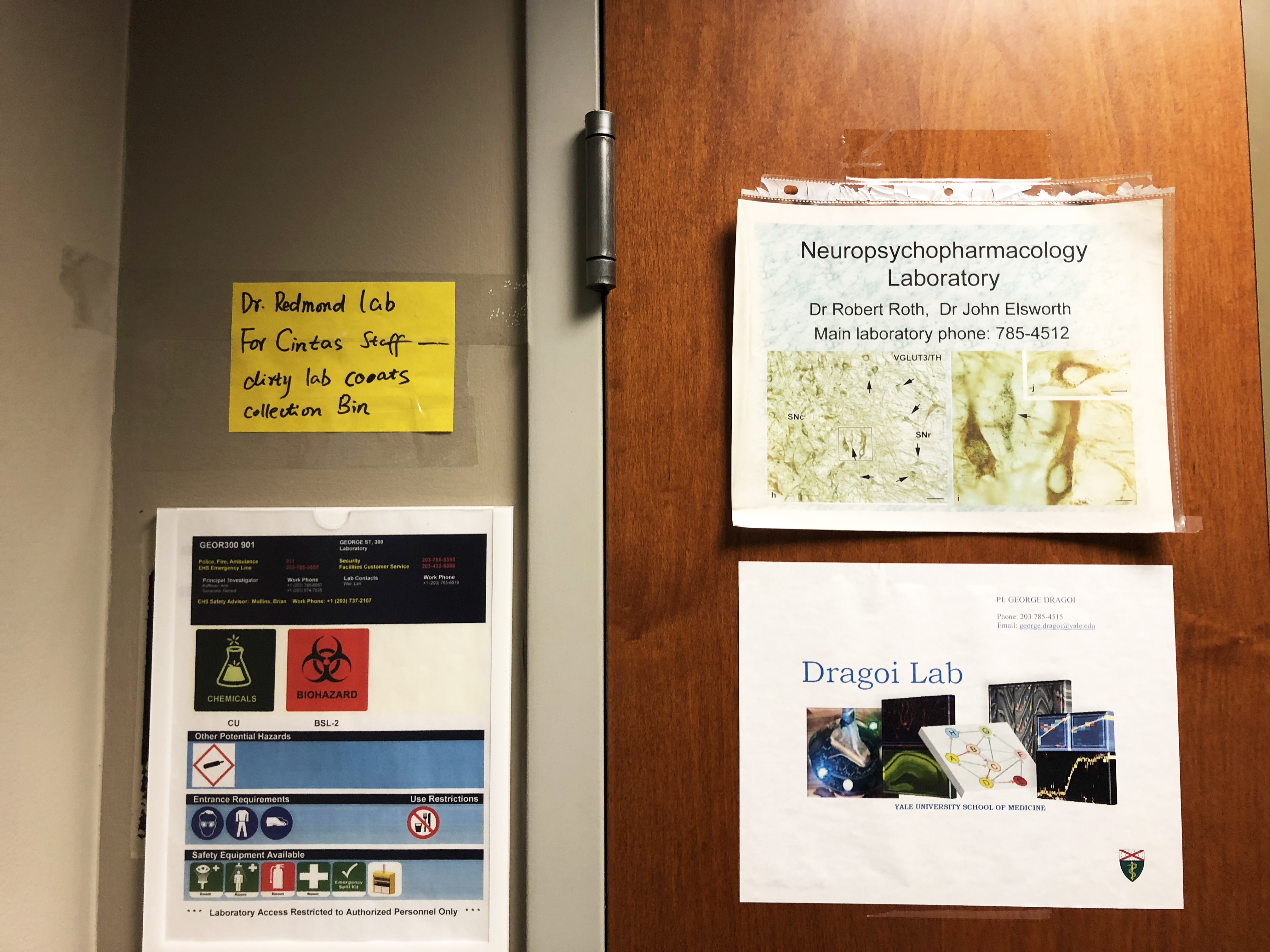
Redmond's former lab (Marisa Peryer)

In his letter to the News, Redmond confirmed that he retired last summer, but claimed that he was denied “basic due process rights in this matter.” He did not respond to multiple requests for elaboration. On March 2, Ethan Levin-Epstein, a partner at a law firm advocating for workplace fairness, emailed the News on behalf of Redmond.

Dr. Redmond continues to deny that he engaged in misconduct and continues to strongly disagree with the UWC Panel’s decision and the unfair process by which it was reached,” Levin-Epstein wrote in his email to the News.

“Yale has made me a victim”

In an interview with the News on Jan. 29, Conroy insisted that the University imposed “severe restrictions” on Redmond after his retirement. Redmond is barred from engaging in Yale-related activities, according to a Dec. 3, 2018 email Conroy sent to the News. When asked if Redmond still receives retirement benefits, Conroy directed the News to a University website and read the policy aloud: “All faculty who retire are eligible to receive a subsidy for part of their health insurance.”

Despite the “severe restrictions,” the Yale Journal of Biology and Medicine published a paper for which Redmond is the senior author in September 2018 — roughly one month after his retirement and subsequent ban from engaging in Yale-related activities. Just last month, Redmond submitted a paper to the journal Biochemical and Biophysical Research Communications with his former colleagues in the School of Medicine’s Department of Psychiatry.

This is not the first sexual misconduct case that the School of Medicine has grappled with in recent years. The medical school drew scrutiny last summer for honoring cardiologist Michael Simons MED ’84 — whom the UWC found responsible for sexual harassment in 2013 — with an endowed professorship. In November, the News reported on two additional cases of sexual misconduct that the medical school mishandled.

In a Jan. 30 statement to the News, School of Medicine Dean Robert Alpern said that the school is “committed to creating a culture of respect and inclusion, where sexual misconduct has no place.”

Redmond emphasized in his letter to the News that he sees himself as a “victim” of Yale’s adjudicatory processes.

“Yale and/or its official process has made me a victim and brought great personal damage to me,” Redmond wrote in his letter.

According to Blair, St. Kitts staff decided to put the Yale internship program on hold after speaking with Blair in December 2017. Staff members did not respond to requests for comment.

Still, Redmond said he hopes to continue searching for a treatment for Parkinson’s disease.
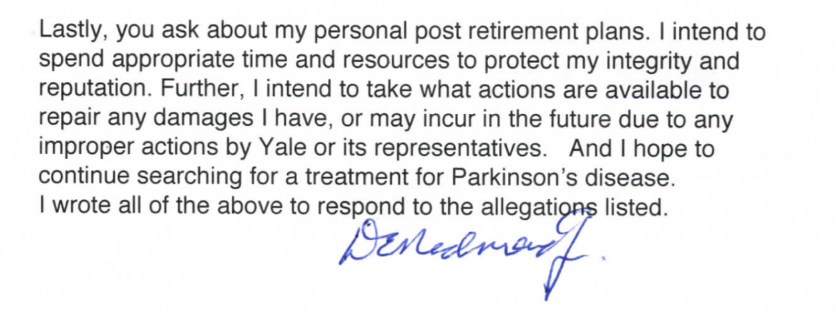
The last paragraph of Eugene Redmond's signed letter to the News.


“A re-examination of Yale’s approach”

Although the University claims that the UWC’s confidentiality policy protects participants, Blair found that it did the opposite. When they wanted to speak, they couldn’t, fearing University retaliation. And when they were resigned to remain silent, the University’s investigation placed an unwanted spotlight on their case.

UWC documents are confidential, and the University may take disciplinary action against any person who shares those documents. The confidentiality policy is designed to “encourage parties and witnesses to participate in UWC proceedings and share all the pertinent information they have to offer,” according to the UWC’s website.

All Yale community members are “expected” to maintain the confidentiality of UWC proceedings, according to UWC policy. Blair does not remember signing an agreement committing to confidentiality, but since their UWC case ended last August, they have felt silenced by the same confidentiality policy meant to preserve the integrity of the UWC process. Blair feared they would be disciplined by Yale’s Executive Committee if they made public UWC documents from their case via the News, even though those documents would corroborate their account of events.

Instead, Yale’s independent investigation has inadvertently brought Blair’s experience at St. Kitts into the public eye. Since the announcement, several acquaintances — including those with no knowledge of the complaint — have asked Blair about their experience on St. Kitts and connection to Redmond. A friend currently working on St. Kitts told Blair that the research facility is buzzing with speculation and gossip about Redmond.

“I feel that my privacy has been invaded after the investigation of Dr. Redmond went public,” Blair told the News. “If things are going to be confidential, they have to be either fully or not.”

Initially, in November, administrators in Yale’s Title IX Office, Office of the Provost and the School of Medicine all declined or did not respond to requests for comment on Redmond’s retirement and on Polak’s delay to issue disciplinary action. These administrators only issued public statements after Yale announced the independent investigation two months later. Conroy declined to comment on whether the University can take action if the independent investigation finds additional survivors, as Redmond is already retired and banned from Yale.

According to Yale’s statement, Salovey ordered the independent investigation — which is being conducted by former U.S. Attorney Deirdre Daly — after receiving another formal complaint against Redmond in 2019.

“We must learn whether there are additional survivors who wish to come forward, and we need to understand the facts relating to the internship program,” Salovey wrote in the Jan. 28 statement.

But this is not the first time Yale has launched an investigation into sexual misconduct allegations against Redmond. According to the University’s statement, former St. Kitts interns brought sexual misconduct complaints against Redmond to Yale’s attention in 1994. Yale’s investigation that year was “unable to verify those earlier allegations,” according to the statement, but Redmond told Yale that he would end the internship program.

Yale did not hold him to that commitment.

Since the 1994 investigation, Redmond has recruited numerous Yale students, including Blair and at least six other undergraduates, to conduct research with him on St. Kitts. Amid the new investigation, Conroy said that he could not share who investigated the complaints against Redmond in 1994, at which time the UWC had not yet been formed. He also declined to comment on whether the University followed up with Redmond on his promise to stop taking interns from Yale, or whether Yale ever reported Redmond to the Connecticut Medical Examining Board after he was found responsible for sexual harassment.

Yale has reported the information it has to the Yale Police Department and the New Haven Police Department, “which will be in contact with law enforcement in St. Kitts,” according to the Jan. 28 statement. The University will cooperate fully if those departments conduct their own investigations, according to Conroy.

Radin — the professor whom Blair confided in — wrote in an email to the News that she was “deeply dismayed to learn from the YDN” that Yale had knowledge about Redmond’s alleged misconduct dating back to 1994.

“That Redmond was able [to] retire after a long career [at] Yale even as his behavior may have derailed the careers of young scholars is cause for serious concern,” Radin wrote. “The courage and leadership of students like [Blair] should be recognized as such and prompt a re-examination of Yale’s approach to dealing with sexual misconduct.”

Now, a year after they filed their UWC complaint against Redmond, Blair feels resigned to the situation. When they first reported their case to the UWC, Blair did not know that other interns had reported similar experiences with Redmond in the past. While Blair is hopeful that the independent investigation will have a positive outcome, they feel overwhelmed and frustrated that the University did not launch an investigation into Redmond’s conduct earlier.

“I continually feel like the University did not take my case necessarily as seriously as I had wished,” Blair said. “I think it is now taking it seriously, but I really wish that this had all happened before [Redmond] had been allowed to retire.”

Credits

Powered by

AFTER THE BAN

Published on

Two years in, Trump’s immigration policies continue to disrupt the lives of internationals at Yale.

In January 2017, Mohamed Eltoum ’19 said goodbye to his family, placed his bags in the back of his uncle’s car and headed to the airport to return to Yale for his sophomore spring semester. As he rode, Eltoum thought about the break. It had been uneventful. He’d played soccer with friends, hung out with neighbors in the garden in his front yard and walked the dusty alleys of his hometown, Khartoum, the capital of Sudan. But troubling news from the U.S. had hit the front pages of all the Arab newspapers in the region: The newly elected U.S. president was considering an executive order to ban citizens of majority-Muslim countries from traveling to the U.S. The news had upset Eltoum and his friends studying at American universities, but at the time, no order had been issued. In the car, he thought about his parents. It had been easy to say goodbye; his last trip home had been in September. They’d barely had time to miss him.

Eltoum arrived in New Haven on Jan. 15, two days before classes began. Had he waited 10 more days, he may never have arrived. Ten days into the semester, President Donald Trump issued an executive order banning all citizens from seven countries — Iran, Iraq, Libya, Somalia, Syria, Yemen and Sudan — from entering the United States for at least 90 days. The order stated that “immigrant and nonimmigrant entry into the United States of aliens from [these] countries would be detrimental to [U.S.] interests.”

Almost immediately, Trump’s travel ban faced challenges, in court and on campus. University president Peter Salovey released an email strongly condemning the ban, and Yale joined the Association of American Universities to urge the Trump administration to end the ban. More than a thousand Yalies gathered on Cross Campus to hold a vigil for those affected. “No hate, no fear, refugees are welcome here,” students chanted in unison. Court cases quickly enjoined the ban, but in June, the Supreme Court allowed a second iteration to take partial effect. A later, fuller version of the ban was upheld — this time in full — in June of 2018.

Over the last two years, a small group of Yale students and scholars from banned countries have suffered the consequences and uncertainty of Trump’s travel ban. If students from these countries leave the U.S., they may be unable to return.

The day Trump ordered the ban, Eltoum’s parents called in a panic. How would Trump’s order affect him? Could he keep his student visa? Eltoum did not know. He made an appointment with Yale’s Office of International Students & Scholars and kept going to class. He wouldn’t see his parents again for almost two years.

As of fall 2018, 17 international students from countries that are currently on the travel ban attend Yale University. A comparable number of affected students — 19 — were enrolled in fall 2017.

After the ban was announced, OISS launched into action. Ann Kuhlman, its executive director, and her colleagues reached out to the students affected by the ban, advising them not to leave the U.S. without first consulting OISS or an immigration attorney. They opened their offices for two consecutive afternoons to members of the Yale community for consultations. Ozan Say, an OISS advisor originally from Turkey, met multiple times with Eltoum to explain what was going on.

Kuhlman explained that the role of OISS at the time involved “staying on top of what [was] going on,” providing immigration counsel and connecting international students to legal services.

There is a strong consensus among immigration advisors and attorneys nationwide that students from the affected countries should not leave the U.S. while the travel ban is in effect, according to Kuhlman.

“It was, and still is, very hard — as anyone can imagine — to be unsure of one’s future, suddenly,” said Elizabeth Bradley, who served as head of Branford College until early 2017. “Students came to office hours, and friends of the affected students also came to talk and think through how they could support their peers.”

But there are limits to what the University can do in the face of an order issued from the highest office in the U.S. government. When asked what more the University could have done at the time, Bradley, who now serves as president of Vassar College, expressed that the University administration did everything within its capacity at the time.

Attempts by the University to lobby the government or judiciary to overturn the travel ban have been unsuccessful. Along with 30 other universities and colleges, Yale filed an amicus brief before the Supreme Court challenging the third version of the travel ban, which “threatens their ability to attract scholars from around the world.” The decision was not what Yale had hoped. The Court upheld the ban.

In the weeks following Trump’s order, it became clear to Eltoum and others in his situation that they would not be returning home for a while.

“That whole semester I was thinking, if I had just stayed an extra day or two at home, then it could have been much, much worse, and I would have had to take the semester off,” Eltoum said.

Some international students were not so lucky. According to Eltoum, one of his friends from Sudan, who studies in Michigan and declined to be interviewed, was on a plane to the States when the travel ban was announced. At U.S. customs, he was told he could not enter and had to return home immediately. It did not matter that he had a valid student visa.

As Eltoum realized he would be unable to return home until the travel ban ended, the difficult reality of the year ahead dawned on him.

“The second semester of my sophomore year, I felt the worst,” Eltoum said.  “It was just very hard to get through. I felt frustration at the entire system that made the whole semester unbearable.”

Eltoum realized he wanted to become a doctor in high school when he worked at local orphanages and hospitals. While working as an assistant at a local hospital, he shadowed a senior doctor in heart and lung surgery and witnessed the profound impact he had on his patients’ lives. At the time, he didn’t think of attending an American university. It wasn’t until he was one of two students to earn the top score on Sudan’s national exams, giving  him a spot in the country’s only International Baccalaureate program, that he was encouraged to apply to American universities.

Even prior to the Trump administration, immigration processes for students from countries without favorable immigration agreements with the U.S. have been cumbersome and inconvenient.

U.S. student visas for Sudanese students expire every six months. If they leave the country on expired visas and wish to reenter, they first need to renew them at a U.S. embassy, usually in their home country. This has meant that every time Eltoum leaves the U.S, he also has to travel home to renew his student visa. But the visa renewal process takes at least four weeks, sometimes longer, and the three-week winter break is not always adequate time to complete the renewal process.

In Eltoum’s sophomore year, he was stopped at the Istanbul airport in transit to the U.S. because the immigration officers demanded he renew his student visa to be allowed to travel, despite being cleared for travel in Sudan. The visa was due to expire the next day. He had to return home and ended up arriving at Yale three weeks after classes began.

“That was the first semester of my sophomore year, and that was definitely a very hard semester because I was just playing catch-up the whole time,” Eltoum said. “That flew into the second semester. Then with Trump being elected, it just ended up making things even worse.”

In the weeks after the ban, Eltoum thought about trying to complete his degree in three years instead of four to minimize the time he spent in the U.S. while the immigration situation was uncertain. To complete his degree early, he overloaded his class schedule that semester, taking five and a half credits. His grades suffered.

Kuhlman, Say and their colleagues at OISS helped Eltoum secure a research job at Yale, so he could stay on campus for the summer of 2017 while he was unable to return home.

Eltoum tried to stay hopeful. Every Friday, he called his parents. They would update him about the tumultuous situation in Sudan, where the government had just slashed subsidies for fuel and food. They would tell him how his three younger brothers were doing. One had enrolled in an IB program back home, intent on following Eltoum’s footsteps to study in the U.S. His parents would not let Trump’s ban deter their sons from a quality American education.

Then in September 2017, Trump issued a third version of the travel ban that removed Sudan from the list of banned countries. But Eltoum wasn’t certain that this would be the end of his immigration challenges. He was advised by OISS not to leave the country for winter break.

“The general feeling of people in Sudan [was] that it [was] a very volatile situation,” Eltoum said. “We had seen between one day and the next, we could be on the ban list, and we could not be on the ban list. One day we were terrorists, and the next day we were not.”

AJ, a Yale affiliate who requested a pseudonym given the sensitivity of the topic, is a citizen of one of the banned countries. His passport was set to expire in late 2016. But civil conflict prevented him from returning home to renew his passport, and in America, the embassy of his home country had been shuttered.

“I would have been effectively stateless if my documents had expired,” AJ said. After consulting with an immigration law clinic, he realized his best option was to seek asylum in the U.S. Individuals seeking asylum have to demonstrate they are unable to return to their home country due to a “well-founded fear of persecution” for an aspect of their identity — such as their religion, race or sexual orientation. AJ is gay.

As such, he found the asylum process difficult and intrusive. The most important step of the process is an interview, during which an asylum officer determines if the applicant’s fear of prosecution is legitimate. So AJ had to find people to testify to and provide evidence for his sexuality.

“When you are talking about your religion — yes, you’re talking about something very personal. But you’re not talking about your emotional labor, who you’re attracted to and how you’re attracted to these people. Who you had sex with. Who is the first person you ever had sex with,” AJ explained. “Those types of details are very embedded in and necessary in the asylum process.”

The process of seeking asylum has only become more complicated under the Trump administration. In the same month that he issued the travel ban, Trump temporarily suspended the U.S. asylum program, capped the number of refugees and indefinitely blocked all refugees from Syria.

Though AJ finally gained asylum in July 2017, his immigration woes are far from over. He still cannot travel outside the U.S. without fear of being denied entry. Under normal circumstances, refugees who lack valid passports can apply for “Refugee Travel Documents” to travel transnationally. But while the travel ban is in effect, asylees from banned countries find it increasingly risky to travel even with a valid Refugee Travel Document.

In theory, the travel ban is meant to provide exemptions for asylees, granted on case-by-case bases. But in practice, few asylees are granted a waiver to bypass the travel ban. In his dissent to the most recent Supreme Court decision, which upheld the travel ban, Justice Stephen Breyer provided evidence that the exemption was effectively nonexistent.

“The State Department reported that during the Proclamation’s first month, two waivers were approved out of 6,555 eligible applicants,” Breyer wrote.

As such, AJ has not been able to leave American borders to see his family since he arrived in the country close to three years ago. In June, it will be three years since he has last seen his parents and his brother. He remains hopeful that the wave of national support for refugees will help his situation.

“People are waking up,” he said. “There is a national consciousness about who they are and to whom they are committed and who they should be protecting.”

While the travel ban and refugee cap dominate headlines, the Trump administration has been quietly working to implement policies that limit opportunities for all international students, not just those affected by the ban. Some executive orders have called into question what students are permitted to do under their statuses.

Kuhlman said that two years after the first order, her office is still “waiting to understand the full implication” of Trump’s policy. Because the Trump administration is still reviewing these orders, the legal limbo “creates more uncertainty for international students.”

The administration signaled its shift in attitude on Aug. 9, 2018, with what it called the Unlawful Presence Policy Memo. “Unlawful presence” is the policy that governs how long students may stay in the country — their buffer period — before they face deportation. Since 1996, students who had violated their student visa status would only start to eat into their buffer period on the day an immigration officer or judge ruled that the student had violated their status. The student would have 180 days to regain proper status or leave the country.

Trump’s memo announced a new way to interpret the unlawful presence policy. Now, when an immigration officer or judge rules that a student has violated their status, immigration officers will subtract the number of days that had passed since the student committed the violation from the 180 day buffer period, effectively shortening it. In this way, the memo introduced harsher penalties for students who violate their visa status.

Students can violate their status in numerous ways, such as working more than 20 hours per week, failing to extend an expiring I-20 document — which serves as evidence for the student’s legal status in the U.S. — or neglecting to report a new residential address within 10 days of moving. If discovered violating their visa, students could be barred from returning to the U.S. for three years, 10 years or permanently.

An international student interviewed, who requested anonymity for fear of legal repercussions, told me they once failed to sign their I-20 before it expired. Another student did not report his new off-campus address within 10 days of moving, because he was unaware of the requirement. In both cases, they rectified the status violation and regained proper status before immigration officials found out.

Mark Gazepis ’21, an international student from Greece, said he thinks that punishing students for flouting the rules on a “first-strike” basis is overly harsh. Gazepis wants to revive the grace period that existed pre-ban, during which students were given the chance to rectify their mistake.

A slew of memos, policy proposals and executive orders point to a general trend in the Trump presidency of making it harder for foreign nationals to work in the U.S. For instance, Trump called for a review of the H-1B program, the primary vehicle for gaining a work visa. An “extreme vetting” procedure pushed by the administration would introduce new hurdles for students seeking to work in the U.S.

Kuhlman expects other such reviews to affect programs like the STEM Optional Practical Training system, which permits recent graduates to work in the U.S for up to three years. But she does not know when they will take effect or what they will entail. She has advised students to start looking for a Plan B in case they are unable to secure a visa to work in the U.S. after graduation. One possible alternative that Kuhlman explained is attending graduate school in the U.S.

Kuhlman said these changes have discouraged international enrollment in U.S. universities. According to the 2018 Open Doors report, published by the U.S. Department of State, the number of newly enrolled international students in the U.S. dropped by 6.3 percent between the 2016–17 and 2017–18 academic years. Graduate school enrollment dropped by 5.5 percent in the same period.

Despite enrollment drops and policy changes, undergraduate applications to Yale from international students have actually increased over the past several years, according to Mark Dunn, director of outreach and communications at Yale’s admissions office.  Dunn declined to comment about the admissions statistics for students from travel ban countries.

Still, some international students have reconsidered their post-graduate plans to stay in the U.S. following Trump’s election, citing concerns about racism and xenophobia. Scarlet Luk, GRD ’19, had been keen to work in the U.S. when she first arrived for graduate school in 2013. But as a person of color, her impulse to leave the country has grown stronger, partially due to the political climate here since the Trump presidency began. She now plans to return to Australia after she completes her doctorate.

“There is a feeling you are not necessarily welcome beyond a certain point,” Luk said.

Since graduating last spring, Gregory Ng ’18 has been working as an intern at two New York City museums while completing his graduate school applications. He hopes to get his master’s from New York University in performance studies before enrolling in a doctorate program in the field. But Ng, who hails from Singapore, has little want or need to stay in the U.S. permanently.

Ng noted that the experiences of international students at Yale are so fractured along lines of nationality and ethnicity that the notion of “‘international-ness” at Yale holds little meaning. Eltoum pointed out that the student visa for a Sudanese citizen is six months, while a student visa for his other international peers is four or five years.

For Eltoum, the pull of a U.S. education remains strong. A degree from Yale is a stepping -stone to achieve his goal of working as a doctor in Sudan, where he sees a strong need. Even during the most difficult time in the Trump presidency, when he was unable to return home, he recognized the value of remaining in the U.S. He still hopes to pursue a medical degree here after he graduates.

“You very much have to dissociate the person who is doing this from the whole country,” Eltoum said. “It did not make me see the quality of education in the U.S. as any less. It’s just at this point now, the U.S. is not a very good place to be a Sudanese citizen.”

For asylees and asylum-seekers like AJ, the desire to live and gain legal status in the U.S. is a question of stability and safety. AJ had been transient for several years before arriving in the U.S after he was forced to leave his home country. He moved between countries where he experienced vicious racism.

“When I arrived in the United States, I was just like, I don’t want to do it anymore. I don’t want to move anywhere else, and I want to be stable, and I want to be on the way to citizenship. And I want to be resettled somewhere. And I want to have a permanent status,” AJ said.

For now, Eltoum and AJ are determined to achieve what they first came to the United States to do. AJ is in the process of gaining a green card and believes that it is only a matter of time before he is able to leave the country to see his family again.

Eltoum finally returned home the summer of 2018. It had been close to two years since he had last seen his family. He was shocked by how much his three younger brothers had grown in the last year and a half. His second brother, 18, who was preparing to enroll in a U.S. university that fall, had matured, stepping up to fill Eltoum’s role as the eldest son in the household.

“My third brother, after me and my second brother, is most aware of the implications of what it means to be a student from Sudan in an American university,” Eltoum said, “[I] went through a lot of issues and struggles, and [my brothers] will learn from that.”

Today, Eltoum mentors first years as an Ezra Stiles first-year counselor and is a molecular,  cellular and developmental biology major. He is preparing to apply to medical school. He fully expects that navigating the application process as a citizen of a country where even tourist visas to the U.S. are often denied will be challenging. He intends to stay in the States to work while waiting to interview with medical schools instead of returning home to minimize the chance of being denied entry on the way back, which would jeopardize his applications.

“[Working as a doctor in Sudan] was my original goal in life, and still remains to be my original goal in life,” he said, “I see the U.S. and the U.S. educational system as a way for me to gain the necessary training, the necessary experience, just to reach me to my goal.”

The summer after returning home, Eltoum spent hours walking around Khartoum, taking in what had changed. Everywhere, new billboards and newly built mosques reminded him of the lost time. He followed the route he used to take to school, before attending university in America, before he learned what it meant to be Sudanese there. He thought about how his younger brother was now a few centimeters taller than him. It saddened him to realize that he had missed out on two years of his brothers’ lives. At least in his mother’s garden, the flowers, spice plants and mango tree were still growing.

Stained, Lacquered, Checkered: Elihu and I in Chennai

Published on February 25, 2019

Yale traded slaves in my father’s hometown. Where does that leave me?

St. Mary’s Church is stained a clean white that balances out the blues and greens of the landscape. Nothing in the building’s architecture suggests how close it is to the Hindu temples 15 minutes away, let alone to the dark-skinned people that frequent such establishments. It seems to try to exist independent of its circumstances. The pews are wicker-laced benches, a typical product of South India. In the living room of my grandfather’s house 15 minutes away, we sit on similar wood benches. They were my grandmother’s. If I were to trace my lineage back in time, past the limits of our family records, I might find myself standing alongside a woman whose nose resembles my father’s, in the year 1680. It was then that the church held its first marriage ceremony — for Elihu Yale.

The church is one of the oldest British building in India. During the height of the East India Company’s empire, British subjects commonly referred to it as the “Westminster Abbey of the East.” Yale was one in a string of governors to be married in this church. But the brown congregation members I speak to don’t remember any of these weddings. In fact, they tell me they see the namesake of Yale University as just another unremarkable figure in what can only be named a fraught history. People do not like to revel in their history because no narrative can make sense of what happened here. The people I speak to here like to say that it is colonization, and then move on. We do not discuss the centuries of domination. Often I am told it is more helpful to look to the future, if not the present. Wallowing does not help anyone, says the church pastor here. They believe there the future holds hope, I think. They have to.

When we first stumble into the church, I hear my father curse under his breath. Like most of Chennai — the capital of Tamil Nadu, India’s southernmost state — it is swathed in sultry air. Crowds of dark-skinned people move back and forth on dated motorcycles and Vespas on a neighboring street. In the throng of skin, my father and I stick out as light, drawing stares. My father is with me partially as my escort: He grew up here and speaks Tamil fluently. But he’s also here because of what I’ve been telling him about Yale, about what was done to our people. He is no fan of religion, and certainly no fan of a religion meant as a proxy for imperial governance.

The air here has the same moisture and thickness as the air in St. James Parish Church in Montego Bay, Jamaica. The rafters are just as grand as those in Tan Dinh Church in Ho Chi Minh City, Vietnam. These are both places my father and I have travelled to together, trying to understand the messy world we live in. Wandering past this church’s threshold, his eyes widen. But I don’t see what is immediately evident to him, to anyone who grew up in the open wounds of colonization, who knows “British” as a bad word like the back of their hand.

The pastor is an older woman with a sari under her white gown. She asks my father and me if we are Christian. No, says my father, I am from here. Her dark hair is tied up in a bun that is decorated with jasmine flowers. I can smell the fragrance following the wind as I chat with her after service. When she talks to me, I can’t help but wonder if this is how my grandmother, Vijaya, might look if she were alive. I wonder if this is how she would treat me, with soft oiled palms. And then I wonder about her mother.

When I press the pastor about Yale, she does not seem to know whom I am talking about. I say, he was the governor of Fort St. George, which draws a short pause. She takes my hand and directs me to a marble plaque with Yale’s name on it. In her office, set in a water-stained frame, is a small engraving of him. I think it’s all we have.

Thank you, I say. I come back here many times during my stay in Chennai. The walls: some white, some now stained a sulfuric yellow.

The Tamil Nadu Archives are painted a brilliant sienna. When I see the outlines of the red and white arches beyond the gate, I stop to take some photographs. Later, I learn, this design was made in the Indo-Saracenic architectural style, meant to reference the Islamic architecture for which India is traditionally known. But no Saracenic buildings were commissioned by brown voices or brown hands; instead, the revival style was used by the British during the period of the British Raj.

The library itself is practically open air, shelves saturated with dark pages, some of which are laminated, others imposed on cotton. The librarian who helps me mentions how the archive was severely understaffed because there wasn’t enough government money. Looking through 300-year-old pages, I see the toll that lack of money takes on preserving history. The archive is stacked with books on the Indian Ocean slave trade, books that Yale’s Orbis Library Catalogue has never heard of. The librarians who worked there didn’t seem to know why I was there. I kept telling myself that I did, that I knew what I was walking into. I didn’t. I still don’t really understand what happened there. I am still trying to clarify the facts.

Yale served as the governor of Fort St. George, now known as Chennai, from 1687 to 1692.

As I understand it, Fort St. George was a part of a larger network of stations in the Global South that was central to the British commercial venture. We had natural resources, and so they used us. We had people who could work, and so they took them. The truth is that I have written and rewritten this piece praying it will expose itself, crystallize or evaporate, like a bedside glass of water. It won’t.

During shopping period, I looked for a class on the Indian Ocean slave trade. If I couldn’t teach myself, maybe someone else could. There wasn’t one. The world does not offer the Indian Ocean slave trade the attention it requires, despite the fact that it enslaved many people. This disregard towards the region is often called the “tyranny of the Atlantic.” Despite growing up in the wake of the Indian Ocean slave trade, my father didn’t know anything about it.

When reading, I learned that many of those kidnapped and sold were African, and, according to scholar Richard B. Allen, “tens, if not hundreds, of thousands of slaves were exported from India and Southeast Asia …”

In lieu of the class I wanted, I am taking a class I need, called “Mobile South Asians and the Global Legal Order” with professor Rohit De. The class is mostly about South Asians and indentured servitude, another overlooked topic. One day, I approached him after class. I knew the Indian Ocean trade was different from the Atlantic, but the Atlantic was all that I knew, all that I grew up learning about. Could he explain?

He started by explaining major differences between the Atlantic and Indian Ocean trades. First, the slave trade in the Indian Ocean was associated with a pre-existing trade in the region in which enslaved individuals primarily performed household and domestic labor. Further, slavery in the Company was usually a result of “debt bondage” in which families sold their children to the Company to address debt.

De left the room in a flurry, and I thought of all those spare moments when he had reoriented the little knowledge I had. As one of the few South Asians teaching in the humanities at Yale, he is very valued by the brown community. Very valued, and thus, very busy. He told me to reach out to Tiraana Bains, YGS ’21, a past student of his.

I posed the same questions to her. “There were several forms of slavery … the kind that involved the purchase and sale of local people from South Asia itself, especially during times of famine …, the transport of enslaved Africans brought from West Africa to St. Helena and then to Madras or from East Africa and Madagascar via Bombay … many of these slaves found their way to English, later British settlements in Southeast Asia, which was in itself also a source of traffic in slaves.” What she said was starting to match what I was learning in De’s class. Though marginal, I had found the corner pieces of my people’s history. I knew a lot of histories. But I didn’t know the history my father would have called his own, had he been taught it. If I wanted to build a picture from the corners, I would need edges.

Edges, like the flush grass in Chennai, daffodils decorating the bottom of the picture: Those who were sold “had no way of escaping the situation they [were] in,” said De. But then I am lacking the colors of the sky, the architecture; I am missing the faces in the puzzle where I know people are supposed to be.

Professor Jay Gitlin, the associate director for the Howard R. Lamar Center for the Study of Frontiers and Borders, wrote in an email that “scholars have not fully investigated the trans-Saharan and Indian Ocean slave trades. They should.” So I have been told that I must build my own canon, start my own section in the library. But how much are we expected to build before we grow weary?

I learn many things in Chennai. At the Fort St. George Museum, amid pearlescent, peacock blue walls, I learn that the slave trade was moderated by the East India Company. A stained-brown map shows that the EIC divided Chennai into “White-town” and “Black-town.” “Black-town” compromised the entire city outside of the fort’s walls and was populated by the native peoples, who were commonly referred to as “black” in the EIC’s records. I can’t help but think of every story my mother had told me about how happy my father’s extended family was when they met her; you’re so white, they said. Yale was responsible for the fortification of said dividing walls even though the Company objected, was responsible for driving the separation of these communities into the physical soil, according to East India Company records in Manuscript and Archives.

The archive teaches me that the EIC relied on local slaves from the beginning of their time in the subcontinent. As in, looking down on people who are smaller and browner than you isn’t new. When I first get off the flight from the U.S., my dad and I meet a couple from Belgium. Excitedly, the woman mentions that they have seen a slum already. I know the real India, she says to me. As in, she wants to teach me. As in, I want to retch. Mostly, from the jetlag, or because of the flash of images that jolt through my head.

Local scholarship tells us that teenagers were often sold as slaves in the market. At one point, it was common practice for slave traders to kidnap children away from their parents. Those taken and shipped to other colonies — including Sumatra, Indonesia, the “East Indies” and Southeast Asia — were joined by individuals condemned by the EIC to hard labor in lieu of capital punishment. While many Company records in the Tamil Nadu Archive press the point that Madrasis often “sold themselves” into slavery, records show that this argument was usually a “defensive trick played by the slave traders to justify their greedy activities.” The community’s desperation was made worse by famines, which became more common as the British transitioned the community into commercial farming.

In 1683, the slave trade of Madras was supposedly abolished by Governor William Gyfford because of outcry from the local community. However, the fine associated with breaking the law was so small that the trade continued, unaffected. In fact, the Madras slave trade peaked in the 1680s. By the end of 17th century, the Madras slave trade, which was regulated by the Company, had increased in volume tremendously.

I am standing by the beach in Chennai. We are looking east, towards the Andaman Islands, Indonesia and Thailand. The sky is kissed a kind of blue for which purple is an afterthought, a blue that makes me think of the sky at 4 o’clock in New Haven. Women stand in the water wearing white. No one wears a swimsuit, all saris. It is one of my last Sundays here. I have been at the archive today. I have been to the ocean. I have been to my aunt’s university. I have been through great confusion and great sadness. Now, I am thinking of a painting I looked up on my phone on the way here. It is a portrait of Elihu Yale with a few other White men. In the far right corner is a boy, presented as a conceit, I later learn. But in this oil painting he is as plain as day, and he is Black.

Professor Joseph Yannielli — previously a postdoc at the Gilder Lehrman Center for the Study of Slavery, Resistance, and Abolition — has extensively studied Elihu Yale’s involvement with the Indian Ocean slave trade. I read a lot of his work while I was in India. While some sources seek to portray Yale as an abolitionist, this is counterfactual, Yannielli writes. Yannielli notes that in addition to supporting the Company’s policy of exporting black South Indian slaves to colonies like that on St. Helena, Elihu Yale attended a meeting wherein it was agreed that “a minimum of ten slaves [must be] sent on every outbound European ship … ” At least ten. This is the figure that bothers my father the most. Ten. A number large enough to be a whole family, and small enough to comprehend. Ten. The number of people who left on boats, looking back, looking like him. The number of people who probably never came back.

Yannielli noted that in 1689, Yale sent a ship to the island of Madagascar requesting that slaves be purchased and taken to the colony on Sumatra. While Yale himself didn’t own any slaves, “he profited both directly and indirectly from their sale,” Yannielli said. To me, there isn’t much of a difference. If you traffic in the suffering of others, you are far from exonerated. This wealth is what allowed his money to come to our University, and certainly, Yannielli said, it was what incentivized the University to chase after men like Yale.

I emailed Gitlin on the advice of someone in Yale’s Manuscripts & Archives. I don’t know what I was expecting. Certainly not the response I received. Gitlin believes that “it would also be misleading to characterize [Yale] as a slave trader … Yale’s personal wealth came primarily from a private trade, on the side, in diamonds and other precious gems.” While this may be true, diamonds are far from pure. Diamonds, like the big one on my father’s gold ring. The diamond is from his grandmother’s, my great grandmother’s, nose ring. Even diamonds tell stories. Even diamonds come from somewhere.

“It’s impossible to disentangle the diamond trade from the slave trade,” Yannielli told me over the phone. “The East India Company used the slave trade to consolidate political and economic power, and that power enabled Yale’s mercantile activities.” It is worth recalling that the Company’s initial interest in the subcontinent was to extract natural resources; Yale himself signed “… profitable treaties to the Company’s benefit [that were] … undoubtedly exploitative,” according to an article in the Duke Undergraduate Journal of South Asian Studies by Nikila Sri-Kumar ’11.

The reality is that the slave trade was central to the Yale’s life. Bains notes that “… Yale was part of a broader milieu in both India and England, in which people thought of slave trading and the deployment of slave labor as a political economic strategy …” The Yale Center for British Art possesses a painting in which a black slave can be seen alongside Yale and his compatriots. He is young. He is a child. Defenders of Elihu Yale continually reiterate that Yale himself did not own slaves. Yannielli explained to me that, regardless of whether this is true, Yale is present in two portraits that feature slaves, unusual even for other imperialists.

Yale’s involvement in the slave trade is such a central point in his personal narrative that former Dean of Yale College Jonathan Holloway felt it necessary to preempt a conversation on the issue in his Opening Assembly Address to the class of 2019. “…There’s no doubting the fact that he participated in the slave trade, profiting from the sale of humans just as he profited from the sale of so many actual objects that were part of the East India trade empire,” he said in the speech.

Titus Kaphar ART ’06 had two paintings on display in the Yale University Art Gallery in September of 2016, before I came to Yale. I was drawn to one in particular, titled “Enough About You,” a reconfiguration of the original portrait of Yale and the little boy. The White men in the painting are contorted, their faces and features now missing from the image. All is obscured, save for the boy’s face, framed in gold.

This trip to India was my first trip to the subcontinent in a long time. It was my first to Chidambaram, the town south of Chennai where my grandfather is from. The town was built around the temple, which is about 1,100 years old. It is a UNESCO heritage site. Still, people here are casual about the beauty of every archway, the gold statues, the kumkum. I’ve been raised in the United States, where we put things behind glass, explains my father. Here, he says, the history does not get stuck in the past. It’s part of current reality. So they walk casually through temples older than the United States. They inside the memories and outside the reality so that they are intertwined, imbuing one with the other.

When I visit St. Mary’s Church, I see a plaque with Elihu Yale’s name on it. It makes me angry. I want to know why history allowed the name of this man to be immortalized in stone while some, like my great-grandmother’s, go missing. Samuel Delany says that “the language you speak in is the world you see.” I have, as a person of South Asian origin, written this article in English. I attend my classes in English. I live my life in English. I see Elihu Yale’s name carved in that white stone in my first language, in English. Wandering through that church, and here, in these hallways of dark wood and stone in New Haven, I realize: We cannot seek to exist independent of our circumstances. That painting is part of our history at Yale, just like Fort St. George is part of mine. So, too, is whatever was taken out of the ports in my father’s home city and never returned.

The East India Company isn’t here today, but it left a mark on the land. While I am in India, I keep thinking about how lucky I am, finally appreciating everything there. There is so much beauty to be seen, by the beach at sunset and at my grandfather’s temple. The thick smell of honey and sugar, carted in big trucks just in time for Pongal. I have never seen sugar cane stacked so high. There is so much about the universe to love in these small square miles of lush land, especially understanding the violence that was here before, that truthfully, is still here. But sometimes it feels like this gift of sight is coming two generations too late.

In our last visit to the church, I think I understand what my father is saying. In my grandfather’s house, we make sambar with my grandmother Vijaya’s karai. I carry her name in mine. Her stories live with me and color my present. So, too, it is with Elihu Yale. His memory, what he did, who he was, lives in the present for every person in Chennai, but also for us, here, in New Haven.


Cold Cases, Open Wounds

Published on January 21, 2019

Closure feels out of reach for families of New Haven’s unsolved crimes. 

In the break room at work, Sherell Nesmith watched televised news coverage of a mysterious discovery — along the Metro-North Railroad tracks at the State Street train station, someone had scattered dismembered human limbs. On July 15, 2015, the stench of rotting flesh had led a passerby to the location of two severed legs. A bag containing handless human arms was discovered below the Chapel Street bridge.

“I’m watching this and I’m saying — wow, people cutting people up now? Like where do they do that?” Nesmith said. “Not knowing that two weeks later, it was going to end up in my backyard, literally.”

The limbs belonged to her brother, Ray Roberson.

In the intervening three years, his murder has not been solved.

A few weeks after the initial discovery of his legs, police uncovered Roberson’s torso in the abandoned Salvation Army on 274 Crown Street. He was a 54-year-old New Haven resident, a house painter and artist, the eldest of six siblings, affectionately known to family and friends as “Booboo.”

“I think we were all numb,” Nesmith said. “Of course, you cry instantly. But it makes you numb because you’re like, this can’t be. Everybody thinks that these things don’t hit their families.”

Ray Roberson’s murder is an ongoing investigation at the New Haven police. A prevailing sense of anger and mistrust plagues the families of unsolved homicides; grief extends beyond the criminal justice system. Nesmith continues to pray that his case will be solved.

“It’s hard,” she said. “You try to push it back so you don’t think about it, but there are times when you can’t do that. It’s a process where you’re numb. We’re still here. We’ve still got to live. But you don’t ever forget about it.”

Some families seek closure through arrests and convictions, a difficult process in open cases. Ongoing investigations serve as daily reminders of painful events they wish to leave behind.

“Some people are fortunate in the atrocity that they may know who [the killer] is,” she said. “But there are some of us whose crimes may be elongated.”

In 1998, Yale senior Suzanne Jovin was found fatally stabbed in the back near the corner of Edgehill and East Rock roads. Dec. 4, 2018 marks the 20th anniversary of her murder.

“From our perspective, this year is no different than any before,” the victim’s parents, Donna Arndt-Jovin GRD ’68 and Thomas Jovin, shared in an email with the News. “Suzanne was a good citizen (and a good student) of Yale, was happy there and derived great benefits from an outstanding institution of higher learning.”

On the night of her murder, she was walking back to campus from a pizza party for the New Haven chapter of Best Buddies, an international organization dedicated to serving people with intellectual and developmental disabilities. A celebrated member of the Yale community, she posthumously received the Special Elm and Ivy Award from The Community Foundation for Greater New Haven in 1999. There are numerous dedications honoring her contributions to the Yale community, including a memorial plaque in the Davenport College courtyard. The Suzanne N. Jovin Memorial Fund continues to support promising undergraduate students who “reflect Suzanne’s aspirations and commitments.”

Over the intervening 20 years, the Jovins have maintained close contact with public investigators in New Haven. They are still searching for conclusions to be made about the circumstances of her death. In an email to the News, her parents credited the University as an “outstanding institution of higher learning.” But they urged the University to finally share the information gained by its private investigators with the New Haven and Connecticut authorities.

“For whatever reason, the University has opted, at least up to now, not to release the material,” the Jovins wrote. “We by no means condemn the University, merely urge it to join us in facing the challenges generated by the violence that is so prevalent in our society.”

University spokesperson Karen Peart stated that Yale “has cooperated fully with the investigation and has provided all available information that the law enforcement authorities have requested.”

According to the Division of Criminal Justice, Jovin’s case is one of 38 open cold cases in the state of Connecticut. Many are serious crimes or homicides of decades past, ranging from the 1968 abduction of 13-year-old Debra Spickler to the 2012 Waterford shooting of Kyle Seidel.

In an effort to dedicate special resources to the investigation of unsolved crimes, the Connecticut Office of the Chief State’s Attorney established its Cold Case Unit in 1998. Central to the core of its mission is the idea that every case, no matter how old, deserves to be solved. As the Senior Assistant State’s Attorney for the New Haven Judicial District, Seth Garbarsky works with a team of 25 law enforcement individuals to prosecute felonies for the state of Connecticut. Although a majority of homicides in the New Haven County occur in the City of New Haven, his role extends to cover any and all cases in the County’s jurisdiction, including the murders of Ray Roberson and Suzanne Jovin.

“The primary function of a cold case unit is to look into cases that for whatever reason have (been) deemed to have gone unsolved. It’s just to put a new, fresh pair of eyes,” Garbarsky said. “It could be a case that’s two weeks old; it could be a case that’s 20 years old. … It’s not a very exact science.”

The Governor’s Office authorizes thousands of dollars for information leading to arrests and convictions in open cold cases. Sizes of rewards vary by case; the maximum state commitment is $50,000. Additional funds come from the families and communities of murder victims. In the case of Suzanne Jovin, Yale University has offered $100,000 in addition to the state’s $50,000, making the total cash reward the largest in Connecticut.

Authorities work with a wide range of sources for potential leads. “That could be family members; it could be eyewitnesses; it could be witnesses that are cooperating from prison — jailhouse informants,” Garbarsky said. Fluctuating budget cuts and limited access to resources requires creative methods to find tips on unsolved crimes.

In 2010, the Cold Case Unit released the first edition of cold case playing cards, each card featuring a picture and brief details about an unsolved case. Since then, the unit has received 675 tips on open cases, leading to 20 arrests and convictions. A total of four editions have been distributed through the Connecticut correctional system. The fourth and current edition was released just last month.

Rapid advancements in forensic science also help to uncover previously unknown details, allowing new methods of application towards criminal investigation. It was postmortem DNA testing that led to the identification of Roberson’s dismembered body. DNA identification allows authorities to gather DNA from articles of clothing, surfaces and other pieces of evidence.

“Every day, there is constant advancement in this field, which obviously goes to help us, Garbarsky said. “It also goes to exonerate individuals who were found not to have committed a crime.”

Garbarsky’s work is inextricably linked to legitimizing the grief of the living.

“I don’t even think it has anything to do with a punishment or jail or incarceration,” he said. “I think [families] just want to know who did this horrific thing and why they did this horrific thing. I think that’s why we continue to investigate — to give the families some sense of justice and closure.”

Life goes on despite the tragedies of injustice. For Winter Alston, the news of her brother Iroquois Alston’s death coincided with her son’s first birthday on Aug. 6, 2011. She was shopping for the birthday party with her mother when she received the call. They rushed to the scene of the shooting only to be stopped by police — “I told them I was his mother,” April Barron said. He had been shot in the back of a Honda sedan, along with his friend Rickita Smalls. That night, Alston identified her brother’s belongings in an evidence bag at the Norwalk police station.

Alston, 27 at the time of his murder, was a loving father and dedicated son.

“He was always smiling. There was never a dull moment around him,” his daughter Dynasty Alston said.

A family member’s passing is a difficult process to endure, his murder an unexplainable reality to communicate to his child. She remembers being pulled from dance practice and rushed to her grandmother’s house.

“Nobody wanted to tell me what was going on. I had to beg to find out,” she said. “I think about it a lot. I’m more angry if anything. … It’s hard. It’s a lot to take on.”

Seven years after Iroquois Alston’s death, his family has cycled through four police detectives, made countless weekly calls and prayed daily. Barron, Alston’s mother, calls the Norwalk police “three to four times a week” to inquire about new progress. It is a tireless task of never-ending grief, the presence of unceasing sorrow in the absence of her son.

“May 26, 1984 was the best day of my life, and Aug. 6, 2011 was the worst,” she said.

The Alstons have remained in contact with the family of Smalls, the woman also found dead in the sedan. Since the murder, they have relied on each other in times of need.

“We just need justice,” Alston’s daughter said. “It’s been going on too long now. Seven years and nothing. He’s still not here. They still took a life. Whoever did this is still somewhere walking around.”

Sherell Nesmith frequently communicates with the New Haven police, serving as the point person to represent her family in the case. Overcoming her grief to maintain an active role is an essential part of honoring her brother’s passing.

“In the beginning, [the detective] was present quite often. As time goes on, you hear from them a little less. If they get something, they’ll reach out to you. But he’s always made it very clear, ‘If you have any questions, I’m a phone call away. You call me. You text me. We can get together.’”

Over time, it is perhaps inevitable that cold case investigators become an important part of grieving families’ lives, acknowledging that victims of unsolved homicides include the living.

“When I’m walking around throughout the city, I’m looking like — could it be that person? — your mind is all over the place,” said Nesmith. “It’s just a matter of trying to stay sane because it never goes away.”

An arrest or conviction comes at the cost of personal hardship; families of the deceased endure years of grief in search of closure.

“My response then and my response now is: There’s a special place in hell with [the killer’s] name on it,” she said, echoing a sentiment repeated by the Alstons. “One day [they] are going to meet those fiery pits of hell.”

They share their stories in honor of their loved ones, as Nesmith said, to “keep his name out there until justice has come.”

In Between Homes

Published on

Michaelle Gonzalez used to be part of the twenty-three percent of youth experiencing homelessness in Connecticut who are LGBTQ+. Now she’s advocating for them. 

When she was 15 years old, Michaelle Gonzalez came out to her parents as queer. To her surprise, her mother, a member of a Pentecostal cult with extremely conservative views, acted normally.

“She pretended like everything was fine,” Gonzalez said. “I thought everything was fine.”

When her parents announced they were going on vacation to their native Puerto Rico, she thought nothing of it. They dropped her off at a friend’s house and told her they would be back in two weeks.

She never heard from them again.

At first, Gonzalez continued living with her friend’s family. But after enduring six months of frequent beatings from the family’s son, she made the decision to leave, she said.

“I felt like, if I’m going to sit here and get hit or I’m going to go live on the street, then I’ll go live on the street,” Gonzalez said.

Her sister, who remained in the house her parents had left, barred her from entering because of her sexuality. When she couldn’t break in, she slept outside in the extreme cold and in extreme heat. At times, she slept behind The Sound School, sneaking in during after hours for warmth. Other times, she slept on the New Haven Green. For a few months, she slept at a man’s house in exchange for sex. Meanwhile, she started working two jobs at different locations of Dunkin’ Donuts. She ate her meals there sometimes, ate at her school or stole from convenience stores.

“I was so frightened about being very small, and by myself, and nobody knows where I’m at,” she said. “I was always frightened of getting caught [stealing] and also frightened that nobody would ever find out.”

She said that the Department of Children and Families knew of her case and was searching for a living situation for her, but her caseworker told her that few foster families would want to adopt someone as old as her. The department did not respond to a request for comment.

Meanwhile, Gonzalez moved from place to place, unmoored.

On Nov. 16, Gov. Dannel Malloy announced that Connecticut would receive $6.5 million to end youth homelessness in the state by 2020. The grant was the largest sum conferred this year as part of the U.S. Department of Housing and Urban Development’s Youth Homelessness Demonstration Program, which aims to award states with concrete and innovative plans for combating youth homelessness.

According to a study conducted by the True Colors Fund and the National Law Center on Homelessness & Poverty, compared to other states, Connecticut is doing well. The study graded each state on dozens of metrics spanning legal, systemic and environmental barriers faced by youth experiencing homelessness. Their resulting State Index on Youth Homelessness gives Connecticut a score of 61 out of 100 for homeless youth — the third best in the country.

Connecticut is one of only four states to have a strategic plan to end youth homelessness that specifically includes strategies to address LGBTQ+ needs, per the study. And it’s one of only six states that maintains a youth action board, which represents youths’ needs in the making of youth homelessness policy. Overall, Connecticut and the District of Columbia had the highest “environment” scores, indicating a supportive environment for youth experiencing homelessness.

But Connecticut lacks crucial support for homeless youths’ education rights, as well as a state law to provide funding support in the style of the federal Runaway and Homeless Youth Act. And despite efforts to remedy these deficiencies, both across the state and nationwide, the number of youth experiencing homelessness is on the rise.

Last January, Connecticut’s third annual Youth Count administered surveys to youth in schools, colleges, local drop-in sites and other gathering places. Overall, 5,054 homeless or unstably housed youth were counted, up from about 4,300 the previous year.

In the Greater New Haven region, 816 were counted, and in the city of New Haven itself, 87 were counted to be homeless or unstably housed.

The McKinney-Vento Homeless Assistance Act mandates that schools in the U.S. provide a homeless liaison for their students, ensuring that youth experiencing homelessness are identified and connected to services including health care, mental health, substance abuse, transportation and housing. In reality, however, according to Gemma Joseph Lumpkin, the Chief of Youth, Family, & Community Engagement for New Haven Public Schools, the people who serve as McKinney-Vento liaisons are teachers, social workers, guidance counselors and even principals, who prioritize their primary duties over their McKinney-Vento responsibilities. Furthermore, their services tend to be poorly publicized, leaving students experiencing homelessness to feel a lack of support from the school.

Gonzalez said that during her time experiencing homelessness while attending the Sound School, she wasn’t aware that a McKinney-Vento liaison was in the building.

Chronic absenteeism, defined as missing one-tenth of the school year, hovers around 19 percent of the general student population in New Haven. Among students facing homelessness, the figure is more than double: 44 percent. Increasing embarrassment resulting from teachers’ attitudes and her own sense of dignity and presentation contributed to Gonzalez’s worsening attendance — and her eventual dropping out.

“When I did show up to class, teachers would point me out, like oh, you’re late, you need to see me after class,” she said. “And that felt like you’re putting all this attention on me right now, and all the students are noticing I’m wearing the same things I was wearing three days ago, and they all notice now that I haven’t been here for a few days. It made me wonder, what’s the point of being here?”

At a Board of Alders meeting the night of Wednesday, Oct. 17, Gonzalez and other high school students who had experienced homelessness advocated for schools to provide more basic services for students, such as washers and dryers.

Gonzalez also advocated for the need to train teachers and youth peers to work with homeless youth and connect them with important resources.

“If I had been able to see that there was some sort of support available, I would have reached out for it. I wanted to be housed. I wanted off the streets. But I was really afraid of asking for help when I didn’t see any resources available. I just felt like, what are they going to do for me anyway?”

Gonzalez’s friends knew what she was going through, to some extent. But she warned them not to tell anyone. Gonzalez said they were afraid of what they didn’t know — what the school would do, what legal action might ensue.

After talking to other youth who have experienced homelessness, she said that this is a common phenomenon.

“Our friends always know — and they don’t say anything,” she said. “And it’s not their fault, but I feel like the school system is failing us by not pushing us, not educating us, not being open and inclusive and saying that this is a safe place, and nothing bad is going to happen to you and your friend; we will provide some sort of support.”

On a bleak day in 2017 on the Green last year, Gonzalez met another teenager experiencing homelessness, who told her about Youth Continuum.

The organization is the largest resource for unaccompanied homeless youth in New Haven and runs the only shelter for homeless youth in Connecticut. It provides a range of services, from street outreach to a variety of housing opportunities.

Gonzalez came to their drop-in center for homeless youth, where together with a caseworker, she called 211 — the statewide point of entry for homeless services — and began the intake process. Soon, she was accepted into the transitional living program and began sharing an apartment with a roommate. For the first time in more than two years, she had a place to come home to.

(Photo by Isabella Zou)

According to Paul Kosowsky, Youth Continuum’s CEO, the youth homeless population is primarily composed of runaways, youth who are choosing to live outside and “throwaways,” whose families have forced them out of their homes — sometimes after they come out, like Gonzalez, and other times after learning they are pregnant. Across crisis housing beds, the transitional living program, rapid rehousing, permanent supportive housing and scattered site programs, the organization serves approximately 100 youth.

“What we do is so unique because there are so many different pieces, and they’re all connected to each other, so we’re able to move people through the system in a timely way,” Kosowsky said.

Fighting youth homelessness poses unique challenges in a system designed for adults. HUD defines homelessness literally, meaning that to qualify for many longer-term housing resources, someone has to be living either in an emergency shelter or in a place not meant for human habitation.

However, Kosowsky said, many youth avoid adult shelters because they feel out of place or unsafe, and many don’t sleep outside as Gonzalez did. Instead, adolescents will couch-surf to survive. But this creates a sort of limbo, destabilizing their housing situation while disqualifying them from most of the adult-oriented housing services in the area.

“Now they find themselves being sexually trafficked or engaging in survival sex for a place to stay or for food to eat,” Kosowsky said. “Now they’re in danger, and now they qualify for housing, but until they get into that bad situation, they don’t qualify. It’s a system that was built on the adult model, and it doesn’t easily take into account that unique equation that youth [who] are homeless bring. We try to be the agency that understands the issues and provide a range of services and can help figure out how to get into the system.”

One of these services is LGBTQ+ counseling. Twenty-three percent of youth in the 2018 Connecticut Youth Count identified as LGBTQ+, and nationwide, the estimates range from 20–40 percent.

Gonzalez’s homelessness directly resulted from perceptions of her identity. Her situation seemed only to reinforce her parents’ beliefs, leading to an ongoing mental health struggle with self-identity and worth.

“All I’d ever heard at seminars and things was like, gay people do drugs, and they end up homeless, and everybody gets HIV and AIDS, and they die, they go to hell, and they’re evil,” Gonzalez said. “I got a very negative education about it. And then, it was negative reinforcement when I was housing unstable and living on the street.”

The Voices of Youth Count, an ongoing project by the University of Chicago, interviewed 26,161 people about their experiences with youth homelessness for one recent study. It found that not only are LGBTQ+ youth at more than double the risk of homelessness compared to non-LGBTQ+ peers, but homeless LGBTQ+ youth had over twice the rate of early death among youth experiencing homelessness.

The research also showed that most LGBTQ+ youth became homeless not in the immediate aftermath of “coming out,” as in Gonzalez’s case, but as the result of increasing family instability and frayed relationships over time.

This was the case for Violet Thomas, 20, who came out to her family as a trans woman during her senior year of high school and, as her situation at home worsened, eventually decided to leave. According to an article from Connecticut Public Radio, she couch-surfed for a while before living in her car.

Research advocates for increased resources for LGBTQ+ youth to provide the kind of counseling and targeted support that has helped Gonzalez. The staff and counseling at Youth Continuum, some of whom are openly LGBTQ+, helped Gonzalez accept her sexuality, something she was previously unable to separate from her homelessness.

“I have to forgive myself,” Gonzalez said. “I need to stop hating myself for something I shouldn’t hate myself for.”

(Photo courtesy of Michaelle Gonzalez)

Kellyann Day — the CEO of New Reach, an organization that runs shelters primarily serving women and children — believes that ending youth homelessness could help address the issue of adult homelessness.

“If you give kids a stable environment to grow up in, a stable home, you help prevent them from becoming homeless later as adults,” Day said.

Studies as recent as 2010 have found that adverse childhood events, including the neglect and abuse that accompany homelessness, are powerful risk factors for adult homelessness. According to the American Psychological Association, homeless children are twice as likely as other children to have a learning disability, repeat a grade or be suspended from school and are twice as likely to experience hunger and its adverse effects on cognitive development. Also, about half of school-age children grapple with depression or anxiety, and unaccompanied youth are often more likely to struggle with mental health and substance abuse issues.

But working to rectify this is difficult. New Reach must fight to balance long-term prevention with the immediate needs of people in crisis, which vary greatly case to case. Even families with older children have different needs than those with younger ones, Day said. Parents of young children need childcare to work, while teenagers might require career and academic support.

“We want to help people today, but also make sure that they’re thriving and staying housed,” Day said. “For the chronically homeless individual who’s on the Green and who’s struggling with mental health and substance abuse, that thriving definition is different than the [one for a] 21-year-old mom who’s got two kids under the age of four, in a shelter. Neither is right or wrong: it’s just different. So the interventions need to be different, and the services need to be different.”

New Reach is receiving some of Connecticut’s grant money to help provide these services. And out of the $6.5 million, Youth Continuum CEO Paul Kosowsky said his organization will be receiving $450,000, all to be used in New Haven. He said the money will help his agency to double the number of short-term beds in its crisis housing program from six to 12, hire two youth navigators and enable 28 people — up from four — to receive rapid rehousing services, emergency housing stabilization and short-term rent assistance to get into their own apartments as soon as possible.

“The most important thing is to provide more of what’s needed so we don’t have to have a waiting list,” he said. “The goal of all the programs to make sure that homelessness is rare, brief, and non-recurring.”

Youth Continuum is hiring several “youth navigators” to work with youth on the brink of homelessness to help stabilize their families or connect them to other community resources to keep them out of the homeless system. For those who do become homeless, they provide crisis housing to keep their period of homelessness as brief as possible. Finally, their longer-term housing and support programs aim to lift them into self-sufficiency and ensure they don’t have to enter the system again.

Gonzalez is now part of a Youth Advisory Board at Youth Continuum, a group of about 12 former or current clients of the organization that advocate for the needs of the youth it serves. She said it gives them “a sense of power in [their] own decision-making.”

The board represents the needs of the homeless youth population in city government settings, participating in New Haven Board of Education meetings once a month.

“We wanted to become human to these people, so we’ve created our own platform to speak and to share our experiences,” she said.

The board also engages in statewide initiatives to end youth homelessness, attending monthly meetings at Youth Action Hub, a youth-led research and advocacy organization, and participating in Youth Engagement Team Initiatives, which bring together youth advisory boards from across Connecticut.

At Youth Action Hub, they meet with the likes of Jay Perry, 25, who was abandoned by his parents as a 2-month-old because he was constantly sick and hard to care for. He grew up in the foster care system and became homeless after he aged out of the system at age 18.

“My experience being homeless has proven useful for some of the projects we work on at the Hub, and I think it has made the people we interview feel more comfortable and understood,” he wrote in a recent blog post. “Working at the Youth Action Hub has allowed me to gain more contact with support systems, as I have continued to struggle with unstable housing, and the knowledge I have gained has made a big difference in my life.”

The members help organize the annual Youth Count, conduct sensitivity trainings for Yale student volunteers at Youth Continuum, and train to use and teach others to use naloxone, an opioid overdose reversal drug.

Gonzalez said that after Youth Continuum helped house her for the first time, she felt inspired to give back through advocacy work. She hopes to stay in the program as long as possible — probably until December of 2019 — and, meanwhile, start earning enough money to afford her own apartment when the time comes. In January, she will begin a six-year term with the National Guard, serving for one weekend a month and two full weeks a year.

Gonzalez hopes to continue her work with youth homelessness as a career, working full-time with Youth Continuum or a similar organization — or even starting her own nonprofit to enhance the network of services.

“When I was homeless, it made me feel like I was less than a person sometimes,” she said. “And I don’t think anybody deserves that.”

The University Model

Published on

As world governments sit idle, Yale experiments with carbon pricing that could save the planet — but is a university the right test bed?

Since Aug. 26, Travis Tran ’21 has placed every piece of his personally-generated trash into a 64-ounce glass mason jar. Filled with a Tide Pod bag, Glutino bar wrapper, cupcake mold and several plastic spoons, the result looks like an avant-garde art piece — a colorful critique of consumerism. The jar, which sits on a shelf in his common room, serves as a physical reminder for him to “live his values.”

Tran feels morally responsible for the trash he creates. After a summer in Tanzania, where he witnessed the damaging effects of climate change firsthand, Tran has committed to a zero-waste lifestyle. He spent the fall semester transforming his Berkeley suite into a hub for environmental innovation. He composts banana peels in an old yogurt container and concocts his own toothpaste, detergent and deodorant from baking soda, vinegars and natural oils. To bathe, he fills an industrial orange Homer’s All-Purpose bucket with four gallons of water and pours it over his body in a Berkeley shower stall.

“When it comes to waste and our earth, I think I have a higher level of caring than most,” said Tran.

While his behavior is admittedly extreme, Tran is by no means alone in his concern for the planet. Over 70 percent of Americans are “alarmed, concerned, or cautious” about climate change, according to the Yale Program on Climate Change Communication, an interdisciplinary research team that investigates barriers and motivators to climate action.

Concern is often an important precursor to climate action at Yale, but the former does not reliably predict the latter. To bridge the gap between value and action, economists and environmentalists have devised a plan: make people pay for pollution through a global tax on carbon.

Carbon pricing creates natural incentives to reduce fossil fuel consumption and develop clean technology. If polluters were to pay the “social cost” of carbon at a rate reflecting the harm they imposed, the theory holds, they would find creative and cost-effective ways to reduce their carbon footprint.

While a carbon tax has received bipartisan support in polls and is cited in climate reports as a panacea, world governments have struggled to impose the kind of comprehensive tax that could save our planet from the environmental, economic and social damage predicted to occur as early as 2040.

As the world debates and awaits the implementation of a carbon tax, Yale and eight other American colleges and universities have taken matters into their own hands. These campuses have launched internal carbon-pricing programs to decrease carbon emissions and promote green innovation. But is it effective to tax emissions within the non-market economy of a college campus?  

Universities are at once optimally and adversely positioned to implement carbon-pricing programs. They can be more transparent with their data than private companies, contributing to global understanding of carbon pricing, and have more flexibility with implementation than a corporation or government.

“As a research university, we are poised to test out new solutions to global challenges,” Virginia Chapman, director of the Office of Sustainability, wrote in an email. “The Yale Carbon Charge provides great visibility around energy use and conservation.”

But given the inherent difficulty of financially incentivizing students and faculty who do not personally pay energy bills, Yale forest policy professor Robert Mendelsohn has some reservations about universities sharing their experimental results.

“From theory to practice, the devil is always in the details. Great ideas can be defeated without proper application,” said Mendelsohn. “We don’t want to prove that pricing is a bad idea just because it wasn’t administered properly on one campus.”

Casey Pickett, the director of Yale’s internal carbon-pricing program, takes a different stance.

“Carbon pricing in a non-market economy is not the most obvious fit,” said Pickett. “But at some point, it becomes a wasted effort to try to predict and perfect everything. It’s useful to just go out and try it.”


Yale’s carbon-pricing program came about as a collaborative effort between its students and professors. The carbon tax is the brainchild of Yale economics professor William Nordhaus ’63, who has advocated for taxation as an effective climate remedy since the 1970s.

On Dec. 10, Nordhaus collected his prize: a Nobel diploma, a medal and 4.5 million Swedish krona, equivalent to about $500,000. Months earlier, Nordhaus learned he’d won the Nobel Prize in economics while still in bed. “I slept through it,” he said, at a press conference.

He was honored for calculating the economic damage inflicted by a single ton of emitted carbon — a model that translates into a succinct policy, backed by scientists and economists alike: Tax what you don’t want.

“Nordhaus’ prize gives added impetus to the idea of carbon charges as the right kind of policy to drive not just attention to climate change, but also the innovation required to spur a clean energy future,” said Daniel Esty, a professor of environmental law at Yale.  

But since the mid-1990s, when Nordhaus’ solution first gained political attention, no major world government has succeeded in imposing the kind of carbon tax for which Nordhaus and his colleagues advocate. In Washington state, a referendum to create a first-in-the-nation carbon tax was easily defeated last November. Another plan, co-authored by former Republican Secretaries of State James Baker and George Shultz, hopes to make carbon pricing more attractive by returning all proceeds from a $40 per ton carbon tax to the American people on an equal and monthly basis via dividend checks. While the plan has received bipartisan support, according to an October poll by the Yale Program on Climate Change Communication, its passage in Congress looks unlikely under the current administration. In theory, a carbon tax is a more efficient way to reduce carbon emissions than regulation, but at the ballot, voters struggle to justify policies that raise their current cost of living in return for a more livable planet in the distant future.

This inaction has come at a high price. On the same day in October when the Royal Swedish Academy of Sciences announced Nordhaus’ Nobel, the Intergovernmental Panel on Climate Change released a landmark report, produced by 91 scientists, including Yale environmental studies professor Karen Seto. The report predicts that 1.5 degrees Celsius of warming above pre-industrial levels could come as early as 2040, causing food shortages, flooding and the displacement of tens of millions of people. At the same time, America’s emissions show no sign of slowing. In fact, this year, they rose by 3.4 percent, the largest leap since 2010, according to the Rhodium Group. To curb emissions, the IPCC report recommends swift action through a global carbon tax. Nordhaus estimates a critical two or three–year period to successfully implement a global carbon-pricing program while avoiding the estimated $54 trillion–worth of damage expected by 2040.

On campus, things are looking more hopeful. In 2014, professors Nordhaus and Esty hosted an outdoor “teach out” on Cross Campus to discuss solutions to climate change in celebration of Earth Day. Inspired by the discussion, a group of graduate and undergraduate students drafted and submitted a letter to the Yale administration suggesting that the University adopt a carbon-pricing program. President Peter Salovey appointed a committee to investigate the feasibility of the program, and at their recommendation, Yale launched a financially impactful pilot carbon charge program in 2015 — the first university in the world to do so.

The pilot program initially included 20 Yale buildings and tested four different schemes. Collectively, the pilot units reduced emissions by 4.9 percent below the baseline, more than the control group’s 1.4 percent reduction. In 2017, Yale expanded the carbon-pricing scheme to 259 campus buildings that together account for about 70 percent of the institution’s emissions. In January 2018, Yale launched the Carbon Charge in its residential colleges. Each participating building receives a monthly report detailing its electricity, chilled water, natural gas and steam consumption. These emissions are reported in metric tons of carbon dioxide equivalent and made publicly accessible on the Energy Explorer an interactive digital map created and maintained by Yale Facilities.

Yale’s revenue-neutral carbon charge is essentially a redistribution of funds between the University’s planning units, based on their emissions reduction as compared to the campus average. Like business units in a corporation, planning units are the University’s top-level administrative designations, including its graduate and professional schools, museums and libraries, senior administrative offices, and operational departments. Under the Carbon Charge, each planning unit has two budget lines in its monthly report: a charge line for its buildings’ carbon charges, priced at $40 per MTCDE emitted, and a return line, which gives a percentage of the University-wide carbon charge to each planning unit. If a building outperforms the campus average in emissions reductions, its return exceeds its charge, netting funds for its planning unit. If a building underperforms the campus average, its charge exceeds its return, and the planning unit contributes the net funds to the carbon charge.

Every Yale College building — from William L. Harkness Hall and Linsly-Chittenden Hall to the 14 residential colleges — falls under the designation of one planning unit: the Faculty of Arts and Sciences, headed by Dean Tamar Gendler. While Yale College, headed by Dean Marvin Chun, is organizationally independent from the Faculty of Arts and Sciences, all of its buildings roll up to the FAS financially. For example, if Pierson College students turned off their lights, turned down their heat and shortened their showers, thereby reducing Pierson’s emissions, Deans Gendler and Chun could choose to financially reward the College. If Pierson was particularly wasteful one month, the FAS pays its charge. Back in the 2016 pilot program, Pierson College received a $3,000 rebate for their energy reduction, which it plans to invest in automatic water bottle refill stations.

“For the Carbon Charge to be effective at the residential college level, we needed to get students involved,” said Tanya Wiedeking, the Carbon Charge Liaison for the Council of Heads of Colleges and the building manager of Pierson College.

“Students need to be at the center of the Carbon Charge in its design, implementation and the evaluation of lessons learned, especially as end-users of energy at Yale,” said Ryan Laemel ’14, a former project manager of the Yale Carbon Charge, who urges students to take ownership of the program in order to maximize its efficacy.

Residential colleges present a unique set of challenges for the Carbon Charge program. As with any campus building, its students, faculty and staff do not personally pay energy bills. An optimal pricing system would incentivize every member of the Yale community, but under this model, responsibility falls primarily on building managers and heads of planning units. As residential buildings, the colleges also face the challenge of full-time occupancy and personalized climate zones. Tran’s suite in Berkeley might be turning down their heat and limiting their showers, but their efforts could be completely offset by their neighbors across the hall. On the other hand, since energy use in the colleges is highly dependent on occupant behavior, they present a major opportunity for collective student impact.

Sarah Brandt ’17 wrote her senior thesis on the environmental attitudes of Yale students and faculty under the Carbon Charge pilot program. She identified concern for the environment as the primary driver of emissions-reducing behavioral change, but her research concluded that people at Yale would be willing to further reduce their consumption with decentralized economic incentives, clear feedback on energy use and more collaboration. With these ideas in mind, the Carbon Charge Working Group — a student group spearheaded by Wiedeking — is spreading awareness and rewarding good energy habits within the residential colleges.

“Most of our work is figuring out how to get the word out to students,” said Trini Kechkian, a Pierson sophomore in the CCWG. “Because when students are aware and participating in an internal carbon-pricing program, it gives them some sense of agency in a problem where we most often feel helpless.”

The Carbon Charge Challenge last spring offered cash prizes for innovative ideas to save energy in the residential colleges. The winning proposal advocated for incorporating a sustainability workshop into first-year orientation. Wiedeking transformed the “Recess Checklist,” a list of energy-saving measures students should take before going on break, into a lottery for Pierson students to win a free suite dinner and movie.

“Pizza is a very good motivator,” said Esty. “In my experience, on a college campus, it’s probably the single strongest economic incentive, which goes to my spirit of green lights, a reward for doing what we want people to do.”

The Yale College planning unit received a modest return in the most recent financial year, according to Wiedeking. Among Yale College buildings, the residential colleges were the biggest contributors to energy reductions and returns, which attests to the positive impact student behavior can have in tackling the emissions problem. But as a whole, is the Yale Carbon Charge working?

Eighteen months have passed since the Carbon Charge’s campuswide expansion, but according to the program’s director Casey Pickett, it is too early to assess its efficacy and impact. Pickett, who runs the carbon charge program from the Provost’s Office, estimates it will take at least five years to produce significant data. When it comes to climate action, five years is a long time. Nordhaus predicted a critical two to three–year period to implement a global carbon tax and avoid $54 trillion in damage.

Unlike most major studies, Yale has no clear control group to which to compare its results. Rather than retain the initial non-charged control group, the program was implemented as widely as possible in 2017. So to measure impact, Pickett plans to compare Yale emissions levels to other institutions with similar consumption meters but without a carbon charge program.

Like Mendelsohn, Pickett is wary of prematurely releasing an analysis, in part because carbon-pricing schemes tend to affect long-term decision-making, like the construction of new buildings and purchasing of major pieces of equipment, not short-term outcomes.

“It’s a dicey thing,” said Pickett. “You don’t want to report on the experiment before a reasonable person would expect there to be a result, because the lack of a result could be misinterpreted as a lack of an impact, when it’s really just too early to say.”

Besides, for Pickett, emissions reduction is almost beside the point. He views the Carbon Charge program as an experiment and the campus as its petri dish. Its success depends on its academic value and its ability to produce research that could inform local, state and national policy design.

“There are lots of different ways we could reduce campus emissions with much greater confidence. The purpose of this effort is to experiment with carbon pricing,” Pickett said. “This will be a success whether it has an impact or not because there is a lot of useful information to be harvested.

Thankfully, Yale’s Office of Sustainability is taking other steps to reach its emission reduction goals, mainly through capital projects and operational improvements executed by Yale’s Energy Management team. The University is on track to meet its 2050 commitment to carbon-neutrality, including its intermediary goal to reduce emissions 43 percent below 2005 levels by 2020.

Despite lingering uncertainty about efficacy, carbon-pricing programs are taking off at universities across the country. Pickett — in collaboration with researchers at Swarthmore College, Smith College and Second Nature, a non-profit — has developed a toolkit to help campuses implement a version of Yale’s policies.

“Colleges and universities are uniquely positioned to innovate and inform the broader effort,” said Alex Barron, an environmental science professor who worked with undergraduates on a $70 proxy carbon price at Smith College. “With the toolkit, we can help other schools, so they don’t have to reinvent the wheel each time.”

After hearing about the Yale Carbon Charge, Camilo Monge SOM ’19, a Peruvian economist, was inspired to bring internal carbon pricing to campuses in Peru. He found the toolkit very helpful in developing his proposal.

“My background has zero relation to any sort of carbon charge, but having this toolkit available made all the difference,” said Monge. “It has a lot of potential, and it has to go outside the U.S. — to China, to India, the big guys.”

Pickett expressed the potential for Yale to learn from peer institutions as they adopt their own carbon-pricing models. Each university will serve as a new test bed.

“As more institutions engage in carbon pricing, we’ll start to see lots of different approaches,” Pickett said. “I hope that we will make some adjustments to our own program design to help this policy idea better fit the institutional context.”

As the movement spreads in the education sector, climate activists on campus hope to influence the wider policy discussion.

“Our program has started so many conversations about effective climate policy on campus,” said Nathaniel Graff, a Climate Action Senior Fellow, working on a revenue-positive carbon-pricing model at Swarthmore. “But the real question is: How do we get this off campus? How do we get this in states and nations and across the globe?”

Universities can bring visibility to the global challenge of emissions reduction, ideally pressuring governments to implement market-based environmental solutions of their own. In the absence of government initiatives, Students for Carbon Dividends — a bipartisan student-led movement that aims to catapult the Baker-Shultz carbon dividends plan into the national spotlight — is lobbying for carbon pricing on college campuses.

“Campus carbon pricing could genuinely help colleges meet their emission reduction goals, birth a flood of new research and keep student conversation focused on carbon pricing in sync with national-level outreach,” said Alexander Posner ’19, the co-founder and president of the group.

But in the ominous countdown to 2040 and beyond, focusing the national conversation on carbon pricing is not enough. As politicians debate the merits of a global carbon tax and Yalies await the Carbon Charge results, concrete climate action is needed more than ever. Without external incentives, genuine concern for the environment — rather than the free market — must drive this green innovation.

At Yale, most pro-environmental behavior is motivated by concern.

“More than any other single factor, both interviewees and survey respondents cited their concern for the environment as what motivated them to abate their energy use in buildings at Yale,” wrote Brandt in her thesis. “This mentality is an important precursor to environmental action, and the success [of climate action] might hinge on a predisposed sympathy for environmental causes.”

Yale’s student-led environmental innovation takes many forms: from projects that help local food trucks go solar and publications that highlight environmental news to sit-ins that demand Yale divest from fossil fuel companies — the most recent of which resulted in 48 arrests. While these avenues of activism have little in common, they all function independently of economic incentives. And there’s Tran, for whom green innovation, from dorm-room composts to bucket showers, is a way of life.

“We need market-based approaches and national policies to change the world in a substantial way,” said Tran. “But in the meantime, I ask what are some actual steps I can take right now? If I want to tackle the problem of carbon emissions, I can at least start with myself.” 


Open Secrets:
#MeToo in the Med School

Published on November 5, 2018

This article contains sexually explicit language.

On Feb. 12, 2010, Michael Simons, a cardiology professor at the Yale School of Medicine, penned a letter to Annarita Di Lorenzo, an Italian postdoctoral associate at the time. The single note, handwritten in effortful Italian, soon became a series of emails, conversations and letters, in which the accomplished doctor professed his desire for the younger researcher.

“I want to kiss your lips on the coast of Liguria … and every part of your body in every continent and city in the world,” he wrote in one of the letters. “I want to see you in evening dress at La Scala … and naked on the beach of Jamaica.”

Di Lorenzo made her lack of romantic interest in him clear and told him that the letter was insulting to her, her boyfriend and Simons’ wife. But Simons continued to harass her, telling Di Lorenzo that she was choosing the wrong man: Unlike her boyfriend, Simons promised Di Lorenzo that he could “open the world of science” to her.

When Di Lorenzo left Yale to pursue a career at Cornell University in 2011, Simons repeatedly made derogatory comments about Frank Giordano — her then boyfriend and now husband — who remained at Yale.

In 2013, the University-Wide Committee on Sexual Misconduct found Simons guilty of sexually harassing Di Lorenzo and creating a hostile work environment for Giordano. The Yale Daily News obtained a report from an outside fact finder, as well as two reports from the UWC, which outline new details about this allegation against Simons. A faculty member at the School of Medicine who leaked the documents to the News requested anonymity for fear of retribution. The News has chosen to identify the victims of the case because their names were previously disclosed in a 2014 New York Times report. Simons did not respond to multiple requests for comment.

Five years after the UWC’s decision, Simons made headlines again. After the University transferred him from the Robert W. Berliner chair to the Waldemar von Zedtwitz chair at the end of July, Yale medical faculty rallied against the new title. Typically, endowed chairs are reserved for senior faculty members and often include supplementary funding. By September, more than 1,000 students, alumni and faculty members across the School of Medicine had signed an open letter to University President Peter Salovey condemning the decision. Amid the controversy, on Sept. 18 at 3 p.m., executive board members of the Committee on the Status of Women in Medicine gathered in the Steiner Room of the Yale School of Medicine to discuss this decision with School of Medicine Dean Robert Alpern and Chief Diversity Officer Darin Latimore.

According to two SWIM executive board members who werepresent, Alpern began the meeting by defending the University’s decision. He argued that Yale did not intend to confer a new honor on Simons with the transfer of chairs. And at one point during the meeting, as Alpern fielded questions and justified the University’s decision, he claimed that he had an obligation to speak for Simons.

“I have to defend the defenseless,” Alpern said. Two SWIM executive board members at the meeting — who were interviewed on separate occasions — confirmed Alpern’s words. Two other members of the executive board, including Epidemiology professor Nancy Ruddle, said they couldn’t remember the exact phrase Alpern used but recalled him describing Simons as “defenseless.” When asked about the context in which he described Simons as “defenseless,” Alpern declined to comment.

“I was just shocked,” Ruddle said. “I was zeroing in on the ‘defenseless’ because I was thinking of all the other people who are defenseless at the medical school, just like the women who experience sexual misconduct.”

For many faculty members at the School of Medicine, Simons’ new professorship represents the culmination of a long-festering wound from the University’s failure to properly address cases of sexual misconduct. New revelations about Simons’ case, as well as two cases of sexual misconduct that are open secrets at the School of Medicine, highlight an institutional culture that prioritizes prestige over the safety of its faculty, students and staff. In the face of continuing advocacy by students, faculty and alumni to end workplace sexual misconduct, Alpern’s characterization of Simons raises the question — who holds power at the Yale School of Medicine, and who is left defenseless?

“AND SHE WOULD NEVER KNOW”

Despite Simons’ advances, Di Lorenzo said she continued to communicate with him politely and respectfully because she was afraid of “alienating or angering [him],” per the UWC report. At the time, Simons was supporting Di Lorenzo’s efforts to get a grant. As a prominent figure in the field of medical research, Simons had the power to interfere with Di Lorenzo’s ability to secure professional positions. The UWC report detailed that in his opening statement at a UWC hearing, Simons said he could have “killed” Di Lorenzo’s candidacy with a single word “and she would never know.”

Michael Simons.

And even after Di Lorenzo left Yale in 2011, according to the UWC report, Simons publicly made “embarrassing remarks regarding [Giordano’s] performance and abilities.” Finding no help within the School of Medicine, the couple filed formal UWC complaints in 2013. In the UWC investigation, Giordano claimed that Simons froze him out professionally. Witnesses interviewed by the impartial fact finder during the UWC investigation confirmed that Simons had publicly derided Giordano “beyond the scope of any legitimate supervisory action,” the UWC report stated. Still, the report stopped short of saying that Simons’ actions — including removing Giordano from a grant — had been retaliatory.

The UWC panel found Simons guilty of “creating a hostile work environment” for Di Lorenzo and unprofessionally exercising authority over Giordano. For “significantly [misusing] the leadership role entrusted to him as a section chief,” the panel recommended that Simons be permanently removed from his position at the helm of the department. The panel also suggested that the University abstain from granting Simons another comparable or higher leadership position for a period of five years and that any further violation of Yale’s sexual misconduct policy should result in suspension or termination.

Although University Provost Benjamin Polak claimed to “accept the panel’s conclusion that [Simons’] actions in pursuing Professor Di Lorenzo constituted sexual harassment,” he rejected the UWC’s recommendation and instead gave Simons an 18-month suspension. Amid faculty backlash, and with a New York Times investigation into the case, Yale announced that Simons had decided not to return to his previous position as cardiology chief. Still, Simons quietly retained his Robert B. Berliner professorship, the one endowed to him years prior as a mark of excellence in his career.

“A PLACE WHERE ALL CAN LEARN, WORK AND THRIVE”

Five years after Simons resigned from his position as cardiology chief, the University’s decision to award him another endowed professorship has left many Yale medical faculty doubting whether the school has made any progress in preventing sexual misconduct.

In response to the backlash, Yale spokeswoman Karen Peart issued a statement on Sept. 6 defending the University’s decision to award Simons the von Zedtwitz chair. She argued that the University simply transferred Simons’ professorship without intending to confer a new honor —  the same defense Alpern would offer later in the month. Before Simons received the von Zedtwitz professorship, he held a professorship named in honor of Robert Berliner ’36, a former dean of the medical school. But a member of the Berliner family contacted representatives of the School of Medicine this spring to say she was “quite upset and appalled” that Simons still held her father’s professorship.

However, as criticism accumulated, Alpern issued Simons an ultimatum on Sept. 20: He either had to resign from his position as von Zedtwitz chair, or the appointment would be taken from him. In response, Simons filed a lawsuit against Yale. According to the court documents, Alpern offered that if Simons gave up the endowed chair of his own accord, the University would pay him an annual amount equivalent to the supplementary payout from the chair — approximately $140,000. Simons refused to resign, and, on Sept. 21, Alpern announced that he had stripped Simons of the von Zedtwitz chair “out of concern for the community’s well-being.” On the same day, Salovey affirmed in a statement to the News that sexual harassment and misconduct have no place at the University.

“Sexual misconduct, including harassment, deeply harms those who experience it and is at odds with the trust, respect, and collaboration that are critical to our mission of research, scholarship, education, preservation and practice,” Salovey wrote. “We must continue to build on the University’s years of focused effort to prevent and address sexual misconduct on our campus. Together, we can continue to strengthen our community to ensure that Yale is a place where all can learn, work and thrive.”

But for the School of Medicine to be “a place where all can learn, work and thrive,” six faculty members claimed that the University has much more to do, especially when it comes to reckoning with past cases of sexual misconduct.

“IF YOU ARE POWERFUL ENOUGH”

In November 2006, former secretary at the School of Medicine Mary Beth Garceau sued Yale, alleging another case of sexual misconduct. According to court documents obtained by the News, Garceau accused Joseph Schlessinger, the chair of the Pharmacology Department, of sexually harassing her in 11 separate occasions throughout her three-year employment at Yale. Garceau also claimed that the University did nothing to stop him.

The complaint Garceau filed in the Connecticut district court argued that Schlessinger repeatedly made lewd observations and suggestions to her. For example, Schlessinger bragged that he had slept with 46 different women, joked about penis size, showed her photos of naked men ejaculating and commented that Garceau’s breasts were “not very big,” as per the complaint. Garceau also alleged that Yale refused to address her concerns when she brought the situation to the attention of University officials. Instead, she claimed, Yale “protect[ed] Dr. Schlessinger as he was deemed more valuable to the University.”

Garceau’s lawsuit against the University was settled in June 2007, although the details of the settlement are not available to the public. Schlessinger did not respond to request for comment. Alpern said he cannot comment on “personnel issues.”

Schlessinger continues to serve as chair of the Pharmacology Department and holds a prestigious endowed professorship named for William Prusoff.

“You don’t settle unless there is real guilt and no chance of winning,” said a School of Medicine professor who requested anonymity for the fear of retribution. “[Schlessinger] continues to be chair, even now with the #MeToo movement. … If you have sexual misconduct allegations, you shouldn’t continue to be rewarded, and he is frequently brought up as an example of … rewarding bad behavior if you are powerful enough.”

A CULTURE OF “OPEN SECRETS”

At the time of Garceau’s lawsuit, Yale lacked a dedicated administrative body to adjudicate formal complaints of sexual misconduct. But even after the establishment of the UWC in 2011, according to faculty members at the School of Medicine, the University has still failed to properly handle allegations of sexual misconduct.

In February 2015, less than a year after The New York Times published a series of reports on Simons’ case, two federal lawsuits were filed against Rex Mahnensmith MED ’77, former nephrology professor and medical director of the DaVita New Haven Dialysis Clinic, where Yale physicians treat their patients.

Court documents from these lawsuits detail a history of sexual misconduct that stretches back more than a decade and involved seven present and former employees of the dialysis center, including nurses, a social worker and a dietitian. According to court documents, in 2002, Mahnensmith pressed his erect penis against the back of a female social worker — one of the plaintiffs of the case — while she was sitting on a stool at the center’s hemodialysis unit. When she reported the episode, she said her supervisor — who is not identified in the court documents — told her that this was simply the “culture of the clinic” and that she should avoid Mahnensmith.

The complaint also documented at least 10 incidents of sexual assault from 2013. In November, Mahnensmith allegedly approached a nurse who was eating lunch and “began thrusting his pelvis into the back of her chair in a sexual way rocking it to and fro.” The complaint also claimed that in July 2013, Mahnensmith went into a patient’s room where another nurse was sitting on a stool and pressed his erect penis against her back while “firmly holding and rubbing her shoulders.”

DaVita, a company based in Denver, runs the dialysis center where these incidents happened. According to the court documents, DaVita stressed to its staff its “intent to keep Dr. Mahnensmith happy to protect its contracts with Yale” because “the Yale contracts afforded DaVita both financial gain and status.” DaVita could not be reached for comment.

According to a faculty member at the Yale School of Medicine — who spoke to News on the condition of anonymity for fear of retribution — there was a “common knowledge that [Mahnensmith] was acting very inappropriately to the detriment of people who worked with him or who were trained by him.” It is unclear whether these allegations were reported to the UWC.

And according to six School of Medicine faculty, the University’s mishandlings of the sexual misconduct allegations against Simons, Schlessinger and Mahnensmith are not atypical.

Nina Stachenfeld, co-chair of SWIM and senior research scientist in the Department of Obstetrics, Gynecology, and Reproductive Sciences claimed that there is a culture of “open secrets” at the school, where stories of sexual misconduct circulate among female faculty and students, but very few incidents are reported.

“So much of this is woven into the fabric of this place that names just pass by,” said Lynn Fiellin MED ’96, associate professor of medicine. “You don’t know what happened and how the situation went, but you know that it happened. You could talk to five different people at the school, especially women, and they will each have a couple handfuls of stories like this.”

“WHEN PEOPLE WITH A LOT OF POWER ARE ACCUSED BY THOSE WITH LESS”

According to a survey published in the Journal of Personnel Psychology in 2003, universities have the second highest rate of sexual misconduct across workplaces. Fifty-eight percent of female faculty and staff in academia experience harassment, second only to 69 percent in the United States Military.

In its recent report examining Title IX cases brought against Yale faculty members since 2011, the Women Faculty Forum attributed the high frequency of sexual misconduct in universities to the organizational hierarchy that “creates particular power asymmetries [and] leave[s] certain populations vulnerable.”

According to Claire Bowern, chair of the Women Faculty Forum and professor of linguistics, “nearly two-thirds of faculty sexual misconduct cases are directed against people faculty members have power over.” She added that power hierarchies in academia breed “an unhealthy environment where [students and junior faculty members] frequently become victims of sexual harassment or assault and still have a hard time coming forward.”

In an interview with the News, epidemiology professor Nancy Ruddle GRD ’68, who is also a member of the SWIM executive board, said faculty positions at the School of Medicine are particularly hierarchical. While costs for running other professional schools come from “hard money” — or the University’s budget — the School of Medicine funds a big portion of their faculty salaries, utilities fees and research expenses with “soft money,” or grants.

Ruddle explained that professors at the School of Medicine, especially those in departments without clinical revenue, are expected to earn grants that will fund a portion of their salary. In addition, grants are used to finance the “indirect costs” of their research, including rent, utilities and other administrative expenses of the school. In fact, Alpern said 10 percent of the school’s total revenue in the most recent fiscal year came from indirect costs from grants.

“Indirect costs are very important to the School of Medicine because that’s what keeps the place running,” Stachenfeld, co-chair of SWIM, said. “It pays for everything. It keeps the lights on, and it pays for clerical support. … That’s why the University has to hold on to the people who bring big grants.”

She added that the School of Medicine’s reliance on grants makes it difficult for the administration to hold perpetrators of sexual misconduct accountable, especially those who receive large grants.

According to the National Institutes of Health website, Simons is the principal investigator for six different projects. This year, his projects are receiving a total of $4,453,090 from the NIH, which funds the majority of the school’s grant revenue. Of this, $1,757,058 go to the school’s indirect costs.

Psychiatry professor Christopher Pittenger ’94 GRD ’94, who serves as the vice chair of the the School of Medicine Faculty Advisory Council, said indirect costs are “part and parcel of the power differentials” at the school.

“In any organization, people in positions of power … have some built-in advantage,” Pittenger said. “Having lots of grants — which correlates with doing important work in the field and bringing status and money to the University — gives you that power. … Some people have more power and some have less power, and the situation gets messy and complicated when people with a lot of power are accused by those with less power.”

“IF WE KEEP DOING THE THINGS THE WAY WE ALWAYS HAVE”

Amid controversy over Yale’s decision to grant a new honorary chair to Simons, Alpern’s third term as the dean of the Yale School of Medicine is nearing its end. In the past months, Salovey has solicited medical faculty’s “views concerning the state of the school under [Alpern’s] leadership.” Although the survey is part of a standard reappointment procedure, the timing of the review could be damaging to Alpern, whose administration has faced intense scrutiny over the past few months for its handling of Simons’ professorship.

The open letter to Salovey, signed by more than 1,000 Yale community members, referred to Alpern’s reappointment process. The letter criticized that the school “[had] become synonymous with harassment” during his tenure and called for “new, innovative leadership” that will create an “academic institution that is safe and equitable for everyone.”

“Dean Alpern is responsible for fostering the culture in which these cases arose, and for the culture that allows such men to remain in power,” the letter stated. “It is time for a change to return Yale to an institution of which we can be proud.”

Responding to criticism, Alpern defended that he has helped the medical school make “substantial progress in advancing all of [its] core missions — education, clinical care, research and climate.” Noting that he addressed transparency in faculty compensation, improved parental leave policies and opened a second childcare center, Alpern said he helped foster a welcoming environment for female faculty and students.

In an email to the News, he stated that he is working “to identify and implement ways to enhance our programs to prevent and address sexual misconduct.”

The percentage of female faculty at the School of Medicine has gradually increased during Alpern’s deanship. According to Ruddle, who is a member of the SWIM executive board, the percentage of female tenured faculty increased from 17 percent in 2002 to 27 percent last spring, and the number of female endowed professors rose from 12 percent in 1973 to 24 percent this year.

Still, gender imbalances persist at the school. According to a 2017 report that the Women Faculty Forum published last December, there are 107 male professors and 22 female professors with endowed chairs. Only six out of 31 section chiefs are female and four out of 28 department chairs at the school are held by women.

In an interview with the News in September, Provost Polak said Yale has made great progress improving gender equality and that its diversity initiatives have “exceeded expectations.” Polak attributed the difficulties female students and faculty still face to “the pipeline,” or the historical underrepresentation of women in academia.

However, Elizabeth Jonas ’82, internal medicine professor and a co-chair of SWIM, argued that “numbers simply don’t add up” when assuming that the current gender imbalance is exclusively the result of a historical underrepresentation of women.

According to 2015 research conducted by the Association of American Medical Colleges, women have made up at least 40 percent of medical school students since 1992. Per the Women Faculty Forum report, 46 percent of Yale school of medicine students in the 2001–02 school year were female.

Pittenger, who serves as the vice chair of the Faculty Advisory Council, said that were the persistent gender imbalance “just a pipeline issue … it would’ve fixed itself by now.”

“Superimposed on the pipeline issue is the effort we put in for gender equity,” Pittenger said. “If we keep doing the things the way we always have, then we are going to keep getting the same results.”

“I DONT THINK HIS HEART IS IN IT”

Since January 2015, SWIM has worked on 18 different projects to promote gender equity at the School of Medicine. In their conversations with Alpern, SWIM board members proposed increasing the number of Title IX officers, appointing more women to leadership positions and avoiding promotion of a faculty member with a history of harassment. At the committee’s request, Alpern created the positions chief diversity officer and deputy dean for faculty affairs.

Still, six executive board members of SWIM said Alpern has effectively neglected many of their proposals.

According to a recent report by the National Academies of Sciences, Engineering, and Medicine, the two major characteristics of work environments with high rates of sexual harassment are male-dominated gender ratios in leadership and an organizational climate that conveys tolerance of sexual harassment.

For years, executive board members of SWIM have been advocating for the school to hold perpetrators of sexual misconduct accountable. Faculty members found guilty of sexual misconduct should not only be prevented from receiving promotions, but their current positions — including endowed chairs — should also be reconsidered, Stachenfeld said. In February, the committee recommended to Alpern that the faculty handbook should specify that individuals found guilty of sexual misconduct risk losing their endowed chairs. SWIM and the Women Faculty Forum have requested University Title IX Coordinator Stephanie Spangler and University President Salovey to consider adding the clause to the handbook.

SWIM also proposed that the University should increase female representation among section chiefs and departmental chairs. SWIM is hoping that the School of Medicine will increase the ratio of women and underrepresented minorities interviewed for leadership positions to 40 percent by January 2020, both Stachenfeld and Jonas said.

According to Jonas, taking endowed chairs away from those found guilty of sexual misconduct and increasing female chairs and section chiefs have “not been taken seriously by the administration.” In fact, female representation in leadership positions has remained largely static in the past years, Jonas said.

In an email to the News, Alpern defended that every search committee at the School of Medicine now includes at least 50 percent women. Alpern added that Latimore leads implicit bias training for search committees and is present at all meetings.

“Both Dean Latimore and I believe that our search committees have been strongly committed to diversity and, more specifically, continually strive to expand the diversity of our leadership,” Alpern said.

But according to SWIM executive board member Ruddle — who has been on at least five chair search committees — gender biases still inform the search processes for leadership positions. Ruddle said she has often heard her fellow committee members ask “what the husband is going to do” when considering a female candidate, while the question is rarely asked of their male counterparts. She added that because departmental chairs and clinical chiefs are selected based on many criteria, search committee members can “easily find reasons to blame” to explain why a female candidate was disqualified.

“From unconscious bias to conscious bias, I’ve seen all kinds of things I would not want to have to see again,” Ruddle said. “But at the end, [the committee members] would just say that she didn’t meet the criteria.”

Given this slow progress at the School of Medicine, five executive board members of SWIM — who talked to the News on a condition of anonymity for fear of angering the dean — said they questioned Alpern’s commitment to achieving gender equality.

One SWIM member said she thinks Alpern is satisfied with the current power dynamic at the school and is “a part of the problem” as someone “in charge of the good old boys club.”

Another member of SWIM accused Alpern of saying that the school could choose “to have either diversity or excellence” at a meeting with the committee a few years ago.

“If he’s motivated to make a better environment for women because he thinks that will save his job, fine,” said the same SWIM member. “But when people have that kind of motivation, they make small mistakes that show that their heart isn’t in it. … I don’t think his heart is in it. [Alpern] has had so many opportunities … to create change from the top, but it just hasn’t happened.”

Asked for comment, Alpern said that he was “highly committed to [increasing] the diversity of the faculty especially at the leadership level.”

At the time of his appointment, there were two female chairs at the School of Medicine. Now, five of the departmental chairs are female.

“THERE’S MORE TO COME”

As community members have pushed the university to support victims, the accused have begun to apply their own pressure on Yale. On Sept. 21, Simons filed a lawsuit alleging that the University has been “pandering to the rage of activists” whose “sensibilities are perhaps too tender to appreciate Dr. Simons’s need not [to] pay” a lifetime consequence for a case that was adjudicated years ago. Earlier that day, Alpern had announced in a schoolwide email that he had stripped Simons from the endowed professorship “out of concern for the community’s well-being.”

In response to Simons’ lawsuit, executive board members of SWIM issued a statement reaffirming their commitment to ending sexual misconduct and promoting a healthy environment for women at the School of Medicine. Regardless of the outcome of the lawsuit, SWIM members stated that the energy surrounding the controversy is going to “galvanize the administration to examine issues affecting gender and race inequality in general.”

Other professors also noted that more faculty members, students and alumni are advocating for a healthier culture at the school.

“Recently, we have seen the Yale community stepping up, standing their ground and making their voices heard,” Fiellin said. “Until now, powerful men have had control over the medical school, but we are seeing what can be accomplished with the collective voice. … There is so much that still need to be addressed. There is a lot of unrest in the community with people demanding that things need to be done the right way. And there’s more to come.”

Correction, Nov. 9: Due to an editing error, a previous version of this article incorrectly stated that Joseph Schlessinger was accused of 1,111 separate instances of sexual harassment. He was, in fact, accused of 11. 

Correction, Nov. 28: A previous clarification for this article stated that during Alpern’s 15-year tenure as a dean, the number of female chairs increased from 3 to 4. In fact, the number of female chairs increased from 2 to 5. The current female chairs at the School of Medicine are Roberta Hines, Gail D’Onofrio, Linda Mayes, Mary O’Connor and Nita Ahuja.

Khan and his consort:
Former confidant now accuses Khan of assault

Published on October 5, 2018

This article contains violent and sexually graphic language. 

Editor’s Note: Two days after this story was published, Yale placed Saifullah Khan on emergency suspension.

For months, Jon Andrews was Saifullah Khan’s most ardent supporter.

As Khan, a 25-year-old senior, went on trial last February on charges that he raped a fellow Yale student in her Trumbull College dorm room, Andrews, 24, supported him every step of the way, helping him draft legal correspondence and develop courtroom strategies to undermine the credibility of his accuser. Andrews had experience in this area: He was a board member for Families Advocating for Campus Equality, an advocacy group that works to defend college students accused of sexual assault. After meeting at a FACE event in November 2017, Andrews said, the pair spent hundreds of hours on the phone together in the months leading up to the trial, developing an emotional bond that evolved into a romantic relationship. On trial days, Andrews sent Khan gift baskets to help him cope with the pressure. Khan was ultimately found not guilty on all counts and returned to Yale this fall.

But in a series of interviews this summer, Andrews, who is gay, said he was sexually assaulted by the man he worked so hard to defend against rape charges. Over the course of their seven-month relationship, Andrews said, Khan sexually assaulted him during an alcohol-fueled threesome in Washington, D.C., last June and physically attacked him on two other occasions.

“Being with Saif for the nine months we were together was like being slowly smothered,” Andrews said. “Every day he tangled me up more and more in his twisted world.”

Much of Andrews’ account of the threesome was corroborated by the third participant — a woman who has asked to be identified by the pseudonym Sophie — though she said that there were details of the encounter she could not confirm.

Khan declined to comment on Andrews’ accusations, though he had already spoken extensively with the News about his social and academic life at Yale. In a statement to the News on Sept. 16, Khan’s lawyer, Margaret Valois, denied that Khan ever had sexual contact with Andrews and described the assault accusations as “ridiculous” and “false and defamatory.”

“These accusations are painful and illegitimate, and Mr. Khan’s life is not tabloid fodder,” Valois wrote.

On Sept. 19, Khan claimed in an email to the News that he would provide documents proving that “Mr. Andrews is an admitted liar.” Neither Khan nor his lawyer has since contacted the News or provided any such documents.

Despite their frequent communication, Andrews said he and Khan saw each other in person only three times over the course of their relationship: once at a biannual FACE conference in Dallas, another time in May while celebrating Andrews’ birthday in Indianapolis and a final time in Washington, D.C., during a FACE event. On these occasions, Andrews said, Khan instructed him to complete specific, usually submissive physical acts in order to sexually arouse him, though they never had penetrative intercourse. And over the phone, Andrews said, the two often had sexually explicit conversations, some of which spilled into text messages that Andrews provided to the News.

Andrews resigned from FACE this summer after the group’s board of directors discovered his relationship with Khan in early June. The group’s two co-presidents, Alison Scott and Cynthia Garrett, wrote in a memo distributed to the board of directors that Andrews’ “romantic relationship with a FACE student has negatively impacted FACE students, families, and Friends of FACE.” And FACE’s board of directors also discussed Andrews’ “romantic relationship” with Khan during a two-hour conference call on June 25, a recording of which was obtained by the News. (Garrett did not provide a comment for this story.)

Khan was acquitted in March, and Yale allowed him to resume classes this summer. But shortly after the acquittal, his relationship with Andrews took a dark turn, according to legal records and interviews with Andrews and three other people with direct knowledge of the relationship.

On Aug. 17, a judge in Andrews’ home state of Indiana granted him a protective order against Khan based on his descriptions of the threesome and the two other incidents — one in which Andrews said Khan had struck him across the face and another in which he alleged that Khan had suffocated him. On Aug. 29, Andrews reported his encounters with Khan to the District of Columbia’s Metropolitan Police Department. Kristen Metzger, a spokesperson for the metro police, said that Andrews’ case is currently under investigation.

Valois said that Khan “has never been contacted by any law enforcement officers from Washington, D.C., or Indiana regarding any criminal investigation” and is unaware of “any such investigations.”

Andrews, who began speaking with the News in July about his experiences with Khan, said that he filed the protective order for fear of Khan retaliating when he found out that Andrews was discussing their relationship with reporters. And, Andrews said he spoke to police about his allegations against Khan because he was concerned for the safety of Yale students now that Khan is back on campus.

“It took me quite a while to fully come to terms with what happened to me,” Andrews said. “For a few weeks I told myself, and others, that maybe I deserved what I got when he assaulted me.”

Throughout their relationship, Andrews said, Khan aggressively denigrated women, referring to them as “whores.” Andrews provided text messages to the News with examples of such language.

“Saif always struck me as someone who was different. But he didn’t strike me as someone who was guilty until he started telling me about his fantasies of raping women and men alike,” he said. “They disturbed me, and I brushed them off as jokes for a long while before I realized how serious he was and how dark his fantasies were. I regret ever indulging in them.”

Valois said that Khan “categorically denies sending any message to anyone in which he denigrates women or refers to them as ‘whores’” and that any messages corroborating the allegation provided to the News were “fabrications.”

After he was arrested on rape charges in November 2015, the University suspended Khan pending the results of an investigation by the Yale Police Department. Following his acquittal in March, the University-Wide Committee on Sexual Misconduct — which uses a “preponderance of evidence” standard to make judgments rather than the more demanding criminal standard of “beyond reasonable doubt” — began to investigate Khan’s conduct. The committee has yet to reach a decision.

In early August, Andrews attempted to file a complaint against Khan with the UWC. But Yale officials informed him that the University has no jurisdiction over misconduct that does not take place on campus or at a Yale-sponsored event, unless the accuser is a current or former member of the Yale community.

Yale spokesperson Tom Conroy said the University does not discuss “matters, including allegations, relating to individual students, nor does it comment on matters addressed by the UWC.”

With the UWC investigation dragging on, the University granted Khan permission over the summer to enroll in classes at Yale. He currently lives in an apartment on Chapel Street, a short walk from the center of campus.

This semester, Khan is taking the popular constitutional law lecture taught by Yale Law School professor Akhil Reed Amar ’80 LAW ’84. He is also enrolled in “The Criminal Mind,” an introductory psychology lecture on the study of criminal behavior. Khan has decided, however, to stay away from gender studies classes. That would be “too on the nose,” he said. “I’m taking the high road.”

“CHIEF CONSORT”

Andrews joined FACE in early 2016 after two male students in his fraternity at Hanover College each accused him of sexual assault. He maintains that the students fabricated the allegations to get back at him for making a similar assault accusation against one of them.

Hanover did not find Andrews responsible for the accusation made by the first student, but following a subsequent struggle with depression and a suicide attempt, Andrews dropped out of Hanover anyway. Though he was no longer enrolled there, the school found Andrews responsible for the second allegation of sexual misconduct.

In February 2016, Andrews hired an attorney to advise him regarding the Title IX complaints he faced at Hanover. That attorney was Margaret Valois, the same lawyer who now represents Khan. She and Andrews stayed in touch afterward over phone and social media. Until last month, she followed him on Twitter.

It was Andrews who recruited Valois as Khan’s legal adviser in April 2018. In one text message to Andrews over the summer, she expressed concerns about Khan’s trustworthiness. And in a message from May 3, she wrote that Khan “has this way of talking in double-speak … it’s like he’s always giving you some information but not all of it.” In a third text, from June 15, she wrote that “[Khan] acts like secret agent man, I feel like I’m in the dark.”

Valois told the News that her text messages to Andrews “do not signify anything other than prudent and zealous advocacy.”

“At first, I knew little of Mr. Khan and was certainly concerned when Mr. Andrews reported purported inconsistencies or omissions in Mr. Khan’s statements,” Valois said. “As with any new client, I was on the lookout for potential manipulation or other ulterior motives …. To be clear, I have never found evidence of such conduct on Mr. Khan’s part.”

Andrews met Khan for the first time in November 2017, at the biannual FACE conference in Dallas. At first, Andrews said, the event was business as usual: FACE members assembled into support groups for students accused of sexual misconduct on college campuses; they gathered for consultation sessions with lawyers who specialize in campus sexual misconduct cases; and they attended speaking events focused on Title IX.

But one night, a student member of the organization raised concerns to Andrews about Khan’s profile on the gay dating app Grindr, in which, according to Andrews, Khan promised to “fuck the masculinity out of” his sexual partners. Andrews decided to check in on Khan later that afternoon. When the two met up, Andrews said, the conversation turned flirtatious, as he and Khan discussed their shared interest in bondage, discipline, sadism and masochism — a set of sexual preferences known as BDSM. (Valois said that Khan has never used Grindr.)

But as the relationship developed, Andrews said, it became clear that Khan saw him not just as a romantic partner, but also as a vehicle for facilitating sexual encounters with women.

“Saif always made it clear that my ‘job’ as his ‘chief consort’ … [was] to find him ‘whores’ that he could fuck,” Andrews said. “I always felt uncomfortable with this.”

On March 27, Khan texted Andrews: “I love the fact that whores come seeking your advice,” according to a screenshot Andrews provided to the News. “I don’t think they are courageous enough to come up to me.”

In phone calls, Andrews said, Khan made outlandish and misogynistic business propositions. One idea Khan suggested was to open a “rape hotel,” in which women would check in to be voluntarily assaulted, Andrews said. (Valois denied that Kahn has ever expressed interest in opening a “rape hotel.”)

For Khan, sexual violence was more than just a fantasy, though, Andrews said. When Khan visited Andrews in Indianapolis to see the musical “Wicked,” Andrews recalled, the two got into a fight when Andrews suggested leaving a bar early to meet up with some of his friends. Seeing the musical, a favorite of Andrews’, was one of the best times they had together, he said. But later that night, he continued, Khan began ridiculing his body weight, told him to strip naked, forced him onto the ground and then stepped on Andrews’ chest until he started hyperventilating.

Valois denied this allegation on Khan’s behalf. But Andrews reported the incident in his application for the protective order. And, several weeks later, when a threesome Andrews said Khan had pressured him into arranging turned abusive, the couple’s relationship finally reached a breaking point.

THE THREESOME

Andrews was nervous. In June, on Khan’s instructions, he had posted an ad on FetLife, a social networking site for sexual fetishists, seeking an “attractive, open minded girl” to join him and Khan for a threesome. Sophie, a D.C.-based professional in her early 20s, responded.

By this point in the relationship, Andrews, who had never had a sexual encounter with a woman, had begun to worry that Khan was not so much interested in him as in “what I could contribute to his weird twisted fantasies.” The week before they met Sophie, Andrews expressed these concerns to Khan.

“He assured me he would never kiss her or do anything romantic with her,” Andrews recalled. “He told me I was the only person he trusted.”

On the evening of June 6, the three of them met at a liquor shop in D.C. before making their way back to a room at the Phoenix Park Hotel. Sophie later said in an interview with the News that she remembered Andrews “sweating through his shirt” when they first met. In the hotel room, to cope with his anxiety, Andrews said, he drank about 10 glasses of wine in the hours leading up to the threesome. Then, Sophie and Andrews said, the three undressed.

Valois said Khan “categorically denies participating in any sexual contact between Mr. Andrews and the other woman.”

For Sophie, the first red flag was Khan’s repeated question: “Do you know who I am?” She did not. The second came when Khan approached her from behind, restrained her and began forcing wine down her throat. According to Sophie, this was not something they had discussed in advance.

“I didn’t safeword, which, I guess, would be a little hard since I had a bottle in my mouth,” she said. “But I was not into it.”

Before the threesome began, the three had agreed that Khan would beat Sophie with a paddle. And at first, things went as planned. But soon, Andrews and Sophie both said, the beating grew too intense. Andrews said he yelled at Khan to stop, but to no avail.

“He was hitting me really, really hard — like way too hard …. He left some pretty unacceptable marks on me, like on my face,” Sophie said. “I remember I safeworded at one point. And, listen, I never safeword.”

When the hitting finally came to an end, Andrews and Sophie said, Khan ordered Sophie to penetrate Andrews with a strap-on dildo. Andrews said he refused multiple times, but Khan would not take no for an answer. He told the News that he felt coerced by Khan into allowing Sophie to penetrate him. During the act, Andrews recalled, he tried to use the safeword, “redlight,” but Khan spat in Andrews’ face. The word “only applied to the woman,” Andrews explained, “not for us.”

“It’s not like I wasn’t able to [resist Khan]. I’m physically bigger and definitely stronger than he is. But our entire relationship was this endless cycle of him making me feel insufficient,” Andrews said. “He would also spend a long time tearing me down emotionally before he would do anything physical.”

In a last-ditch effort to make Khan tell Sophie to stop, Andrews remembers saying “Glinda, Glinda, Glinda,” invoking a character in “Wicked” — the musical they had seen together in Indianapolis. Andrews hoped that reminding Khan of a happy time in their relationship would make him relent. Even as he spoke, Andrews said, he began to lose consciousness from a combination of stress and inebriation.

Andrews does not know how long he was unconscious. But when he awoke, he said, Khan was slapping him, and Sophie was still penetrating him.

Valois said Khan denies that Andrews was unconscious while he had sex with Sophie.

“Honestly, my goal was to not be there, mentally,” Andrews recalled. “But I remember waking up to Saif talking to me, asking what I was doing and if I was OK. I just wanted it all to be over faster, so I said I was. I knew it wouldn’t stop until he wanted it to.”

Sophie said she did not sense any reluctance from Andrews while penetrating him because she was too distracted by the sex. Afterward, she said, Andrews seemed “together and alert,” though “a little bit shaken up.”

“I just sort of hoped that this was all part of their relationship,” Sophie said.

It was only when she got home that she realized who Khan was after “two seconds of Googling.”

“I should have Googled this guy,” she said. “I fucked up pretty bad.”

Andrews said he does not blame Sophie for the assault.

On June 10, four days after the threesome, he recalled, he got into an argument with Khan in the hotel room about finances. During the dispute, Andrews said, Khan asked him to hold a towel to the left side of his face, then “violently slapped” him and went to bed. Later that same day, Andrews said, he and Khan ended their relationship.

“To the extent that Mr. Khan slapped anyone,” Valois said, “he did so in self-defense and in order to rebuff an unwanted sexual advance from a deranged individual whom he had previously considered to be a friend, but who became obsessively infatuated with him.”

After the breakup, Andrews resolved to avoid Khan for as long as he could. He returned to Indiana to live with his mother. He helped out with household chores and started taking online classes offered by Southern New Hampshire University. He also decided to convert to Catholicism.

“I had always heard this story about people praying the rosary for the first time, hoping for some intercession during a crisis,” he said.

But, as time passed, Andrews grew increasingly distressed about Khan’s behavior during the threesome. He started to wonder whether Khan really should have been acquitted of the original rape charges dating back to his time at Yale. Andrews now believes there is “a body of evidence” that Khan acted inappropriately toward his first accuser. And by the beginning of August, Andrews had come to the conclusion that Khan sexually assaulted him during the threesome.

“Looking back now at everything I did to help him, it was so heartbreaking for him to turn around and prove everything everyone else said about him right,” Andrews said. “I hoped that Indianapolis was a fluke and that if I just did everything right in D.C. we would be OK. Then I saw he was just a monster who would do anything to satisfy himself.”

BACK TO SCHOOL

This semester, Khan is taking five classes.

He has finished the requirements for the cognitive science major. To structure his time and boost productivity, he said, he makes sure to schedule a class at 11:35 a.m. every day. When Amar, the constitutional law professor, asked Khan if he would feel awkward  attending a group discussion section, Khan dismissed the concern.

“I should be treated like a normal student,” he recalled telling Amar.

Still, Khan knows that he is hardly a normal student. His profile photo on the dating app Tinder shows him walking outside the New Haven County Courthouse; the photo appeared on page A17 of The New York Times on May 5, alongside a story about his rape trial. In his Tinder bio, he asked potential matches to “be open to experiences” and “honest about expectations.”

Khan would never go to a party on campus, he said; that would be “too confrontational.” But those constraints have not put an end to his romantic escapades. People have still been hitting on him, he added.

“Let’s just say that I’m off campus,” Khan said with a grin. “That helps.”

Editor’s note: The author of this article is a current member of the Yale Daily News’ managing board of 2020. Generally, the News does not allow editors listed on its masthead to publish content in the newspaper’s daily coverage. However, this story was written and primarily edited while the author was still a staff reporter working under the News’ managing board of 2019, and is thus an exception to the rule. 

Figure of Speech:
Jamie Kirchick’s Run for the Yale Corporation

Published on September 16, 2018

“I assumed college kids didn’t want to be policed and coddled and now we have a situation where students are basically begging for the administration to micromanage their lives,” said James Kirchick ’06, leaning back in the desk chair in his D.C. office at the Brookings Institution.

Two months ago, Kirchick — a journalist and former notorious campus conservative — announced his candidacy for alumni trustee of the Yale Corporation, also known as the board of trustees. He chose to run in part because he feels that “there doesn’t seem to be anyone on the board of trustees who is representing [his] viewpoint.” Kirchick is the first candidate in 16 years to campaign for a seat on the Corporation without University support. In order for his name to officially appear on the ballot, he needs 4,266 signatures — 3 percent of the total number of ballots distributed in last year’s election — by 11:59 p.m. on Oct. 1. As of early September, his campaign estimates that it has garnered 1,500.

In a June op-ed in the Wall Street Journal, Kirchick announced his candidacy and vowed to protect free speech, even amidst attacks by “fashionable opinion.” His goal is “to restore Yale values.” To spread his message, Kirchick has appeared in Yale clubs across the nation, sent mail to alumni and mounted a full-fledged media tour. With the support of the William F. Buckley, Jr. Program — whose mission is to increase ideological diversity on Yale’s campus — Kirchick hopes to restore the right to free expression, a right he believes came under attack on Yale’s campus during a series of protests during the fall of 2015.

In the fall of 2015, then-Associate Master of Silliman Erika Christakis sent an email to the college, expressing frustration with an earlier University statement that urged students to refrain from dressing in racially or culturally insensitive Halloween costumes. Students, upset by the suggestion that the right to free speech should supercede other concerns, later approached then-Master of Silliman Nicholas Christakis in the college courtyard. They criticized the email as racially insensitive and demanded an apology.

The confrontation alone, which was filmed and went viral on social media, was not the sole impetus for Kirchick’s campaign. Rather, according to Kirchick, it was the University’s decision in 2017 to award two of the students involved — whose contentious standoff with Nicholas Christakis in the Silliman courtyard was widely shared on the internet — the Nakanishi Prize, dedicated to graduating seniors who have enhanced “race and/or ethnic relations at Yale College.”

Kirchick was appalled that Yale had honored “the ringleaders of that mob.” Nothing like that would ever have happened while he was an undergraduate in the early aughts, he said. The rhetoric used in the Silliman confrontation was not a way to speak to a fellow student, let alone an elder, he added.

Kirchick resents this growing intolerance and dogmatism in the student body. He noted that the Foundation for Individual Rights in Education, a campus free speech advocacy group, labelled Yale with a “yellow light.” The yellow light is one of four designations — green, yellow, red and warning — designed to compare the protection of the right to free speech at colleges nationwide through a uniform standard. As the intermediate designation, a yellow indicates that the university in question has ambiguous regulations that allow administrative exploitation and subjective application. According to the Foundation for Individual Rights in Education, such policies include Yale’s definitions of sexual misconduct, consent and harassment, as well as complaint procedures for racial or ethnic harassment, among others. In comparison, both Harvard and Princeton received a red light, a graver assessment of policies that unambiguously restrict free speech on campus.

“A lot of the alums looked at [the Christakis controversy] and [said], ‘What the hell is going on?’” Kirchick said.

As member of the Yale Corporation, Kirchick promises to uphold the pillars of the Woodward Report, the 1974 booklet on the University’s free speech policy. He also intends to bring those principles into the Corporation, the governing and policymaking body of the University. The group’s 17 regular members, including University President Peter Salovey, ten appointed members and six elected alumni, convene five times annually, filing into the Corporation Room in Woodbridge Hall. Decisions that shape the future of the University, such as the coeducation of Yale College, the renaming of Calhoun and the expansion of the undergraduate population, rest in the hands of the Corporation.

The six alumni trustees are elected by Yale graduates across the University’s schools, and in most election cycles, all candidates are appointed by the Alumni Fellow Nominating Committee. Yale’s alumni population chooses between these cherry-picked candidates, whose resumes often boast finance and consulting gigs such as McKinsey, or who have the name-brand power of Maya Lin ’81 ARC ’86 and Janet Yellen GRD ’71. But, with the selectivity of the cohort, two candidates, prior to Kirchick, have successfully petitioned to be included on the ballot and won the general election.

These candidates — one, the first Jew and another, a local New Haven pastor — have sought to usher in major change to a notoriously secretive body, once a group of Protestant ministers. But in the past, when candidates like Kirchick have upended the usually quiet election process for alumni trustee, Yale powers-that-be have not hesitated to initiate a counter effort to maintain the status quo.

To Kirchick, a seasoned political commentator, upsetting the status quo is his trade. Since his days as an undergraduate in Pierson College, Kirchick himself has long challenged “fashionable opinion.”

GAINING NOTORIETY

During Kirchick’s freshman year, the Graduate Employees and Students Organization — the precursor to Local 33 — held a protest demanding recognition from the University. Glancing down from his fifth floor Lanman-Wright dorm room, a freshman named Jamie Kirchick shouted, “Go teach a section!”

Over the course of his undergraduate career, Kirchick continued to argue against graduate student unionization both in person and in print. As a columnist for the Yale Daily News, he adopted controversial stances — so controversial that he recalled the “dirty glances” he used to receive from passersby across the street. Once, he received a threat from a graduate student over his pieces about graduate student organization in the News, in which the graduate student warned she would jeopardize his grade if she were ever to teach a class in which he was a student. Kirchick said he reported the threat to the Yale College Dean’s Office.

Though the Yale Daily News was not Kirchick’s only extracurricular — he was the vice president of the Independent Party in the Yale Political Union and a member of the the Dramat, the comedy group Fifth Humour and the Jewish society Shabtai — it was by far his most prominent platform.

When asked what he thought about being a controversial figure, Kirchick replied, “I guess it’s just a certain type of masochism.”

Kirchick describes himself as a “classical liberal” and “aggressively centrist.” To his fellow classmates, however, Kirchick was “the pre-eminent conservative at Yale” at the time, one who threw himself into battles with the campus liberals, said former classmate Aryeh Cohen-Wade ’05, who did not know Kirchick personally.

“Jamie, as we all called him, then was was just one of these few people that did enough unusual things that pretty much on campus knew who he was,” Cohen-Wade said. “At a place like Yale, if you’re known by the whole campus, there’s probably something very strange about you.

When the Wall Street Journal op-ed announcing Kirchick’s candidacy was published, Cohen-Wade’s small group of friends from Yale was shocked. He added that, to run for the Yale Corporation at Kirchick’s age, one must have a high opinion of oneself.

In February of his freshman year, Kirchick sat in the back of a room in the Afro-American Cultural Center for a lecture by Amiri Baraka, former poet laureate of New Jersey. Months earlier, the writer had drawn criticism for claiming Israeli workers had knowledge of the September 11 attacks and was later stripped of his honorific for those remarks. At Yale, Kirchick recalled, Baraka read that poem, “Somebody Blew Up America,” and received a standing ovation.

During the event, Kirchick, who is Jewish, asked Baraka to defend his remarks with facts and sources. Baraka asserted that he had read it in Arabic newspapers, Kirchick said, scoffing at Baraka’s claim 15 years after the fact

But noting the freshman’s skepticism, the writer — in front of a crowd of Kirchick’s peers — announced that the teenager appeared to have “constipation of the face” and required a “brain enema.”

In wake of the invectives, the former News columnist penned an editorial condemning the affair as one of “the most disturbing events of [his] entire life.” Kirchick criticized the event not for the personal insults Baraka spewed but for the Afro-American Cultural Center’s and Black Student Alliance’s decision to invite the controversial poet to campus and for the praise he received. Kirchick claimed the organizations demonstrated a disregard for “civil discourse on campus.”

“I wish the Yale students today would behave in a similar fashion,” Kirchick said of his method of response: writing an op-ed as a retort and conversing with fellow students. He compared his response to that of the students who confronted Nicholas Christakis in the Silliman courtyard. Still, Kirchick contends he would not even know how to converse with someone who found the Christakis email racist. If any rational person found it offensive, “We have a real serious problem,” he said.

As an undergraduate, Kirchick had a fondness for those who brought controversy to campus. The News columnist was a member of the Yale College Students for Democracy, which supported U.S. involvement in the Iraq War, and a chapter of a conservative think tank known as the Middle East Forum. The latter invited Daniel Pipes, the founder of the Middle East Forum, to speak on campus. Pipes had drawn controversy for his remarks on Islam, stating that “Western European societies are unprepared for the massive immigration of brown-skinned peoples cooking strange foods and maintaining different standards of hygiene. … All immigrants bring exotic customs and attitudes, but Muslim customs are more troublesome than most.”

During Pipes’ 2003 lecture, the room in Linsly-Chittenden Hall was packed. Cohen-Wade, who attended the event, recalled that Betty Trachtenberg, then-dean of student affairs, served as a bouncer at the door, in anticipation of protest. At least a third of attendees donned black clothing and black gags across their mouths, in opposition to Pipes’ derogatory comments about brown-skinned peoples and Muslims. Cohen-Wade speculated that Middle East Forum President Eliana Johnson ’06 may have cherry-picked questions for the Q&A session after Pipes’ remarks to alternate between critical comments and queries from the contingent of neo-conservatives on campus.

But Kirchick recalled the event as a model for controversial campus speakers. Attendees protested and asked questions, without forcing the event to be shut down.

Matthew Louchheim ’04, the former President of Yale Students for Democracy, said he remembered a kind of “knee-jerk pacifism” of many students at the time. But Louchheim, who met Kirchick through the  Independent Party, said that the aspiring Corporation candidate was never one to shy away from challenging conventions.

“To be honest, he didn’t identify as a conservative back when we were at Yale,” Louchheim said. “He was willing to stick his neck out. … He cares more about pursuing the truth than he does about offending people.”

In his freshman year, Kirchick also published an editorial with Johnson, a good friend, in FrontPage Magazine. The piece, published not long after the fall of Baghdad, directly criticized the remarks of professors who spoke at an anti-war teach-in, calling them “nihilists” and their remarks “a spectacle of self-aggrandizement.”

“If Jamie believes in free speech on campus, why did he write an article for a national conservative magazine, impugning the patriotism of professors who are protesting the Iraq War?” Cohen-Wade questioned. “I don’t really trust Jamie Kirchick’s definition of [free speech].”

The piece resulted in a public back-and-forth between Kirchick and Johnson and professor James Sleeper. After its publication, Sleeper wrote an op-ed in the News of his own, in which he noted that two freshmen — whom he did not refer to by name — had “arrive[d] here primed to attack professors in public.”

Kirchick and Johnson then appeared on Joe Scarborough’s show on MSNBC, condemning the professor for his remarks. Scarborough criticized Sleeper for calling the young students “Fedayeen Uncle Sams” and signs of a “neo-Stalinism.” Kirchick and Johnson demanded an apology, to which Sleeper responded with another op-ed in the News claiming that the alleged “ad hominem epithets” were exaggerations.

Today, tension remains between Kirchick and Sleeper. Sleeper declined to be interviewed for this story but sent a link to a video along with a statement. The video shows Kirchick, donning rainbow suspenders, appearing on Russia Today, a network paid for by the Russian government. At the time, the live panel intended to discuss the awaited sentencing of the leaker Chelsea Manning, then known as Bradley.

In an act of protest, Kirchick refused to discuss Manning’s sentencing, citing a hostile and violent climate for gay people in Russia and the “gay propaganda law,” which prohibited exposure of minors to content that normalized homosexuality.

“Being here on a Kremlin-funded propaganda network, I’m going to wear my gay pride suspenders and speak out against the horrific, anti-gay legislation that Vladimir Putin has signed into law,” Kirchick said in the video.

“It’s part of a desperation for public attention and vindication that began in 2003 when, at 18, he went on Joe Scarborough’s MSNBC show to denounce professors opposed to Iraq War drum-beating,” Sleeper wrote in a statement to the News. “He veils a seemingly unquenchable, neo-connish craving for revenge by touting his gayness and devotion to free speech. It ill-suits him for any role in governing Yale, let alone in defending liberal education against the real threats to it.”

Questioning why his sexuality was relevant, Kirchick called the comment, on the part of Sleeper, a “low blow but characteristic.”

Indeed, as his old friend Louchheim noted, Kirchick does not shy from controversial comments or quips, whether directed at a professor or then-Dean of Yale College Peter Salovey.

As a senior, Kirchick co-authored the script for the senior class skit, performed on Class Day. In that year’s production, the graduate student union kidnapped Salovey threatening to shave off his mustache unless the University recognized their group.

But Trachtenberg, the dean of student affairs at the time, cut the jest, which she believed was disrespectful.

Afterward, Kirchick bumped into Salovey, who lauded the script. Kirchick told the Yale College dean the story of the axed mustache joke, which delighted Salovey, who called the plot-line “brilliant,” Kirchick said. Salovey questioned why the storyline had been censored in the first place, he added.

In this instance, he and Salovey saw eye to eye, Kirchick said: Both opposed oversensitivity. In moments like these, the University president has offered appropriate recognition of the right to free speech, but, in some cases, the administration has fallen short of those principles, he said.

“A HAPPY WARRIOR” 

The night of the Yale Daily News 125th celebration in 2003, Kirchick bumped into William F. Buckley Jr. ’50 and his son Christopher Buckley ’75 while the two toured the paper’s headquarters. The elder Buckley had once served as the chairman of the Yale Daily New and his son as the founding co-editor of the Magazine. William F. Buckley, like Kirchick, published columns in the News. He too often disparaged Yale liberals and weighed in on the controversies of his times, most notably defending then-U.S. Sen. Joseph McCarthy in his anti-communist efforts. Buckley was once called “the most dangerous undergraduate in the history of Yale” for his controversial editorials attacking the liberalism and atheism that he claimed overwhelmed the campus. Buckley later hosted the popular television program “Firing Line” and founded the National Review, a magazine with a conservative editorial stance.

Face-to-face with Kirchick, Buckley told the student that his wife would be unable to attend the banquet for the News’ celebration later that evening and asked Kirchick to fill her empty seat at the table. Though Kirchick could not attend due to an evening showing of a student-written production, the two began corresponding. As an undergraduate, Kirchick even helped then-New York Times Book Review editor Sam Tanenhaus research archival documents for a biography of Buckley.

For his present campaign, Kirchick said he drew some inspiration from his conservative predecessor’s 1965 run for mayor of New York City. Then, Buckley ran an unlikely campaign as an ideological conservative.

During the campaign for New York City mayor, Buckley was once asked what he would do if he won.

“Demand a recount,” he retorted.

“I think I’m more inspired by that,” Kirchick said, chuckling. “I’m trying to come at this with sort of being a happy warrior. … Levity, that’s what I take from Buckley.”

Like Kirchick, Buckley also ran for the Yale Corporation. Buoyed by the popular reception of his treatise “God and Man at Yale,” Buckley looked to effect some real change at his alma mater. In the book, he criticized Yale for its seeming secularity and hostility toward religious beliefs, as well as its emphasis on collectivism. Similarly, Buckley’s campaign for alumni fellow of the Corporation stood in direct opposition to actions by the Yale administration.

“[Buckley] thought there should be more ideological diversity on campus,” said Al Felzenberg, who authored a book on Buckley and taught a seminar on his life at Yale. “He thought … that religion and capitalism were downplayed if not ridiculed.”

Kirchick’s and Buckley’s campaigns took a decidedly reminiscent tone. Each candidate recalled the better days at Yale. Both lamented an emerging ethos on campus that seemed to suppress ideological minorities. Where Buckley advocated for the rights of the religious, Kirchick said the same for the campus conservatives.

Still, Kirchick rejected the comparisons between his own candidacy for the Yale Corporation and that of Buckley. He noted that maintaining the rights of legacies in Yale’s admission process was the core tenet of the Buckley campaign. Indeed, Buckley lodged an attack against Yale’s admissions process for the advantages it gave to students from underrepresented backgrounds — a practice which Buckley called “egalitarian hocus-pocus.” Kirchick commented that his predecessor’s platform was “reactionary” in that respect.

Lauren Noble ’11 — Kirchick’s campaign advisor and William F. Buckley, Jr. program executive director — contended that his platform was “far superior.”

In his 1968 Corporation campaign, Buckley succeeded in  securing enough signatures to make the ballot but ultimately lost to Cyrus R. Vance ’39 LAW ’42, who would later serve as secretary of state under Jimmy Carter, in the general election. Vance, the favorite of then-University President Kingman Brewster, was not the last cherry-picked candidate to defeat an outsider in the race.

In 2002, the Rev. W. David Lee DIV ’93, a minister at the Varick Memorial AME Zion Church, successfully found his way onto the ballot, garnering 4,000 signatures along with $30,000 in union funding for his campaign. The minister boasted a long list of high-profile endorsements — including then-Mayor of New Haven John DeStefano and U.S. Sen. Joseph Lieberman ’64 LAW ’67. But the University alumni and administration had coordinated efforts to thwart Lee, who early on had signaled his allegiance to Yale’s unions. A group of alumni led by former University Secretary Henry Chauncey ’57 and Frances Beinecke ’71 spent over $80,000 on mailings to convince alumni to vote against Lee. Chauncey, who led the group dubbed “Alumni for Responsible Trusteeship, argued at the time that Lee would be beholden to special interests. Meanwhile, the Association of Yale Alumni spent over $60,000 on controversial mailings to educate alumni about Lee’s candidacy, the Association of Yale Alumni board of governors said at the time.

In the end, Lee lost; the minister received only 16.7 percent of the vote and was defeated by Maya Lin, the architect of the Vietnam Veterans Memorial and the Women’s Table on Cross Campus.

Kirchick is similarly critical of the University, though on a largely different set of issues. If he were to gather the necessary signatures, the University could very well put another candidate like Vance or Lin — one who would secure a surefire victory for the Association of Yale Alumni  — to ensure his defeat. Nevertheless, Kirchick is not worried. He has not faced any institutional resistance yet.

“I’m joking that, if I get on the ballot, they’re going to choose, you know, Meryl Streep [DRA ’75] to run against me.”

CONTESTING THE ELECTION

Working alongside Noble, Kirchick has organized a national listening tour across America. His campaign has four pillars: reforming the Alumni Fellow Election to promote transparency, protecting free speech, promoting viewpoint diversity and reducing administrative bloat.

He noted that former Corporation candidate David Lee had the unions behind him in his 2002 race. But with a full-time job and little campaign experience, Kirchick is relying on word-of-mouth to publicize his campaign. He’s been asking class secretaries to mention his candidacy in the class notes at the back of the Alumni Magazine.

“[Campaigning] is a much bigger task than we set out for ourselves,” he lamented.

With about 1,500 signatures, Kirchick has a long way to go before he even secures a spot on the ballot. And the figure is only a guess. Yale uses a third party for the election services, obfuscating the process for assessing campaign progress, he added.

Indeed, for years, elections for alumni trustees have been anything but transparent.

In 2017, the News invited two alumni fellow candidates — Roger Lee ’94 and Kate Walsh ’77, both of whom were chosen by the Alumni Fellow Nominating Committee — for endorsement interviews, which the two accepted. Additionally, more than 450 alumni signed a petition calling for Lee and Walsh to participate in a Buckley Program free speech forum. But University Secretary and Vice President for Student Life Kimberly Goff-Crews instructed the candidates to cancel the meetings, citing a policy against campaigning in the alumni fellow election — a policy not recorded in the University Charter, the Corporation Bylaws or the Miscellaneous Regulations. After pushback from activists, the policy was formally recorded the following year. Yale Corporation Senior Trustee Catharine Bond Hill GRD ’85 questioned whether asking candidates to run would attract the best trustees for the Corporation.

“What is the point of voting in such an election?” Noble, Kirchick’s campaign advisor said. “Agree or disagree with Jamie on any issue, at least he will tell you his views and wants to reform the process.”

As part of his campaign platform, Kirchick has proposed greater transparency in the alumni fellow election to allow voters to learn more about the candidates’ stances on key issues. Further, he lamented the obstacles, including an arduous process to even secure a spot on the ballot, for petition candidates.

“I think the way in which members of the Yale Corporation are chosen is frankly undemocratic,” he said. “They’re chosen by a combination of the administration and the Yale Alumni Association and presented to the alums.”

In his campaign platform, the candidate vows to “reform the rigged system,” in which he believes administrators “muzzle their hand-picked candidates chosen in an opaque process.” Kirchick believes that voters should be aware of contenders’ stances on key issues in higher education, including free speech on campus and graduate student unionization.

THE POLICY

The primary issue for Kirchick, though, is ultimately the administration’s attitude toward campus controversies. According to Kirchick, the way the University treated the Christakises was part of a broader trend, one in which the administration has placed a virtual “kick-me sign” on its back and exposed itself to ridicule.

He criticized Salovey’s response to the incident in May, in which a graduate student called the police on a black graduate student napping in a common space. In an email, the University president had announced a set of diversity and inclusion initiatives, including increased implicit-bias training for Yale Police officers and renewed efforts to build police-community relations. Kirchick said the University president was “falling on his sword” — just as he did three years ago, in the wake of the Christakis controversy.

“All of this new bureaucracy over an isolated incident of one student who apparently has a problem with this sort of thing,” Kirchick complained. “Why are we extrapolating from one isolated incident this claim that the YPD is racist? Yale University is racist? This is ridiculous. The University should be standing up to these slanderers.” In contrast, one-third of incoming first-year students reported that they think there is institutional racism at Yale — only 20 percent said there is not.

Kirchick suggested that the graduate student who called the police take up the issue with her therapist, rather than Yale instituting a set of new bureaucratic procedures and initiatives that would increase costs. He believes tuition has become far too high.

He opposes using a preponderance of the evidence as the standard in campus adjudications of sexual misconduct and believes cases should be arbitrated in a court of law — he alleged that University campuses have a tendency to “railroad” the accused and statistics of campus sexual misconduct are often overestimated. In his campaign platform, he noted the size of Yale’s Title IX staff, as well as other offices at the University related to gender and diversity, questioning whether Yale needed all its hires in these bloated administrative bodies.

“The accused do have rights in this country, whether they are black criminal defendants or white athletes at Yale, they have rights, and I feel like all too often those rights have been trampled upon,” Kirchick said.

According to a News survey distributed in fall 2016, nearly 75 percent of respondents said that Yale does not provide a welcoming environment for conservative students to share their opinions on political issues. He would relish the opportunity to bring the voices of alumni who fear this kind of climate to the Yale Corporation. Hill, the Corporation senior trustee, rejected the notion that the Corporation was uninterested in free speech. Further, she argued that the media selectively covers college campuses, focusing on situation where freedom of expression is jeopardized.

“My sense is that free speech is alive and well on college campuses across America,” said Hill, who is the former president of Vassar College and current managing director of the higher education arm of a research and consulting firm. “On most campuses, thousands and thousands of speakers of all different points of view come into campuses, and students are getting to hear from them and participating in discussion and debates and hearing those different points of view, and none of that gets reported.”

Kirchick is not worried that his critical stance on the University’s politics will be an issue in the Corporation Room in Woodbridge Hall. He noted that in boards of trustees where consensus is the goal, some principles are often sacrificed or overlooked. Most trustees on the Corporation are chosen by the administration, meaning that there’s no real skepticism challenging the consensus, Kirchick said, adding that disagreements are sometimes necessary, even healthy.

“I’ve never admired any writers who don’t have any enemies,” he said.

When asked his thoughts on likability, Kirchick responded:

“Overrated.”

Just 5 percent of first years plan to move off campus

Published on September 6, 2018

Last year, 26.2 percent of juniors and 39.8 percent of seniors opted to live in non-University housing. But only 6 percent of members of the Class of 2022 who responded to the News’ first-year survey intend to move off campus at some point during their college career.

And whereas 40 percent of the Class of 2021 survey respondents that they were not interested in joining Greek organizations on campus, that figure spiked to 67 percent among this year’s survey participants. Still, the fraction of students who reported having interest in Greek Life held constant at around 20 percent, while the number of students on the fence declined.

First-year respondents said they view fraternities more negatively than sororities. Roughly one-fifth of respondents said they had cheated in an academic context. And a little over three-fourths of respondents are concerned about the issue of sexual misconduct on campus.

Even before stepping onto campus for the first time, Yale’s newest students had detailed expectations about campus culture — from social life to the residential college system, and more. Late in the summer, the News sent out a survey to incoming first years to learn more about Yale’s class of 2022. Of the 1,578 first years, 864 responded to the survey — a 54.75 percent response rate. Survey results were not adjusted for selection bias.

Off-campus housing

The Class of 2022 will be the second group of students admitted to Yale since the opening of Benjamin Franklin and Pauli Murray colleges last August. The new colleges will increase the size of Yale College by roughly 800 students once the class of 2024 is admitted two years from now.

Just under 60 percent of respondents said they would prefer to live on Old Campus, as opposed to their residential college. Six percent of survey respondents plan to move off campus, while 57 percent said they would not leave Yale housing and 37 percent said they were unsure.

According to University data, for the 2017–18 school year, about 26 percent of juniors and 40 percent of seniors lived in non-Yale housing. In a News survey distributed to off-campus students in March, students provided a variety of reasons for why they opted out of living in their residential colleges — including to save money, get off the Yale meal plan and have more independence. A total of 1,299 undergraduates responded to that survey — roughly 24 percent of the University’s undergraduate population — and the results were not adjusted for bias.

“I visited a friend at Yale, and he lives in a house off campus, and I just really enjoyed the vibe in that house,” said Hamzah Jhaveri ’22, one of the few respondents who plans to live off campus. “Obviously I am looking forward to living in a residential college, but you’re afforded a new level of freedom that I’ve always wanted to try off campus.”

Greek Life

A little over two-thirds of survey respondents said they were uninterested in joining one of Yale’s eleven fraternities or four sororities. Only 19 percent of respondents said they were “very” or “somewhat” interested in joining Greek life.

Many responded that they were unsure of how they view fraternities and sororities at Yale. While slightly over 10 percent of respondents said they view fraternities “positively” or “very positively,” roughly 32 percent said they view fraternities as “negatively” or “very negatively.” Only 17 percent of respondents said they view sororities “very negatively” or “negatively.”

Kyle Mazer ’22 said that while he is still not sure he will rush a fraternity, he is drawn to its aspects of the culture.

“You hear about the brotherhood and everyone being a good group of guys, being in a fraternity you get the concept of a brotherhood instilled in you,” Mazer said. “And then you also usually have stuff in common with the guys where you get along together — it has really traditional American roots.”

Just over one-fourth of respondents said that they were “concerned” or “very concerned” about sexual misconduct at Yale, while roughly half of respondents said they were “a little concerned.” Twenty-three percent of respondents said they were not at all concerned about sexual misconduct.

Margaux Diebold ’22 said that she was not concerned about sexual misconduct at Yale because New Haven and Yale both feel very safe to her by comparison to other colleges she considered. After Yale, she added, her next-choice school was Tulane, which felt more dangerous to her because of its location in New Orleans.

“Maybe if I was considering a more sheltered school next to Yale, I’d be more concerned,” Diebold explained. “But I feel comfortable with how Yale confronts sexual misconduct through training sessions and other orientation programs to try and balance out the threat.”

Students interviewed also highlighted concerns about sexual misconduct within Yale’s Greek Life community.

“I think that the problem I have is not with all fraternities, but definitely fraternities that have had their names in the news recently with members of their leadership dealing with sexual misconduct,” Mia Coates ’22 said. “And I have some problems with members of those specific fraternities that have not left yet.”

Sex and drugs

Nearly two-thirds of respondents said they had never had sexual intercourse. Of those who said they had had intercourse, 52 percent reported having had one sexual partner and 18 percent reported having had two. Thirty-one respondents said they had had five or more sexual partners. These statistics were not adjusted for Camp Yale.

Most respondents indicated that they had not tried drugs, other than alcohol. More than 97 percent of respondents had not used LSD, cocaine, ecstasy or study drugs, such as Adderall. Slightly over 70 and 90 percent of respondents had never used tobacco or vape products, respectively.

Alcohol was the most commonly used substance among Yale’s class of 2022. The majority of respondents — 63 percent — said they had previously used the substance. Just over 10 percent reported drinking alcohol once a week or more.

Outside the Classroom

Respondents said they were interested in a variety of extracurricular activities offered at Yale, including theatre, politics, debate, publications and undergraduate research.

Roughly 8 percent of respondents said they were recruited athletes, and just over 5 percent of the remaining students said they plan to walk on to a varsity sports team.

An overwhelming majority of respondents, 82 percent, said that they expect academics to be their top priority at Yale — ahead of social life, on-campus employment, extracurriculars and varsity sports.

Survey respondents reported interest in a range of careers after graduation. Forty percent of respondents plan to go to professional school, 2 to 7 percent of first years hope to pursue consulting, nonprofit or public service, health, entrepreneurship, finance, politics, engineering, arts or sports, business, publishing or technology each and less than 2 percent of respondents plan to pursue careers in education.

Clarification, Sep. 6, 2018: A previous version of this article stated that 40 percent of the Class of 2021 reported that they were not interested in joining Greek organizations on campus, while 67 percent of the Class of 2022 said so this year. In fact, the article was referring to those in the Class of 2021 and the Class of 2022 who responded to the first-year survey.