
UP CLOSE: Off the tenure track, faculty grapple with instability and inequality

UP CLOSE: Off the tenure track, faculty grapple with instability and inequality

Published on April 26, 2017

On his computer, Timothy Robinson GRD ’94, a lecturer in the English Department, keeps a record of his employment history. The lengthy spreadsheet illustrates, in his words, that he has been “hired and fired” by the University more than 40 times since he began teaching at Yale in 1995.

But for Robinson, who signs semesterly contracts with the University contingent upon course enrollment, job security is not his sole concern — each year, benefits like summer health care and career advancement opportunities are not a given.

Still, Robinson maintains he has the best job in the world.

“Every morning I pinch myself to remind myself that I’m awake and I’m actually going to Yale University to teach the best students in the world the best literature in the world,” he said.

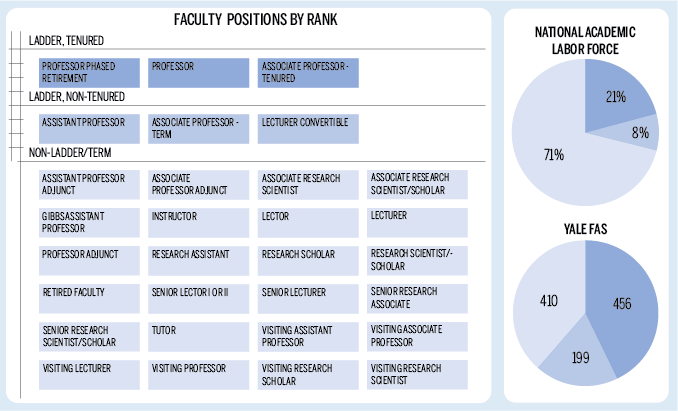
Robinson is one of 410 nonladder faculty members — the 38 percent of professors who are ineligible for tenure — in Yale’s Faculty of Arts and Sciences, which comprises Yale College and the Graduate School of Arts and Sciences. Compared to tenure-track faculty members, nonladder instructors — who hold titles such as lector, lecturer, senior lector I or II, senior lecturer and visiting or research scholar — receive lower wages, fewer benefits and less recognition.

Interviews with a dozen nonladder faculty reveal a shared internal conflict: On one hand, these teachers remain at Yale out of a love for their jobs and their students, but on the other, unequal treatment often leaves them questioning whether Yale is where they belong. Five out of 21 faculty members interviewed spoke on the condition of anonymity, citing fear of retribution due to their lack of job security, and several more declined to be interviewed for the same reason.

Nonladder faculty play an increasingly large role in the lives of undergraduates. Found predominantly in foreign language departments and introductory mathematics and English courses, they also serve as advisors and mentors. And their numbers will soon grow with the expansion of Yale College by 800 students over the next four years.

“Nonladder faculty are an integral part of Yale’s educational mission,” University President Peter Salovey said in an interview last week. “My goal is to continue to create opportunities for these important professionals to play vital roles at Yale and to have rewarding careers here.”

Yet there is little consensus among faculty and administrators over the mitigation of differences between the ladder and nonladder tracks in terms of salary, benefits and recognition. As Yale preps to hire more nonladder faculty, and opposition to these differences grows, will the two-track structure be made more equitable? And, more fundamentally, should it?

GRASPING FOR TANGIBLE BENEFITS

For decades, only nonladder faculty were prohibited from eating free lunches in Yale’s dining halls. It was not until 2012 that nonladders could join their tenure-track colleagues and their students for meals in the residential colleges.

“We had to fight really long and really hard to be given the same free lunch privilege that ladder faculty have,” said senior lector in French Ruth Koizim.

But lunches are just the beginning. The FAS Senate, a 22-member representative body formed in 2015, released a 64-page report this month on the status, pay and conditions of nonladder faculty. The report, containing data collected from 237 nonladder respondents to a February survey and a comprehensive list of recommendations, highlighted widespread faculty concerns about tangible discrepancies in salaries, support for research and travel, paid family and professional development leave.

“The expectations for nonladder language-teaching faculty at Yale have risen exponentially in recent years but with no corresponding increase in their compensation,” said longtime Near Eastern Languages and Civilizations professor Benjamin Foster GRD ’75.

(Photo by Deniz Saip)

Although Yale began hiring nonladder faculty to teach introductory and supplementary courses — for example, in English and foreign languages — today’s nonladders do more teaching and advising work, which faculty members say has changed how nonladder faculty view their roles at the University.

Charles Long, a former deputy provost who retired in 2010 after 45 years at the University, said language department lectors were originally called “native informants” to help students improve their speaking skills, but their responsibilities have since grown beyond basic language courses and most now hold Ph.D.s.

Long added that the situation of nonladder scientists and writing instructors is similar — the University once hired them to run labs and teach basic English courses, but over the decades, the duties and involvement of nonladder faculty have both expanded.

According to the senate survey, 63 percent of all nonladder respondents hold doctoral degrees, 14 percent hold master’s degrees and 5 percent hold bachelor’s degrees.

While nonladder faculty members maintain that they dedicate hours of teaching and advising to the University, many administrators and professors — and some nonladders themselves — argue that the jobs of those on and off the tenure-track are fundamentally different in nature.

“The teaching part is very demanding,” Spanish senior lector II Sybil Alexandrov said. “Language classes meet five days a week, and people assume we teach only the hours we’re in the classroom but that’s not the truth. We work seven days a week, over eight or nine hours a day.”

Alfred Guy, an English lecturer and director of the Yale College Writing Center, said that he has traveled to many other universities to compare writing requirements, and found overwhelmingly that in schools where the writing requirement requires the most work from the professors, those who taught the classes — the equivalent of Yale’s English 114 or 120 — were “95 out of 100 times nonladder faculty.”

According to mathematics lecturer John Hall, the largest introductory courses in the department, like Math 112, 115 and 120 are taught by nonladder faculty.

Explanations for why Yale continues to recruit so many nonladders varied among faculty and administrators interviewed. Dean of the FAS Tamar Gendler said decisions about faculty hiring are made for academic reasons. One English lecturer who requested anonymity speculated that hiring nonladders is more cost-effective for the University. University Provost Benjamin Polak, who oversees Yale’s budget, did not respond to multiple requests for comment.

“We have nonladder people because it’s all about money and commitment,” said Bill Summers, a longtime history of science and medicine and molecular biophysics and biochemistry professor. “What it amounts to is that the only reliable income stream we have here is tuition and endowment, and so Yale’s commitment to other activities that are not involved with that is transient.”

PAY, PAID LEAVE AND CONTRACT RENEWAL

Nonladders point to other inequities in benefits between ladder and nonladder faculty, like shorter parental leave and application-only research leave.

“[Parental leaves have] increased since I’ve been here — I think when I started there was none, then two weeks, now maybe six weeks,” Spanish lector Alexandrov said. “But graduate students and ladder faculty get a whole semester. To my knowledge, we are not biologically different.”

According to the Provost’s Office website, tenure-track faculty are relieved of their teaching duties for an entire academic semester, with no loss of salary or benefits, within the first year of the birth or adoption of a child. Nonladder faculty members, on the other hand, can only take up to eight weeks off.

Ladder and nonladder faculty members also face different paths to receiving professional development. While tenure-track faculty members are automatically eligible to take a sabbatical after completing six consecutive years of full-time faculty activity, there is no equivalent option for nonladders. Faculty members off the ladder can apply for paid professional development leave for one semester, but these opportunities are limited.

In the senate’s survey, 90 percent of respondents said they had never taken a professional development leave, 9 percent had taken one and 1 percent had taken two.

Beyond these hurdles, Hall said there are structural reasons which make it harder for nonladders to take time off, such as nonladders’ focus on regular teaching as opposed to research.

Long stated that the leave system is logically not identical for faculty on and off the ladder, because ladder faculty members need to do research in order to make tenure, while nonladders do not.

Although nonladders are expected to publish work and attend conferences, Foster said they are given little financial support to do so. Multiple nonladders, like Alexandrov, said they attend conferences only if they receive University funding. An anonymous German professor told the News that the Center for Language Study tries to provide funding for one conference attendance a year, but that individual language departments do not.

(Photo by Deniz Saip)

Still, most nonladder faculty members do think about professional development, according to the FAS Senate’s survey. Fifty-one percent of respondents identified career advancement as a key priority, and several respondents cited lack of career advancement opportunities as the “reason why they were contemplating leaving a position in which they were otherwise happy and fulfilled.”

The senate survey also uncovered other inconsistencies in the review and promotion process. The survey found that 37 percent of question respondents held three-year contracts, while 29 percent held single-year contracts, 15 percent held five-year contracts and 4 percent were on semesterly contracts.

“I’ve now had 20 years of one-year appointments,” an anonymous humanities professor told the News. “I know people who have taught for 40-plus years of single-year appointments. … It would be nice if there were some way that after a certain number of years of one-year appointments, you might just get a multiple-year appointment. It would seem on the surface that if you’ve had 20 one-year appointments, maybe things are going okay.”

Three of the 10 nonladders interviewed for this story explicitly said they have not been informed of Yale’s standards for contract review, despite having regularly published research, created and developed courses and received positive feedback from students.

“While I really am grateful to be here and enjoy what I do, the decisions that are made as to my employment, salary and benefits are not based upon any merit that I’m aware of,” Robinson said. “They are based upon some other criterion that I’m totally unaware of and not exposed to, whereas ladder faculty have a very orderly series of review and advancement and promotion.”

According to Edward Kamens, a professor of East Asian languages and literatures and director of graduate studies of Spanish and Portuguese who served as the first chair of the Language Study Committee from 1997 to 2000, equalizing the review process is important for those on and off the ladder, as it combats complacency and encourages innovation in teaching by recognizing excellence. He cited the creation of the rank of “senior lector II” as a way to encourage nonladder faculty members, like those on the ladder, to innovate and contribute nationally to academia.

Classics professor and senate Chair Emily Greenwood, who co-chaired the nonladder report, said the recent survey confirmed that length of service does not seem to have any significant bearing on increase in salary for nonladders.

“The good thing is, I’m paid more than my mother’s cleaning woman,” Koizim said. “But my colleague who’s been here 15 years is paid the same as my mother’s cleaning woman.”

The senate report called the topic of salary “nuanced,” contrasting the fact that “low salary” was cited as an impediment by a relatively low 13 percent of survey respondents, while 75 percent of respondents cited compensation as the best potential enhancement of their experience of Yale.

Koizim said she has been teaching at Yale since 1982 and can depend on a yearly salary increase of about 1 or 1.5 percent, a relatively negligible increase when taking into account inflation and the rising cost of living in New Haven.

ABOVE ALL, RESPECT

It is not just about the benefits, nonladder faculty say. Lack of recognition and inclusion — within departments and from ladder-track faculty — is one of the most common concerns among nonladders. Nonladders said they feel their status is “second-class” compared to tenure-track professors, and exclusion and disrespect even in their own departments are barriers to feeling as valuable to Yale as ladders.

In Kamens’ office in the Hall of Graduate Studies hangs a portrait of his college Japanese teacher. This was her office, he explains, at a time when some nonladder faculty held offices in the same building as tenure-track professors. But for the most part, he said, the department’s nonladders had separate offices on Temple Street, and the paths of these two groups did not cross unless there was a full departmental meeting.

“It’s a somewhat abstract but physical manifestation of what can be some of the obstacles to this integration,” he said.

Faculty noted that the work of nonladders does not necessarily translate into inclusion in department decisions. Nonladder faculty are not allowed to vote in department meetings, and their attendance is at the discretion of the department chair. It was not until about 2005, Koizim recalled, that nonladder faculty were even allowed to attend Yale College faculty meetings.

Long, a former deputy provost, agreed that this change in the rules, originally allowing senior lectors in their second terms to vote in their departments, had a twofold purpose: “[To] show proper recognition and respect for them and acknowledge that they are a really important part of the teaching of Yale College students. And secondly, because they do a lot of teaching and know students well, this allows us to take advantage of their wisdom when making decisions about the curriculum, et cetera.”
(Valeria Villanueva)

Still, individual departments may or may not allow nonladders to attend meetings, which many consider an act of exclusion. Even though untenured faculty cannot vote on decisions like appointments and promotion, they maintain that an invitation itself would be meaningful.

Long recalled that some departments once held two sets of meetings, one general and then one open to only tenure-track faculty — a system he said generally worked well. He added that another method was to have every faculty member come to department meetings and then dismiss all of the nontenured faculty at a certain point, which he said was socially uncomfortable.

“There’s very much an upstairs-downstairs feeling, and it’s okay if you’re upstairs,” a language professor said. “But if you’re downstairs, it’s not so great.”

While Long said it is important for departments to do their best to reduce the sense that “only tenured or only ladder faculty really matter,” other faculty members interviewed reported feeling this sense acutely.

Murray Biggs, an adjunct professor of English and theater, said the problem is less about how nonladder faculty personally feel than how they are regarded by fellow professors, “whose training and habits of thought make it hard for them to see inside their colleagues’ work.”

The varied nature of the work across departments and divisions — even if they all share the nonladder designation — reduces the chance of finding common ground, he said.

“I know that there has always been, and I’m afraid always will be, a sense that they are a lesser kind of faculty in a disciplinary department in a research institution,” Long said. “I think it’s kind of inevitable.”

Guy, the English lecturer, said that out of the six teaching awards given out each year, only one goes to nonladder faculty. The senate report, similarly, advocates for increasing the number of nonladder teaching prizes by three or four each year, which it noted would be at very little extra cost.

Nonladders say that while recognition is important, inclusion is arguably more so.

Kamens said that it is a significant step forward in terms of inclusivity that nonladder faculty are able to attend and sometimes vote at faculty meetings, as well as serve on the 22-member senate, which currently has two nonladder faculty members: Koizim and Hebrew senior lector II Shiri Goren.

Koizim said that one of the most “heartbreaking and heartwarming” elements of working on the senate’s nonladder report was the response of the faculty members, many of whom remarked that this was the only, or one of few, instances that they had been approached to share their experiences.

“There were survey respondents who said, ‘I’ve been teaching at Yale for 20 years, this is the first time anyone has asked me what I think. Thank you for doing this, thank you for giving me a voice,’” Koizim said. “I love what Yale could be, I don’t think I love what Yale is becoming, and I’m going to fight that.”

DIFFERENT NAMES FOR EQUAL WORK?

Even within departments where faculty members on and off the ladder work alongside each other, they often work to meet very different expectations.

According to Gendler, all ladder faculty members are expected to contribute to the University through their research and through their teaching, whereas nonladder faculty members are expected to show expertise in one of those domains or the other but “do not have jobs that are comprehensive in that regard.” And Salovey said that generally, nonladder faculty members are best employed to teach in areas that require “special pedagogical expertise,” such as foreign languages, or where it is difficult to find ladder-faculty instructors.

In language departments, tenure-track professors publish research and write in English while nonladder faculty scholarship in those departments is usually about pedagogy and teaching methodology, Kamens said. These differences mean that the two tracks of faculty take different approaches, are evaluated and critiqued differently and are also received differently in academia.

While nonladder faculty members campaign to make their voices heard and improve their work conditions, many administrators and even peers maintain that the problem is not with inequity, but rather with the idea that faculty members who are on two different tracks should expect to receive equal benefits.

Gendler said that at the medical school, for instance, there is a huge range of faculty positions spanning research, teaching, clinical and voluntary roles, and there is much more “familiarity with the idea that different roles bring with them different responsibilities and different modes of compensation,” which is less present in FAS culture.

“Most [nonladders] are part-time, and it’s often said that they’re exploited by universities demanding more work for less pay,” Biggs said. “That may well happen. But it’s the ladder people who have to do the really time-consuming administrative and committee work.”

The German professor suggested the problem lies with the nonladder position itself.

“I think the lector position is too diverse,” she said, referring to the span of educational background and research responsibilities within the nonladder category. “We can’t have the same benefits for everyone when we have different backgrounds.”

The senate’s report notes that it would be useful to have data to see how Yale’s treatment of its nonladder faculty compares to that of its peer institutions, but its “efforts have been frustrated by the fact that elite private universities guard data on non-tenure-track faculty jealously and any data that is publicly available tends to be poor.”

The Association of American University Presses’ Annual Report on the Economic Status of the Profession for 2015–16 found that tenured faculty members make up about 21 percent of the academic labor force, tenure-track faculty members make up just over eight percent and non-tenure-track faculty members make up 71 percent, up from 62 percent in 2013.

Most of the information that places Yale in context with other universities is therefore anecdotal. Long said he knows from personal experience that the “cadre of nonladder faculty at Yale are better prepared, more carefully hired and better paid” than they are at other institutions. Robinson acknowledged that his “plight” is much better than that of nonladder faculty at the University of Connecticut or New York University who, for financial reasons, must teach around 10 courses each year.

Guy, who came from NYU and has reviewed the writing programs at many universities, said that in a comparative context, Yale is a “very, very fine place to be a nonladder faculty.” He said that when he worked at NYU 25 years ago, people were paid much less for a full semester of teaching than even Yale’s minimum. He added that in terms of writing faculty, Yale nonladders earn 50 percent more per class than anywhere else he has reviewed.

“Relative to this world of teaching off the ladder, Yale is a great place,” Guy said. “People who teach off the ladder at Yale don’t have to have second jobs if they can teach two classes a term here because there’s decent money and benefits. … They don’t have job security, but putting that aside it’s a nice place to teach.”

The German professor said she turned down her last tenure-track job offer because Yale was doing a better job. She cited Yale’s “perks,” such as lunch privileges, being provided a laptop and having office space.

Hall, who previously taught at Harvard, said that a big difference between the two schools is that Harvard has an eight-year lifetime cap on nonladder faculty, with some exceptions, meaning that a nonladder cannot stay as long there as many do at Yale.

A senate survey question about supplemental income found that 24 percent of respondents do summer teaching at Yale, and many others do writing, editing, consulting and summer teaching elsewhere to complement their salary.

Veronika Grimm, a retired classics professor who started teaching at Yale in her 60s, said Yale was a fine place to work after teaching at several universities, but mostly because she was not making her living from it.

“I was quite happy with my place there and most of the time I was feeling very much a part of the department, but of course it helped that I already ran a full career in academics,” Grimm said. “I would not have done it if I was younger.”

“A TEACHER IS A TEACHER”

Still, the distinction between ladder and nonladder faculty means very little to the majority of students. Faculty members believe the terminology is a moot point inside the classroom, and for the most part, students seem to agree: Only two out of 10 students informally surveyed by the News said they had heard the term “nonladder” before or knew what it meant.

“It doesn’t necessarily have a bearing for me on how seriously I take the class or how much I enjoy it,” Diksha Brahmbhatt ’18 said. “A teacher is a teacher.”

All of the nonladder faculty interviewed said their students refer to them as professors and seem to not know that they are technically lectors or lecturers. The German professor said she once tried to explain the difference and her students did not understand.

Still, many nonladders say they believe students should care, but not out of pity.

Koizim said she knows many of her students are concerned with the working conditions of dining hall and maintenance staff at Yale, and that most undergraduates are interested in issues of pay equity, diversity and gender equality. Koizim noted that a higher percentage of nonladder faculty are minority groups and women than ladder faculty.
(Valeria Villanueva)

Yale College Dean Jonathan Holloway said students should be invested in the topic simply because nonladder faculty members are “joined with ladder faculty in teaching them.” He said that he suspects students often do not know which faculty members are on or off the ladder, so their investment should be in who is teaching and advising them, regardless of rank.

Like Gendler, Holloway acknowledged the differences between adjuncts and multiyear nonladder instructors. He emphasized that the growing national phenomenon of “adjunctification,” in which fewer classes are taught by tenure-track faculty, does not apply to Yale because unlike many other institutions, the University does not use nonladder faculty or adjuncts to teach courses that could be taught by full professors.

“Students should pay attention to the larger phenomenon in higher education,” Holloway said. “Something that Yale has structurally mostly avoided is the … expansion of adjuncts teaching. We don’t do that here. We hire our lecturers to work for multiyear appointments and we pay them significantly more than what adjunct faculty get paid.”

MORE STUDENTS, MORE FACULTY HIRES

Gendler said there will be 13 incremental full-time equivalent hires this fall, meaning at least 13 more nonladders will be hired this year than in regular years, with between 10 and 15 more tenure-track offers being made than usual. John Mangan, senior associate dean of the FAS, said the administration is in the process of adding the equivalent of five new nonladder positions in the humanities, two in the social sciences and six to eight in the sciences.

The anticipated increase in nonladder numbers was one of the factors that spurred the senate’s report this year, said Greenwood.

“The senate is concerned about the additional burden that increased class sizes, student mentoring, and advising duties will place on members of the nonladder faculty who are already doing work that is not part of their job description and for which they receive no additional compensation, a situation compounded by job insecurity, low recognition and relatively low salaries,” the report read.

Already, the Yale College Dean’s Office has announced changes to the freshman and sophomore residential college advising system for the incoming freshman class, making nonladder faculty eligible to serve in the permanent pool of advisors even though they have been doing so on an ad hoc basis for decades.

According to Gendler, some of the report’s proposed changes can be implemented without redirecting resources, and others would require careful consideration of the allocation of funds given to the FAS Dean’s Office, and therefore are less likely to take shape.

“I am very happy to make it clear to the chairs who oversee the 53 departments and programs that make up the FAS that part of their responsibility is to make sure that all of the faculty in their department or program, whether they are on the ladder or not, feel affirmed and included and recognized for their contributions,” Gendler said. “Learning from some of my nonladder colleagues that that has not been their experience in particular departments is sobering to me.”

Nearly all faculty members interviewed agreed that culture and circumstances vary so much across disciplines that changes not pertaining to the office of the FAS dean or provost should be made on a departmental basis.

Mangan said the report shows that work needs to be done, but significant strides have been made.

The FAS Dean’s Office has launched a two-year pilot program of conference travel grants for nonladder faculty, Mangan noted. He added that last May, for the first time, the administration recognized retiring nonladder FAS faculty at the final Yale College faculty meeting and will do so again this spring.

The creation and work of the senate have been integral in opening dialogue channels between nonladder faculty members and the Dean’s Office, Mangan said. The office has established a discussion for nonladders and FAS deans with faculty members across academic divisions to make nonladder faculty members feel more included in decision-making processes, he added.

“The FAS includes all of us,” Kamens said. “And I think that’s a message that nonladder faculty members and some ladder faculty members have sufficiently emphasized so that it is more broadly understood and taken as a beginning assumption, but I think we still have to work on that.”

Correction, April 26: The previous version of this story misidentified Edward Kamens as the director of undergraduate studies in Spanish and Portuguese when in fact he is the director of graduate studies.


Credits

Powered by

After Calhoun debate, Salovey seeks to redefine presidency

Published on April 24, 2017

At a crowded faculty meeting in Davies Auditorium last May, University President Peter Salovey faced hard questions about Yale’s decision to keep the name of Calhoun College. Like the undergraduates Salovey had addressed a few days earlier during a famously combative gathering in Battell Chapel, professors from across disciplines rose to dispute his reasoning.

“There was anger. There was firm criticism. There were a few people openly hostile,” Civil War historian David Blight recalled recently. “There were very direct challenges to the whole of the decision.”

Nearly a year after the campus backlash to the renaming decision, Salovey has reached a major crossroads in his nearly 4-year-old presidency. Yale’s finances are stable, new administrators are in place and the campus has quieted, after 18 months of protests and deliberation that culminated in the renaming of Calhoun in February 2017. Now, Salovey is seeking to steer Yale away from the recent tumult and toward the broad ambitions he outlined in his inaugural address at Woolsey Hall in 2013.

But the controversy of the last year and a half, and the skepticism about the Salovey administration left in its wake, raises a crucial question: Can he move past the Calhoun debate, or will it define his presidency?

(Photo by Robbie Short)

In two months of interviews with more than a dozen alumni and around 25 faculty members and administrators, supporters of Salovey praised his attentive listening and adaptive leadership. But as Yale moves on from the renaming debate, his critics — from faculty members to student activists to alumni donors — argued that he was slow and indecisive during the controversy over Calhoun, delaying the announcement of his academic priorities and raising broader concerns about his administration. As has been customary since the 1990s, the Yale Corporation is also scheduled to begin an institutional review of the University, coinciding with the fifth year of Salovey’s presidency.

“Many people around the University have recognized that Yale’s a strong institution, but that President Salovey’s leadership has not been up to the task,” said one senior faculty member with administrative experience at the University, who requested anonymity to speak candidly.

But Salovey is focused on moving forward. Yale is about halfway through a two-year planning phase leading up to its next capital campaign, the first major fundraising push of Salovey’s tenure. His administration is also working on an academic investment plan for the University — a set of targets to guide fundraising and advance Yale’s educational mission. The objectives include greater investment in the sciences and the humanities, better integration of the arts across different professional schools, continued faculty excellence and improvements to Yale’s social science offerings.

“The vision that I’ve been spending this year articulating all over campus is a long-term one,” Salovey said in an interview earlier this month. “We’re talking a vision for the next five to 10 years. I’m totally committed to achieving that vision. And I have been anxious to get it started.”

A DISTRACTING 18 MONTHS

In his Freshman Address in August 2015, Salovey opened the latest round of the Calhoun debate, challenging the new batch of undergraduates to wrestle with Yale’s history. But the academic discussion he envisioned on that summer day was soon overtaken by the racially charged protests that swept Yale in the fall. Last April, following months of deliberation, Salovey announced that Calhoun would keep its name, citing concerns about “historical erasure.”

After the decision set off campus protests from Battell Chapel to Davies Auditorium, Salovey’s 25-person cabinet — an advisory body that includes the provost, academic deans and vice presidents — discussed the possibility of immediately reversing the decision. Although Salovey remained composed in public, the student and faculty backlash took a personal toll, said Gregory Sterling, the dean of the Divinity School, who participated in cabinet discussions last spring.

(Photo by Alex Zhang)

“Anytime you go through a situation where feelings are strong and emotions are high on both sides, and you become a point person for criticism, it’s very difficult,” Sterling said. “President Salovey is a sensitive person. He has a toughness, but he’s also a sensitive human being, so he felt it.”

In August, Salovey created a faculty-led task force charged with outlining broad principles for any renaming decision, starting with a re-evaluation of the legacy of John C. Calhoun, class of 1804. In February, on the basis of those principles, the Corporation voted to rename Calhoun in honor of the pioneering computer scientist Grace Murray Hopper GRD ’34.

Political science professor Steven Smith said that Salovey’s decision to rethink the original announcement was “not a good precedent.” And Salovey has said repeatedly that he wishes he had handled the debate differently.

“In my gut, I thought early in that debate we should bring together faculty and develop a principled way of thinking about the issue, and I should’ve trusted my gut about that,” Salovey said this month. “That would’ve been a good place to start the process rather than end the process.”

Over the course of those 18 months, Salovey’s collaborative leadership style prolonged the decision-making process — which ultimately spanned two semesters of debate, a decision not to rename, another six months of debate and then a reversal of that decision. Last year, an investigation by the News showed that Salovey delayed the naming debate for months by seeking consensus within the Corporation — a stark deviation from the more assertive approach of past presidents, especially his predecessor Richard Levin GRD ’74. Princeton and Harvard both resolved similar controversies over historical symbolism in significantly less time than Salovey took to settle the Calhoun issue.

The extended process also left Salovey frustrated that Yale was unable to move onto other matters, even as he insisted on taking the time to listen to different perspectives, said Robert Alpern, the dean of the School of Medicine.

“As time went on, Peter wanted to be working to make the University better and felt that these issues were taking too much time,” Alpern said. “He had a frustration that there were so many things he wanted to do to make Yale a better university, and I think he felt there was too much energy going into these other issues.”

In an interview in March, Vice President for Development Joan O’Neill said the naming issue was a “distraction” during Yale’s fundraising efforts over the past year and a half. Edward Snyder, the dean of the School of Management, said the months spent debating Calhoun exacted an opportunity cost.

“We only have so much time,” Snyder said. “I did ask myself, when are we going to give sustained effort to other important questions: academic priorities, the next campaign. That’s what universities struggle with. There are issues of the day, and you also need to think about the long-run health of the institution.”

Salovey denies that Yale’s academic planning “was in a holding pattern” during the racially charged debates of 2015 and 2016. Dean of the Faculty of Arts and Sciences Tamar Gendler said that, while the public conversation centered on naming, administrators continued to concentrate on research and teaching.

“We continued to hire faculty, we continued to focus on how we could do our jobs as faculty and as administrators, so I don’t feel like we lost focus,” Gendler said. “A lot of us whose day jobs it is to keep the institution running kept doing what we’ve been asked by the president to do.”

As the naming debate unfolded, Yale dedicated new funding to faculty diversity, added new professors to the Computer Science Department and embarked on a major building project designed to transform the Hall of Graduate Studies into a centralized base for the humanities.

Still, according to two faculty members interviewed, poor planning and tentative decision-making seemed to push essential academic issues to the periphery during the heat of the renaming debate. One member of the FAS Senate, who supported the renaming decision and asked to remain anonymous in order to speak candidly, said the president’s management of the debate lacked “a moral vision,” from the freshman address to the University’s reversal in February.

“It enraged a lot of people when really our focus should have been on making Yale a great place,” the faculty senator said. “So much of the energy in the room was around this issue, when really we could’ve spent all of this time and all of this committee work and all of the emails and all of the protests on things that really have a ‘there’ there for students and for faculty.”

(Photo by Robbie Short)

Salovey’s management of the Calhoun debate offered an illustration of his collaborative leadership style, which contrasts starkly with his predecessor’s more assertive approach. In interviews over the past month, Alpern and another high-ranking administrator described Salovey as less decisive than Levin, who dominated meetings with a commanding presence and immersed himself in the details of strategic planning.

“Rick was incredibly effective, and he also served for 20 years, said Sterling, the dean of the Divinity School. “Anybody that follows an iconic figure like Rick will have some challenges just in meeting people’s expectations.”

Salovey declined to comment on the comparisons between him and Levin. But he acknowledged that the length and intensity of the racially charged debates last year precluded the public rollout of his strategic priorities.

“When to announce plans, goals, when to get a planning process underway, even when to commit to a building project, is both a matter of the president articulating those goals, but also the campus community being ready to engage in a conversation about them,” Salovey said. “And I think for a while we had other issues that were commanding many people’s attention.”

THE OUTLINES OF A VISION

To inquire into Yale’s planning for the next 10 years is to encounter a whirl of academic jargon. In administrative circles, the big-picture ambitions Salovey outlined in November are known as “institutional priorities”: promises, as vague as they are expansive, to invest more in the sciences or to cultivate faculty excellence. Specific subtargets within those areas, such as building lab space or funding new programs, are known as “academic investments.” Connecting the two — the process of turning broad institutional priorities into specific academic investments — is “strategic planning.”

In his 2013 inaugural address, Salovey planted the seeds for the institutional priorities he outlined last fall, emphasizing the importance of a unified and accessible Yale. But four years later, the University must move from ambitious mission statements to a concrete and actionable vision for the future.

“The institutional priorities are broadly articulated versions of what the University has been committed to for two centuries,” Gendler said. “The way in which we operationalize those commitments is what the current conversation is addressing.”

In recent months, Salovey has dedicated much of his time to the development of the academic plan. He and Provost Benjamin Polak gave one of their first major presentations on new academic priorities at a cabinet retreat in August, according to high-level officials who attended. Last November, in an email to faculty and staff members, Salovey released an initial outline of his plans for the sciences, social sciences, arts and humanities. Since the summer, Salovey has sat down with faculty members to discuss those priorities on more than a dozen occasions, including at a meeting of the FAS Senate.

“There’s been a fairly quick pivot to those issues during the academic year, and I don’t think that’s a surprise,” said Snyder, the SOM dean. “There’s been a pent-up interest in those issues that’s been deferred. We have a lot of new deans on campus. People wanted to get at those questions about academic priorities and related issues.”

Aleh Tsyvinski, an economics professor, praised Salovey for his outreach, saying he has shown a clear interest in hearing faculty perspectives on the strategic planning process.

“He mainly listens, because the faculty knows the broad direction that the academic strategy is taking,” Tsyvinski said. “The president, no matter how much he knows, no matter how prescient of a scientist he is, feels he does not have the knowledge of the departments, the academic language. So that’s why it’s so important to ask a very broad spectrum of people for their input.”

So far, Yale’s strategic planning in the sciences has more structure than the University’s work in the humanities and social sciences, Gendler said. In a Jan. 25 email to faculty and staff, Salovey announced the creation of a committee led by Scott Strobel, the vice president who oversees planning on West Campus, to recommend specific investments in the sciences. Anna Pyle, who serves on the committee, said she appreciates Salovey’s enthusiasm for the sciences, and that the committee is working to “put a face on it rather than have it be a completely abstract concept.”

Polak said Salovey’s commitment to advancing the sciences dates back to the first few days of his presidency, when he called for the administration to accelerate work on the seven-story Yale Science Building currently under construction on Science Hill.

“He said to me, ‘Go fix that. Make sure that gets done first,’ and that was done first,” Polak said. “The demolition of Gibbs [Laboratories] that you can see from Science Hill or Whitney Avenue is the upshot of something that Peter laid out essentially his first week as president. Right from the start, he sets the direction, and then we work on getting it done.”

But other areas of the academic plan are significantly less developed, said Daniel Harrison MUS ’86, a music professor who participated in Salovey’s outreach to the faculty and has worked on the arts initiatives. According to Harrison, one of the president’s recent presentations was greeted with skepticism from faculty members in the social sciences, where Yale’s investment targets are less specific.

“The approach he’s taken is riskier, because it means trialing things that aren’t completely thought through, and that is risky because as academics we like to think things through,” Harrison said. “He’s getting feedback. What remains to be seen is how that feedback is taken on board.”

And, despite Salovey’s outreach to the faculty and his collaboration with Polak, some argue that his presidency still has yet to coalesce around a coherent vision for the future of the University.

“There’s a feeling he doesn’t have a plan. He doesn’t have a vision,” said the senior faculty member with an administrative background at Yale. “Maybe this will become it, but I don’t think people feel like in the last few years he’s demonstrated that he has that.”

(Courtesy of WTNH News 8)

The source described the November rollout of Yale’s institutional priorities as a “top-down” process conducted at high speed without much faculty input — a view echoed by the faculty senator who criticized the administration’s handling of the renaming process.

“Sometimes it feels like initiatives drop from the sky,” the faculty senator said. “Even in the message about ‘We’re going to promote the sciences,’ it just seems like people decided something, and everyone just goes along.”

 In the next month, Salovey is scheduled to meet with four different groups of faculty to discuss academic investments.

“My style is to be as consultative as possible. My style is to align my leadership team around a vision and get everyone working together. My style is to look to expertise,” he said.

But the development of academic investments is just one step in a longer process. Once the investment plan is clearly articulated, Yale will have to pitch its targets to potential donors. And that process, which has just entered the planning phase, seems likely to produce its own set of challenges.

 PREPARING FOR THE CAMPAIGN

 In a recent News survey of nearly 2,000 alumni from across the generations, 61 percent of respondents said they supported the renaming decision. But of the 150 alumni who said they had given $50,000 or more to Yale in the past, 52 percent of respondents said the renaming decision would affect their donations either “negatively” or “very negatively.” That group included six alumni who said they had donated more than $1 million to the University.

Richard Glowacki ’54, a former real-estate mogul from Toledo, Ohio, began giving to Yale in the 1970s, around the time of his 20th reunion. In 2014, he endowed an entrepreneurship initiative in SOM. By the beginning of this year, Glowacki had donated just short of $1 million in total to Yale, with several million more earmarked in his will for the SOM and the School of Architecture.

But earlier this semester, dismayed by the racially charged protests that swept campus in 2015 as well as the debate over Calhoun, Glowacki instructed his lawyers to remove Yale from his estate plan. “Yale’s leadership has become so politically correct that it has lost sight of lux et veritas,” he told the News. When he was asked to meet with Salovey to discuss his decision, Glowacki refused.

“I didn’t want to meet with him. He wanted me to reconsider the withdrawal of my gift,” Glowacki said. “I knew what the meeting was for, and I wasn’t gonna take it.”

Glowacki’s discontent with the current administration offers a snapshot of the sort of resistance Salovey may face as he presents his academic plan to donors following the Calhoun decision. While many campus critics have focused on Salovey’s decision-making process, outside the University’s walls, a subset of alumni dislike the substance of the decision as well.

“There will be people who will decide [the renaming decision] is the reason they wouldn’t want to give — there’s no question,” O’Neill said in March.

Salovey declined to comment on Glowacki or any other individual donor. But he expressed hope that critics of his leadership and decision-making would stay open-minded.

“I very much hope that any donor who is questioning their commitment to Yale, that they give me a chance to sit with them,” he said. “I’d like the opportunity to earn their support.”

Still, many alumni do not share Glowacki’s disappointment. Antonio Magliocco ’74 — whose contribution to Yale’s Science Teaching Fund was featured prominently on the website of the Development Office in 2014 — said the renaming decision made him more likely to donate in the future. And 22 percent of alumni surveyed said the name change has encouraged them to give to Yale.

The backlash against the decision comes at a time when the University already trails its peer institutions by certain fundraising metrics. In 2016, Yale’s fundraising total of $519 million ranked it 10th among American universities, according to the Council for Aid to Education. Columbia, Harvard and Stanford were among the schools outperforming Yale, the council found, although some of the higher-ranking schools are currently involved in capital campaigns, making the comparison inexact.

Glenn Murphy ’71, who served as president of the Yale Club of Boston in 2009–10 and was on the governing board of the Association of Yale Alumni in the mid-2000s, said the renaming decision and the administration’s handling of the campus protests “will definitely have a damaging effect on the capital campaign.”

“The inmates were running the asylum,” Murphy said. “The leadership failed to lead.”

(Photo by Kaifeng Wu)

In the wake of the decision, the Development Office has lost some long-serving volunteers, including Chris Chapin ’67, who was an active fundraiser for Yale for more than three decades and resigned as the co-chair of his class alumni fund after the decision was announced in February. Chapin was one of multiple alumni in the class of 1967 — which is celebrating its 50th reunion in May and has made record-breaking reunion gifts in the past — to resign from fundraising positions, he told the News in an interview.

Chapin said he stepped down partly because Salovey demonstrated weak leadership on the naming issue, as well as the other race-related controversies.

“Crises are telling about the qualities of leadership, and I’ve been disappointed about President Salovey,” he said.

Salovey defended the renaming process in a series of large conference calls with alumni after the decision was announced in February. According to Tom Gottshall ’67, who participated in one of the calls, Salovey emphasized that the new principles were narrowly tailored to prevent a “slippery slope” of name changes. Gottshall said Salovey carefully differentiated Calhoun from other prominent namesakes like Jonathan Edwards, class of 1716, and Benjamin Franklin. “His statements were well explained,” Gottshall said.

Indeed, the alumni who will lead Yale’s next fundraising push say it is too early to tell what impact the renaming controversy will have. Chair of the Alumni Fund Tom Leatherbury ’76 said it was hard to predict whether the events of the last year and a half would have any bearing on the capital campaign. And Randolph Nelson ’85, the co-chair of the Development Council, expressed optimism that the campaign would succeed.

“The alumni body has a tremendous amount of confidence in the president,” Nelson said. “He’s a very effective fundraiser because he’s so good at developing relationships person to person.”

O’Neill compared the alumni disgruntlement over the renaming decision to the anger of Yale parents whose children are rejected for admission. “They may not want to talk about Yale, but they may feel better with a little bit of time,” she said. “It may be that they don’t make their annual gift this year, but we hope that we get them back.”

As Yale College dean and later as provost, Salovey gained significant fundraising experience. He worked on the last capital campaign of Levin’s presidency, Yale Tomorrow, which ended in June 2011 and raised nearly $4 billion, the largest total in University history. Over the years, Salovey has developed a reputation as a charming salesman skilled at connecting with donors.

However, the task of winning over alumni in the runup to a capital campaign that he will spearhead presents a new kind of challenge. Many faculty and administrators are optimistic about the next stage of Salovey’s presidency. But the aftermath of the renaming debate continues to cast a shadow over his institutional priorities. And with the University gearing up for the campaign, Salovey must formulate a vision for the future that excites the donor community.

“I’ve thinking about this a lot — What is the role of the president?” Salovey said. “One is [to] set a vision, and I’ve been doing that since my inauguration: a more unified Yale, a more accessible Yale. I’m not done.”

The Other Calhoun

Published on April 22, 2017

The largest community college in Alabama overlooks a barren stretch of highway just north of the old industrial city of Decatur. Constructed in the early 1960s, the red brick complex abuts a small airport where U.S. Army pilots trained during World War II. A gas station and a Subway franchise are the only other landmarks in sight. This campus in suburban Alabama is separated from Yale University by nearly 1,000 miles of land and a seemingly infinite amount of wealth and academic prestige. But the college does have one timely connection to Yale: It is named after John C. Calhoun.

Calhoun Community College is a two-year institution serving roughly 10,000 students, almost a fifth of whom are black. It offers classes in welding and pipe fitting as well as math and history. The college’s mascot is the Warhawk — a reference to Calhoun’s support for the War of 1812 — and the main hangout area on campus is called the Hawk’s Nest. A portrait of Calhoun hangs in the library.

But over the past year and a half, as Yale has weathered a heated debate over the name of its own Calhoun College — culminating this February in the University’s decision to rename the building in honor of computer scientist Grace Murray Hopper GRD ’34 — the community college located just off Highway 31 North in Decatur has been untouched by controversy.

As virtually every student at Yale now knows, Calhoun, a graduate of the class of 1804, was a prominent South Carolina politician who unapologetically promoted chattel slavery in the decades leading up to the Civil War. A pioneering political theorist and the only American to serve as vice-president in two different administrations, Calhoun was also, even by the standards of the antebellum South, an extraordinarily virulent white supremacist, a champion of states’ rights who famously argued that slavery was “a positive good.” But at Calhoun Community College, the background of the school’s namesake remains unfamiliar to the vast majority of students, many of whom have never even heard his full name.

“I don’t think they know there’s a ‘John C’ in front of the Calhoun,” one Calhoun Community College student explained to me over lunch last month.

In March, I flew to Decatur, Alabama to ask students at Calhoun Community College what they thought about their college’s name. The campus I encountered could not have been less like Yale. At the other Calhoun, naming — an issue that has engaged students across the Ivy League for the past 18 months — simply does not register as a legitimate concern.

One of the first students I met at Calhoun was Antoinette Brown, a black woman who serves as president of the college’s student council. After graduating high school in 2015, Brown moved to Alabama from her home in East Stroudsburg, Pennsylvania, carrying with her sad memories of her father, who had recently died of liver cancer. I asked Brown about John C. Calhoun. She said most students she knows have better things to worry about than the name of their college.

“Some people have jobs, some people have kids to take care of, some people have to worry about when they’re going to get their next paycheck to pay off the bills, or they might be in debt, or they might have to worry about how to figure out college tuition, or about their family and their parents,” she said. “It’s just the name of the school. They have other things that are more important.”

Calhoun Community College is far from the only place in the United States that still carries John C. Calhoun’s name. The church in Charleston, South Carolina, where nine black parishioners were shot to death in the summer of 2015 is located on Calhoun Street, just half a block away from an 80-foot monument topped by a statue of the state’s former senator. A lake in Minnesota is also named for Calhoun. So are a small town in Mississippi and a larger one in Georgia.

The college is arguably not even the most significant tribute to Calhoun in the state of Alabama. About 150 miles south of Decatur lies the city of Anniston, the government seat of Calhoun County, a 612-square-mile region named in honor of the antebellum statesman. But in light of Yale’s headline-grabbing naming debate, the story of Calhoun Community College is especially compelling — a vivid illustration of two opposing poles in higher education and a powerful example of the regional divisions that still define American politics and culture.

Calhoun Community College opened in 1941 as the Decatur Trade School, an industrial facility where students learned to make military supplies during World War II. Students at the trade school took welding classes and learned to read blueprints and operate radios. After the war, the school moved to a plot of land next to Pryor Field Regional Airport and was renamed the Tennessee Valley Vocational Technical School. In the early 1960s, as part of a statewide education initiative engineered by then-Gov. George Wallace, it expanded to include a junior college as well as a vocational facility.

(Photo by David Yaffe-Bellany)

In the North, Wallace is best known for his intransigent opposition to the civil rights movement. At his inauguration in 1963, he famously promised, “Segregation now, segregation tomorrow, segregation forever.” But during his first term as governor, Wallace also established some dozen junior colleges across Alabama to revitalize the state economy by preparing high school graduates for the workforce. Nationwide, the 1960s represented a period of significant growth for the community college system, as nearly 500 new facilities opened across the country to keep up with demand from the baby-boom generation.

Robert Norrell, a history professor at the University of Tennessee who is an expert on race relations in the South, said Wallace used the colleges partly as a patronage network to reward political supporters with jobs and construction projects in their hometowns. And according to Yale graduate student Justin Randolph GRD ’20, who attended community college in Alabama and is writing his history dissertation on the 20th-century South, the initiative may also have been designed to improve Alabama’s reputation at a time when the state was under intense national scrutiny because of its resistance to the civil rights movement. “Part of it is this impetus: All eyes are on us, we have to show some kind of modernizing, civilizing or moderating of our political attitudes,” he said.

That impulse apparently did not sway the state Board of Education when it chose names for the new junior colleges in the mid-1960s. Although honorees included early American heroes like Thomas Jefferson, the board also named colleges after such Confederate icons as Joseph Wheeler and Jefferson Davis. And for the junior college opening next door to the Tennessee Valley Vocational Technical School, the board picked John C. Calhoun — “a strong advocate for states’ rights,” as Wallace put it at the college’s dedication ceremony in 1966.

“The Confederate past was romanticized and celebrated as a challenge to the civil rights movement. In the political culture of that time, there was a lot of impulse to celebrate the Confederacy,” Norrell said. “Calhoun didn’t have anything to do with the Confederacy, but he was a symbol of pro-slavery, anti-national government states’ rights — the view that slavery was a good thing in Southern life.”

In the following decades, Calhoun grew to become the largest community college in Alabama, opening a second campus in Huntsville in the mid-1990s and a new arts facility in downtown Decatur last year. But despite the black-and-white portrait of Calhoun that still hangs in the campus library, the history of the college’s namesake has been largely forgotten. Janet Kincherlow-Martin, the college’s public affairs liaison, estimated that 85 percent of current students would not recognize the name John C. Calhoun.

When I arrived in Alabama, I soon found that the cities of Decatur and Huntsville are full of former Calhoun students, whether graduates of the college now working at local businesses or blue-collar employees who took just enough credits to earn a raise. But almost none of the alumni I approached knew anything about the college’s namesake. On the cab ride from Huntsville Airport to my hotel in Decatur, I learned that my driver Hazm Saleem, a 48-year-old Iraqi who worked as an interpreter for the Army after immigrating to the United States in the early 1990s, had taken a handful of online classes through Calhoun in 2013. Saleem described the school as “awesome” — cheap, easy to get into and not much work.

But when I asked whether he had heard of Calhoun the man, Saleem paused and then slowly shook his head. “I’ve never known nothing about him,” he said. “I’ve always thought this is a guy who decided to establish a community college, and had the money to do it. It’s like a business and you put your name on it, that’s what I thought.”

I told Saleem that Calhoun was an outspoken slavery supporter in the 19th century. Saleem started to laugh. At the next traffic light, he scrolled through his iPhone contacts, pointing excitedly to all his black friends, some of them fellow cab drivers who currently study at Calhoun. “They’re all black. They should’ve known,” he said. “I don’t think one of them does.”

As we sped through downtown Decatur, Saleem clicked on a contact ambiguously labeled “Chris or Jamal.”

“Do you know who’s Calhoun?” Saleem shouted into the phone.

“Huh?”

He rolled his eyes. “Who’s the guy who it’s named after, the college?”

“Calhoun? President or something, I don’t know. What is this shit?”

Saleem roared with laughter. “You stupid, man. That guy supported slavery!”

Tariona Adams never planned to attend Calhoun Community College. As the star power forward for the women’s basketball team at her high school in Athens, Alabama, a city a few miles north of Decatur, Adams seemed destined for bigger things, maybe even the W.N.B.A. She earned a full ride to Columbia State Community College in southern Tennessee and was set to start for the basketball team. But after a few months, Adams grew to resent the daily grind of college sports — a morning run, followed by classes, a gym workout and then more classes. At the same time, her grandmother was battling cancer, and her nine-year-old sister was in and out of the hospital with a variety of ailments.

“It’s hard to keep faith when you have school, you have a sport, you have family issues and all that,” said Adams, who is black. “You have got to keep the faith, and that time I had lack of faith, and I just couldn’t do it anymore.”

Adams quit the basketball team at Columbia State and transferred to Shelton State Community College in Tuscaloosa, Alabama. But she had to travel home most weekends to take care of her grandmother, and the two-hour drive from Tuscaloosa to Athens was a tiring routine. So last January, Adams enrolled at Calhoun with dreams of breaking into the music industry like her favorite artist Lil Wayne.

Adams called Calhoun “a great school” and praised the network of advisors who help guide students to their degrees. Still, she regrets throwing away her basketball prospects after a few tough practices at Columbia State. “I have a best friend that plays for Northwest Florida, and she always calls me and tells me what goes on. That just brings back memories,” Adams said. “And then I could run into my high school coach, and it just brings back memories as well. I do miss it. I do.”

Adams is hardly the only student to arrive at Calhoun after missed opportunities, bad luck or a family crisis. One aspiring artist told me she was forced to turn down a slot at the Pacific Northwest College of Art in Oregon because her family couldn’t afford to send her out of state. Another student spent two years at home in nearby Hartsville after he finished high school, doing little but playing video games. He enrolled at Calhoun last year because he had “nothing better to do.”

According to the National Center for Education Statistics, nearly 40 percent of American undergraduates attend two-year public or private colleges. A community college experience is far more typical in American higher education than four years at an elite institution like Yale. The students I met at Calhoun lead very different lives than Yale undergraduates. Most live in Huntsville or Decatur, not San Francisco or New York. Some are adults, like Saleem, my cab driver, earning credits toward a long-sought degree or a quick promotion at work. Others finished high school in the mid-2000s, worked for a few years and only recently found time to pursue further education. Although Calhoun has a successful baseball program, best known for producing the former New York Yankees catcher Jorge Posada, most students do not participate in sports or extracurricular clubs.

“With us being a commuter college, our students are here for one reason: They come here, go to class and then they leave,” Kincherlow-Martin told me. “It’s a much different environment than a residential institution. The only hanging out they do would be between classes.”

On my first day visiting the Decatur campus, I stopped by the Hawk’s Nest, a lounge area connected to the library where students sometimes go to eat lunch or play table tennis. I started chatting with David Orme, a 17-year-old business major who was collecting signatures for a new fraternity, Iota Theta Kappa, that he hopes to start at Calhoun. In high school, Orme played varsity baseball and was good enough to be recruited by Wallace State, a local community college named after the former governor. But at the end of his sophomore year, Orme was caught with 16 marijuana joints in his backpack and promptly expelled from school. “I don’t smoke anymore,” he said. “That really kind of ruined the fun for me.”

After his expulsion, Orme was home-schooled by his father and managed to graduate a year early. Now he plans to pursue a career in management, possibly as the chief financial officer at a major company. But he knew little about John C. Calhoun — he thought I might be referring to the actor John C. Reilly — and when I explained the situation at Yale, he reacted with disdain.

“That’s just stupid,” Orme said. “I’m going to be no one’s hero when I say this, but it’s stupid. It’s a building name.”

Orme was joined at the table by Jay Foster, a biochemistry student finishing his last semester at Calhoun. Foster enrolled at Calhoun in 2015 because of his family’s straitened finances: Suffering from bone spurs and three types of arthritis, his father had recently been forced to leave his welding job. “He’s had to work hard his entire life, and that put kind of a financial strain on us,” Foster said. A self-described “history buff,” Foster was the only student I met who knew anything about John C. Calhoun. But like Orme, he was unimpressed by my account of the renaming protests at Yale.

“It’s a reason for people to whine, because they have nothing else to whine about,” Foster said. “There are much worse things going on than [having] to live in a building named for some guy that’s been dead for a hundred-and-something years.”

Foster and Orme are fervent supporters of President Donald Trump, and both expressed profound distrust for the brand of liberal campus politics that drove Yale’s renaming movement. At one point during the presidential election campaign, Orme said he was reprimanded by a “super left” teacher for wearing his bright-red “Make America Great Again” hat to school. Foster spoke sarcastically about “the great privilege” of sitting between a “staunch female Hillary supporter and a staunch female Bernie Sanders supporter” in a class last semester.

As he scrolled through basketball scores on his laptop, Orme said he could imagine a naming debate taking place at Calhoun — but not about the school’s notorious namesake.

“If there was a building here named after Malcolm X — like the Malcolm X Hall of Science — there’d be some uproar about that,” he said.

It took Yale decades of debate and more than a year and a half of protests, committee meetings and administrative backpedaling to rename Calhoun College. But the official process was always in the University’s hands. At its meeting last February, the Yale Corporation voted to rename Calhoun based on the recommendation of a faculty task force, reversing its decision a year earlier to keep the college name. The change will officially go into effect July 1.

As a public institution, Calhoun Community College does not have that same freedom, according to Kincherlow-Martin. A name change request would have to work its way through the college administration and eventually receive approval from the state legislature. “If everybody in north Alabama decided today we don’t like that name, it doesn’t matter what we like, because there is a process we have to follow to get our name,” she said.

But any attempt to rename Calhoun Community College would face a further obstacle: The college’s administrators are not interested in having this debate. In August 2015, Yale President Peter Salovey used his annual Freshman Address to open a campuswide discussion about naming and historical symbolism. “Members of the class of 2019, here is your first hard problem,” he said. “Welcome to Yale!” By contrast, the president of Calhoun Community College, a former South Carolina legislator named Jim Klauber who arrived on campus two years ago, refused to meet with me to discuss the college name. The acting chancellor of the Alabama Community College System, Jimmy Baker, did not return my phone call.

“The chancellor has made it clear that he would prefer for President Klauber not to speak on it at all,” Kincherlow-Martin told me about a week before I showed up on campus. “That needs to be the end of any conversation.”

As I started asking more questions and contacting college faculty, it became increasingly clear that the Calhoun administration was desperate to avoid the monthslong naming debate that took place at Yale.

One day in February, Kincherlow-Martin called to tell me that Calhoun’s faculty and staff are not allowed to speak to the press without her permission. A few instructors had complained to her about the emails I had sent them, she said. I pointed out that three faculty members had said they would be happy to talk to me. Kincherlow-Martin replied that some instructors “have an agenda” and accused me of “trying to stir up controversy.” During one particularly tense phone call a week before I was scheduled to fly to Alabama, Kincherlow-Martin threatened to kick me off campus if I continued asking questions about John C. Calhoun. That afternoon, she sent a mass email to faculty and staff reminding them to check with her before speaking to the press.

After I arrived on campus in early March, I visited the office of Gene Barnett, a history instructor who had replied enthusiastically to my initial email about the story. As soon as I uttered the words “Yale Daily News,” the previously affable Barnett retreated into a defensive crouch. “You have to talk to Ms. Janet Martin on the third floor of the math and science building,” he said. “I was told to tell you to go see Ms. Janet Martin on the third floor of the math and science building.”

(Photo by David Yaffe-Bellany)

I thanked Barnett for his time and turned to leave. But before I reached the door, he started to speak again. “I have this real bad habit,” he said. “I like having a roof over my head, I like having food to eat and I like riding my horses. And for that, I need a job.”

It was easy to see why Klauber and Kincherlow-Martin might be unhappy that I was coming to campus. After taking over as president in 2015, Klauber ousted three high-ranking college administrators at a cost of around $300,000. A public records request by the Decatur Daily unearthed abuse complaints against the administrators, as well as allegations of financial impropriety. I figured the last thing Klauber needed was another problematic story about Calhoun.

But the college’s resistance to my questions about John C. Calhoun may have deeper historical roots than the administrative upheaval of 2015. In his 2007 book about opposition to the civil rights movement in Mississippi, titled “In Search of Another Country,” the historian Joseph Crespino used the term “racial troubleshooting” to describe a public relations strategy designed to head off racial controversies. When I told Randolph, the Yale graduate student, about my experiences at Calhoun, he said the opposition I had faced from the administration was an example of that phenomenon.

“All these communications and public relations jobs in these small institutions actually came directly out of the civil rights movement,” Randolph said. “Everyone had to have a racial troubleshooter — that’s straight out of 1955.”

On my second day at Calhoun, I went to the third floor of the math and science building to meet with Kincherlow-Martin in person. As I waited in the lobby, her secretary presented me with a “swag bag” of college merchandise: a pen, a key ring, a pack of Post-its — all emblazoned with the word “Calhoun.”

A few minutes later, I followed Kincherlow-Martin into her office, where she sat behind a desk cluttered with papers and promised no more than 15 minutes of her time. At first, she was suspicious and combative, interrupting to ask why I had really come to Alabama. But as I explained the purpose of my trip — to learn about life at the “other Calhoun,” not to stir up controversy — she gradually seemed to warm to me, opening up about her own experiences as a woman of color in Alabama. Kincherlow-Martin has worked at Calhoun for nearly 30 years, but she didn’t learn who John C. Calhoun was until the late 1990s.

Yale decided to rename Calhoun College because his legacy conflicted with the University’s mission. Kincherlow-Martin said she understands why Yale came to that conclusion, but she rejected the notion that the history of the antebellum South has any bearing on the mission of her college. “Our mission is our mission,” she said. “Our mission has nothing to do with what our name is.”

As the interview drew to a close, I told Kincherlow-Martin that students in Calhoun College used to refer to themselves as “Hounies” or members of the “Houn.” She said the “Houn” abbreviation has also caught on in Decatur — much to her distress. “Our name is Calhoun,” she said. “I’m an official kind of person.”

“Don’t you think if somebody should be upset about it, it should be someone who looks like me?” she added. “I’m not getting caught up in what happened 75 years ago, when someone named us. A lot of what you all are talking about, we’ve lived forever. So we’ve tried to move to the positive, because we have lived it as opposed to talking about it.”

The renaming protests at Yale were part of a broader campus movement. The students who took to the streets over the name of Calhoun College also demanded that Yale hire more black faculty members and provide greater support to the four cultural centers. “There are many Yale students, and faculty and staff, who have also encountered the legacy of racism, who live it as well as talk about it,” said Julia Adams, head of the newly renamed Hopper College. “Students at Yale hail from a wide range of economic circumstances, too. The image of Yale may make this harder to see, but it is more and more the case each year.”

In the fall of 2015, as racially charged protests rippled across universities nationwide, from Yale to Missou to Pomona, the main campus of Calhoun Community College remained quiet. This February, when the Yale trustees voted to rename Calhoun College after a female pioneer, barely anyone in Decatur heard the news. At the Calhoun in Alabama, the only thing students complain about is the shortage of parking spaces in front of campus buildings, Kincherlow-Martin said.

When I met Tariona Adams, the former basketball player, she was listening to music in the Chasteen Student Center, next to the campus’ main administrative building. It was around noon, and Adams was already done with class for the day. I asked if there was anything about Calhoun she would like to change. She said it would be great if the college had a basketball team.

(Photo by David Yaffe-Bellany)

Adams had never heard of John C. Calhoun, even though her history class recently finished a unit on the Civil War. “I just came here, so I don’t know too much about the background,” she said. “But I will. I will truly.”

I told her that Yale students believed the name of Calhoun College was a distraction from their education, an assault on their senses that prevented them from concentrating on schoolwork or enjoying themselves outside of class. Adams said the Yale students were being ridiculous.

“Just because they’re in a building it gets in the way of their education? Really? I have to disagree,” she said. “Just because they’re in the building they can’t focus or they can’t get their education? That has nothing to do with it. I could be in a room full of whites, and that’s not going to stop me from getting my education. I could be in an abandoned building, and if a teacher’s in there, she knows what she’s talking about, there’s nothing to stop me from getting my education — nothing. I love my education. That’s why I’ve been to so many schools, because I wouldn’t stop.”

Adams shook her head in disbelief when I told her Yale’s Calhoun College had been renamed in early February. “That’s just outrageous,” she said. “This just happened?” I nodded.

Orme and Foster viewed Yale’s renaming protests as the pathetic antics of politically correct liberals. But for Adams, the naming controversy was a powerful symbol of something altogether different — the cultural and economic gulf between her community college in the deep South and the wealth and privilege of the Ivy League.

“It’s different up there than down here. We just don’t act like that,” Adams said, her voice quavering with emotion. “Education is a gift. I’m not going to let a building stop me from getting my education.”

Preparing for the worst: Immigrant activism in the Trump era

Published on April 21, 2017

Elm City immigrants are not waiting for the city, state or federal government to protect them from Immigration and Customs Enforcement deportation raids. Instead, they are taking matters into their own hands.

Every Monday, the New Haven Peoples Center on Howe Street is filled with a multinational, multilingual, multigenerational group of locals. From 7 to 9 p.m. each week, a combination of immigrants, Yale undergraduates, Yale Law School students and concerned residents meet to discuss problems pertinent to the New Haven immigrant community.

Though the meetings are conducted mostly in Spanish, there is always someone willing to translate for nonspeakers. Young children chase each other through a matrix of metal chairs, squealing and giggling as their parents discuss issues they hope to solve before their children are old enough to worry about them.

Though the meeting atmosphere is welcoming and jovial, the topics addressed by Unidad Latina en Acción, a local 15-year-old grassroots immigrant rights group, are serious. The group is doubling down on its efforts to protect the city’s approximately 14,430 undocumented immigrants from any potential ICE raids.

New Haven last saw a raid in 2007, when federal ICE officers arrested 32 immigrants in Fair Haven, a predominantly immigrant neighborhood. At the time, ULA’s activist efforts centered on fighting for immigrant rights in the Elm City, but in the decade since, much of its work shifted to focus instead on labor laws, seeking justice for exploited workers. Immigrant rights cases have concentrated on individual deportations rather than raids.

However, President Donald Trump’s ascent to power has led the organization to pivot once, this time to prepare for the worst — massive ICE raids.

On Jan. 25, just five days after being sworn into office, Trump signed his first executive order. “Enhancing Public Safety in the Interior of the United States” called for the hiring of 10,000 new ICE officers and promised to cut federal funding from sanctuary cities like New Haven.

“Right now we live in a very difficult time,” said John Lugo, ULA’s main organizer and one of its co-founders. “We are going back to 2007, which is very painful. It is hard seeing people worry, people coming to us crying. It is heartbreaking.”

ULA’s focus on preventing mass deportations in New Haven — through education, protest and a community response network — reflects a nationwide trend in which grassroots organizations protect immigrants living in the United States. Over the last five months, ULA has channeled a decade and a half of organizing experience into resisting federal threats against the local immigrant community.

PUBLIC DEMONSTRATIONS AND POLICY

ULA’s most visible actions have been their rallies and protests. As a group comprised of roughly 200 volunteers, ULA is able to create noise and engage in civil disobedience without the constraint of institutional rules.

In 2016, ULA held regular demonstrations in protest of Calhoun College’s name and against Thai Taste for wage theft. But in recent months, ULA’s actions have shifted focus from local issues to broader, national topics.

“After Nov. 8, it was all about we need to make sure we are doing the right things to make sure people are protected in case the worse happens,” said Jesus Morales, an organizer with ULA. Morales, a junior at the University of Connecticut, has been working with the group for almost one year.

Perhaps most visibly, in the days following Trump’s election the group organized 500 New Haven residents and Yalies for a march of resistance.

The day immediately following the election, ULA organizers called an emergency meeting in which constituents could share their fears about the future. At that meeting, people were scared, angry and disappointed, Morales said. He said the fear was so widespread even he himself felt afraid — despite being documented.

From this meeting came ULA’s massive march, and a series of rallies in the months after condemned Trump’s anti-immigrant rhetoric and policies.

The group’s resolutions have not gone unnoticed: ULA has been effective in getting the attention of politicians and policy makers, according to Mayor Toni Harp.

“[ULA] has come to meet with me several times, but the last time we met was right after Mr. Trump was elected president,” Harp said. “They were very concerned about rhetoric around sanctuary cities and said their members feeling insecure. They wanted to make sure we maintain our commitment to our general orders.”

In January 2006, New Haven issued a police general order formalizing six procedures for the New Haven Police Department. These procedures, which ranged from not inquiring about residents’ immigration status to not making arrests based on warrants from ICE, sought to make immigrants feel safer reporting crimes to the police.

But ULA is looking beyond the local general order. Though Morales said the group had discussed advocating for a stronger Trust Act before the election, Trump’s rise to power gave the topic renewed importance, as deportations were not discussed with the same urgency as they are now. The group is working with the Yale Law School Worker and Immigrant Rights Advocacy Clinic to strengthen the Trust Act.

The Trust Act, which passed in 2013 after advocacy efforts from the Connecticut Immigrant Rights Alliance — a coalition that includes ULA and Junta for Progressive Action, a local nonprofit immigrant advocacy group —  allows state and city governments to submit to ICE’s requests to detain undocumented immigrants only if they have committed a felony crime.

Megan Fountain ’07, an ULA volunteer, added that the group particularly wants to keep ICE from making arrests in courthouses.

“We have a better version that is even stronger and it’s really urgent that we pass it now because the current government has shown no respect for the United States Constitution,” she said. “The current government has made it clear they are detaining immigrants without due process and so Connecticut has an obligation to protect due process.”

EDUCATION AND RAPID RESPONSE

Beyond public demonstrations and legislative advocacy, ULA is also working on the individual level to educate residents on how they can best prepare for eventual deportation raids.

Since early January, ULA has been hosting “Know Your Rights” classes in conjunction with Junta and the New Haven Board of Education, among other partners. Held in schools, health clinics and community spaces, these classes focus on helping immigrants understand their legal rights, such as not being required to open their doors to ICE agents who do not have a warrant.

ULA members have also attempted to reach more immigrants in the community by going door to door in Fair Haven with “Know Your Rights” information. But this has proved more difficult, according to ULA member and New Haven resident Erik Munoz, as immigrants unfamiliar with the group are sometimes afraid, particularly if a canvasser is white.

To reach more residents, ULA is also creating “neighborhood brigades” by dividing its membership into district-based teams who will have more power in reaching their neighbors and alders. The establishment of the brigades are still in progress, though ULA hopes to begin training brigade leaders at the start of next week.

Lastly, in the case of potential raids, ULA wants to set up a “rapid response network.” ULA has  created a hotline number for a 24-hour phone that Lugo has. Beginning next week, the phone will be assigned to seven volunteer ULA members who have committed to taking calls for 24 hours each week. After one volunteer’s shift ends, the phone will pass on to the next volunteer.

If a resident calls in an ICE raid, ULA will first determine the legitimacy of the claim before deciding on further action. The group has received over 100 phone calls since the election from frightened residents who mistook normal police activity as raids, Lugo said.

These false alarms are a testament to the fear that has gripped the immigrant community since the election. Recently, several residents called in after they saw SUVs and officers with canines who turned out to be state troopers training in New Haven, Lugo said.

But if a call does prove to be true, ULA will mobilize a network of New Haven residents who want to help resist ICE. The rapid response team includes members of local social justice organization Showing Up For Racial Justice, members of religious organizations and other concerned community members, including students and lawyers, Lugo said.

Knowing where a raid is occurring will allow ULA to warn immigrants that ICE is in the city.

John DeStefano, who served as New Haven’s mayor from 1994 to 2014, recalled how ICE’s 2007 raid terrified families and harmed immigrant-police relationships. He believes thought ought to be given to meaningful displays of civil disobedience towards federal offices and facilities if they were to participate in retaliatory raids against New Haven.

Co-Chair of SURJ’s Deportation Defense Committee Anna Robinson-Sweet ’11 said SURJ plans to mobilize its members to accompany immigrants to court hearings, attend protests or to go on site to document any potential raids. She said the group already has over 300 contacts, of which at least 50 have committed to going to hearings.

Still, Flavia D’amico, a documented immigrant from Argentina who came to New Haven in 2005, said she has sensed terror in the immigrant community since the election. She occasionally goes to ULA meetings, but many of her undocumented friends are afraid to become involved in ULA as the organization is loud and prominent.

Her friends support ULA’s work, she said, but do not want to risk confrontation with police. She offered the example of one of her undocumented friends, who was afraid to go to the police after her car was broken into for fear of being reported to ICE.

THE PUSH FOR A SANCTUARY CITY

ULA was formed in 2002 by Guatemalan immigrants in New Haven. According to Lugo, a group of about 20 New Haven residents began meeting to oppose a state-level push for a bill that would prnt undocumented immigrants from obtaining driving licences. But the attempt to stop the measure was unsuccessful.

Although they did not succeed in their first endeavor, group members decided to continue meeting to have conversations about problems facing New Haven’s immigrant community, Lugo said. He is now the only one of the original founders still consistently active with ULA. Some have moved on to other forms of advocacy. Others have either since left New Haven or have since been deported, he said.

“It’s really hard to try to stay in contact with that many other people,” Lugo said. “They are moving from one job to another job and one house to another house, and we lost contact with many of them.”

The immigrant community, he noted, is extremely mobile, and ULA loses and gains members often. That mobility leads to one of the group’s main difficulties: It constantly has to train new members who lack institutional memory.

Meetings are open to the public and include New Haven residents from different backgrounds and typically draw at least 30 attendees.

Lugo said he hopes to draw more residents with a new office ULA is renting on Grand Avenue. Beginning this month, ULA will be hosting meetings every week in both locations. The rent for the new space was raised with help from a group of community members who committed to contributing for a year.

Members are encouraged, but not required, to pay $10 in dues each month.  Most of those that pay are not immigrants, Lugo said. Since ULA is not a registered nonprofit, it receives donations through its fiscal agent, Shalom United Church of Christ.

In its early years, ULA focused on being at the front lines of the mid-2000s push to make New Haven a sanctuary city, including the creation of a municipal identification card that all Elm City residents could acquire. The ID gives residents a form of identification that can be used in police interactions and to open local bank accounts, even if they are not federally documented.

Kica Matos, director of Immigrant Rights and Racial Justice at the Center of Community Change and deputy mayor under DeStefano, said she and Lugo began discussing ways to advance an immigration agenda in New Haven in 2004. She was the executive director of Junta at the time, and the groups decided to partner to create a pro-immigrant agenda that addressed the systemic needs of immigrants living in New Haven.

Yale Law School professor Michael Wishnie LAW ’93, who heads the Worker & Immigrant Rights Advocacy Clinic said he, his students and other Law School professors have been working with ULA since 2005. Back then, Wishnie was a visiting professor and he had his students help research and draft a joint report with ULA and Junta entitled “A City to Model.” The report included a number of recommendations for the city, including the adoption of a municipal identification card and improvements to police-civilian relationships in parts of New Haven with large immigrant communities.

DeStefano said the report was the genesis for the identity cards, which were officially instituted in 2007. But 48 hours after the card was issued, ICE conducted a retaliatory raid in New Haven during which they arrested 32 New Haven residents, he said.

DeStefano said the raids resulted in increased support for immigrants in New Haven and from New Haven’s representatives, including Joe Lieberman, former chairman of the Senate Homeland Security and Government Affairs Committee.

Since 2007, ULA has continued to support individuals targeted for deportation.

Among those they have assisted is a Connecticut undocumented resident named Pedro, who did not want his last name included in this article for safety reasons. He explained that he fled Honduras because he supported Honduras’ president, Manuel Zelaya, who was deposed in 2009. He had friends who were killed in Honduras, he said.

Pedro was arrested at the border and was detained for 63 days, first in Texas and then in Pennsylvania. During this time he was only allowed out of his cell for an hour a day, he said. He was released when his family members living in Connecticut posted his $9,000 bond.

He came into contact with ULA in 2014 at the recommendation of a friend. ULA has since connected him with a lawyer and his helping him seek political asylum.

ULA has also fought numerous wage theft cases in the past decade by organizing boycotts against restaurants who have committed wage theft and by taking legal action against wage violations. Most of these violations have been committed against low wage, immigrant workers. Some of the most prominent cases ULA has helped workers win include those brought against Thai Taste and Gourmet Heaven.

Harp said, in fact, that her first interactions with ULA were during her time as a state senator, when the group came forward to members of the legislature to discuss issues centered mostly on labor disputes.

ULA has since advocated for stricter laws surrounding wage theft, Harp said, adding that the group was successful in getting the U.S. Department of Labor to investigate several incidents of wage theft in New Haven.

A BROADER MOVEMENT

ULA is not the only immigrant rights groups gearing up to oppose ICE raids. Across the state and country, other grassroots movements have gained traction since Trump’s election.

On such group, Puente Arizona, a grassroots immigrant rights organization formed in 2007 in Phoenix, Arizona. The group advocated for Garcia de Rayos, an Arizona mother who was deported earlier this year.

And Lugo said ULA has based some of its tactics off of work conducted by Puente. He said ULA was not prepared enough when the raids happened in 2007 and that the group feels that Puente’s tactics have been effective at countering ICE operations in Phoenix.

Lucia Sandoval, who directs Media and Communications for Puente, said people across the country have reached out to Puente to learn how to conduct Know Your Rights courses. Puente is also giving out their number as a hotline that immigrants can call if they are in trouble.

ULA operates independently of national charities or political groups and the group has ample representation from the groups, undocumented immigrants and low-wage workers, which it seeks to protect. For ULA members, the fights they are involved in are extremely real and extremely personal.

Salvador Sarmiento, chair of the Washington D.C. Coalition for Immigrant Rights and the national campaign coordinator for the National Day Laborer Organizing Network, said he believes it is critical to challenge the presidential administration on state and local levels. Work in Washington, D.C. is less effective, he said. He explained that NDLON is a network of dozens of community-based organizations across the country. Though ULA is not a member of NDLON, ULA has worked with NDLON in the past.

Sarmiento said ULA sets a good example of what an immigrant rights group should look like. Many people want to be supportive of immigrants and refugees at this time and they should look to established groups like ULA to engage with, he said.

Matos echoed this sentiment. She said she works with grassroots organizations throughout the country,  and that ULA is among the most effective groups she is aware of.

“Grassroots organizations and their leaders are the ones on the front lines,” she said. “They are the ones that are most trusted by those whose lives are fragile.”

Make The Road CT is currently fighting for immigrant rights in neighboring Bridgeport. Like ULA and Junta, the organization has hosted Know Your Rights workshops, according to Worker Organizer Luis Luna. Make The Road also aims to pressure the local government to declare Bridgeport as a sanctuary city, he said. Luna added that sanctuary cities are safer for all their residents when immigrants are willing to call and work with police if they witness or are the victims of crimes.

Luna said he got his start in immigration activism when he became a member of ULA in 2007. He has now worked at Make the Road for almost one year.

Despite praise from other activist groups, members of ULA say they are simply doing their best with the tactics available to them.

“I think we cannot really promise anything,” Lugo said of preventing ICE raids. “We have the hope that these ideas that we are putting together will work out. All we can say is if we work together we can make it harder for immigration to really damage the community. But we need to stick together.”

Clarification, April 25: This article has been updated with a more accurate description of what Make The Road CT is doing in Bridgeport.

UP CLOSE:
Single-gender groups reckon with shifting attitudes

Published on April 20, 2017

In the spring of 1987, Melinda Stanford ’87 walked into the Saybrook Athenaeum Room to audition for the Yale Whiffenpoofs, the first all-male a capella group in the country —  only 18 years after the college had accepted women. Although Stanford — one of the first women to audition for the group — knew that her rendition of “Somewhere Over the Rainbow” would not earn her a place on the Whiffs, she considered her audition a statement against the group’s longstanding policy of admitting only men.

“The point that we were trying to make was that women were not equal, not even close,” Stanford said. “I just thought, ‘This isn’t right.’ As a musician and, to be honest, as a really good musician, I would have been a Whiffenpoof if I had been male.”

Thirty years after Stanford and eight other women auditioned for the Whiffenpoofs, these symbolic tryouts continue. Around 15 female and nonbinary students auditioned for the Whiffs this year, the largest-ever nonmale turnout in the group’s 108-year history. But none of these students will join the group in the fall, as the Whiffs remain committed to their all-male membership policy.

As the Whiffenpoofs face increasing pressure from portions of the student body to expand their membership, other single-gender organizations on campus have come under similar scrutiny. In January, around 13 women attended the rush events of the Sigma Phi Epsilon fraternity, which voted last year to open its rush process to female and nonbinary students but did not offer them bids because of the organization’s national regulations.

Yale was founded as an exclusively white, all-male space. It remained that way for over a century, until it graduated its first African-American student in 1857. A century and a half later, the University admitted its first female students.

But today’s Yale is radically different from the one formed in Saybrook Colony in 1701: Yale students are seen as being overwhelmingly progressive, even earning the University the moniker “The Gay Ivy” for its inclusive campus climate. Still, organizations formed on the basis of gender persist.

The question of whether single-gender organizations are in tension with Yale’s progressive spirit is a complicated one. As the voices in favor of integrating these spaces grow louder, those who believe they should be left untouched remain committed to their positions: Many contend that female-only groups are important sites of empowerment while others maintain that the right to create organizations based on gender identity, whether male or female, is part and parcel of the right to freely associate. In the midst of heated student discussion, administrators walk a thin line between creating an inclusive environment for all Yalies and, at the same time, avoiding too heavy-handed an approach.

ACROSS COLLEGES

With the conversation about gender on college campuses quickly coming to the forefront, students within and outside of single-gender communities at Yale disagree on how to move toward an equitable solution. As Yale officials grapple with student voices critical of gender-exclusive spaces, administrations at other colleges and universities have taken the issue into their own hands, some placing restrictions on single-gender groups and others banning them altogether.

In 1990, Middlebury College dissolved fraternities on its campus following a 1989 incident in which one fraternity scrawled vulgar words on a female mannequin which was then left outside its house. According to Middlebury’s Vice President for Academic Development Timothy Spears ’80 — who was present throughout the incident’s aftermath — the episode caused a “huge stir” and initiated a long discussion on campus about whether the college should even have fraternities.

“It was a kind of flare up of really unfortunate incidents on campus that precipitated the discussion, but the issues had been there for a while,” Spears said.

One year after the incident, Middlebury’s board of trustees mandated that fraternities either start admitting women or dissolve altogether. Spears noted that most of the fraternities dissolved, and Greek life was soon replaced by a system of coed “social houses.”

Although Middlebury was among the first colleges to dissolve fraternities, it was actually Williams College in Massachusetts that led the charge in the 1960s — before women were admitted to the school — out of concern for the impact of fraternities on students’ social lives.

More recently, in May 2014, Amherst College banned students from participating in unrecognized sororities and fraternities, though on-campus Greek life was abolished in 1984.

Just months later, in September, Wesleyan University ordered that residential fraternities accept women as full members. And last year, Harvard College instituted a policy banning members of single-gender fraternities, sororities and finals clubs from becoming the captain of a college athletic team, holding Harvard-recognized leadership positions or receiving university endorsements for some major scholarships.

In an interview with the News, Yale’s Associate Vice President of Student Engagement Burgwell Howard said the Yale College administration is not currently looking to pursue the integration of single gender organizations, noting in particular that fraternities and sororities are private organizations that fall outside the University’s purview.

“There are inequities [between fraternities and sororities] but because they’re private organizations and because they own their properties, they set the parameters for how the members choose to operate there,” Howard said.

Yale is home to four all-female sororities that are affiliated with national chapters and nine all-male fraternities affiliated with national organizations. Yale’s chapter of Sigma Alpha Epsilon disassociated from its national chapter last year and now operates independently as Leo. There is also one coed fraternity, Fence Club, which was originally founded as a chapter of the national fraternity Psi Upsilon but disaffiliated in 2009 by accepting female members.

Still, Howard said his office looks to maintain a close relationship with Greek life organizations. He added that he hopes to have conversations with students about how to tackle issues like discrepancies between fraternities and sororities, and even engage with national Greek organizations when necessary.

With regard to registered single-gender student clubs, Howard said that although there is a variance of opinion among administrators, as a whole, Yale does not consider these organizations problematic so long as there is “equal opportunity for students to participate in the community.” By way of example, Howard noted that there are all-male, all-female as well as coed singing groups for students to join.

“The University does not get involved in who should be a member of a particular singing group,” Howard said. “It’s not our place to dictate the membership of any particular club or activity but to ensure that people of all genders have access to these types of opportunities.”

THE SOUND OF (MALE) MUSIC

The Whiffenpoofs famously take off an entire year from school to tour for nearly 200 days and perform in over 25 countries. The group, which consists of 14 senior men, has performed for generations in venues like the White House, the Rose Bowl and Carnegie Hall and has cemented its place in the American pop-culture zeitgeist.

Since the 1970s, the Whiffs have voted multiple times not to admit women. In 1987, Whiffenpoof David Code ’87 cast the first-ever vote in favor of admitting women to the group. Though the motion failed, Code went on to spearhead the movement that led to Stanford and her classmates auditioning in protest.

While Yale has changed dramatically since Code and his classmates occupied its halls, the face of one of its most prestigious organizations remains the same.

In the group’s most recent vote on the issue of gender integration, which was held last November, 10 out of the 14 members of the current Whiff class voted to keep the group all-male, according to incoming Whiffenpoof Caleb O’Reilly ’18.

“It breaks my heart,” Code said, that 30 years later his “beloved Whiffenpoofs” remain firmly against admitting women.

“There were decades when the Whiffs did not admit blacks, and they didn’t admit Jews. At the time, the Whiffs believed that to admit them would disturb the essence of what it means to be a Whiff,” Code said. “They sought to preserve ‘some kind of intangible something’ by keeping the group ‘pure.’ These days, their refusal to tap women is just their latest discriminatory attempt to preserve ‘some intangible whatever.’”

But to other current and past members of the organization, the “all-male sound” argument has some weight.

Current Whiffenpoof Luke Stringer ’18 said the sound of the group was a concern raised by group members during the discussions prior to last year’s vote. Stringer said that all-female, coed and all-male choirs have very different sounds, adding that women’s voices tend to be in different in terms of musical range as well as timbre.

In a comment to The New York Times in 1987, Rick Knutsen ’87, then the musical director of the Whiffs, said that admitting women would mean redoing approximately 300 songs in the Whiffenpoof repertoire and having to “start all over again.”

However, O’Reilly called this argument a “weak defense.”

“Our value judgements of a cappella sound are not rootless or objective,” O’Reilly said. “Our musical tradition has always privileged male voices. That, I think, is a questionable premise to begin with.”

Both Code and O’Reilly suggested that rearranging some of the group’s musical arrangements is a small price to pay for a step toward greater gender equality.

But for other singing groups at Yale, changing the signature sound to accommodate female voices has been less of an issue.

For example, the Yale Glee Club, founded initially as an all-male chorus in 1863, went coed in 1970, the year after women were admitted to Yale. According to Glee Club alumnus Linus Travers ’58, Musical Director Fenno Heath ’50 MUS ’52 completely revised between 30 and 40 arrangements previously sung by male voices for over a century the summer following the Glee Club’s decision to admit female singers.

“Almost all of the traditional college songs that had been sung for generations are still in the Yale song book, but in coed arrangements,” Travers said.

According to Code, some traditional Whiffenpoof songs may not even require adjustment. Although such singers might be rare, Code said there are female tenors who could easily blend into existing Whiff arrangements.

Current Glee Club Director Jeffrey Douma said that during the first year that women attended Yale, there were both men’s and women’s glee clubs. Douma said the two clubs toured together in the spring, after which students from both groups agreed to merge into one mixed chorus. Robert Bonds ’71 and Ellen Marshall ’71, then presidents of the men’s and women’s Glee Clubs, respectively, were instrumental in convincing Heath that this was the right thing to do, as were Heath’s own daughters, Douma added.

“The Yale Glee Club went coed because it was the right thing to do,” Code said. “The Whiffs should have gone coed too.”

However, drawing a parallel between the Glee Club and the Whiffenpoofs may not be so straightforward. According to Travers, the integration the Glee Club was an administrative decision brought about by financial necessity rather than an internal one driven by ideology. Unlike the Whiffs, who operate as a private organization, the Yale Glee Club director is a faculty member at the Yale School of Music and the chorus is a registered campus club. The Whiffenpoofs are a 501(c)3 tax-exempt, nonprofit organization, funded by alumni donations and revenue from performances.

Travers said the University did not have the resources to sustain the separate women’s chorus, and Yale administrators — in consultation with Heath — consequently arranged for the two groups to merge.

SEPARATE BUT UNEQUAL

(Anvay Tewari)

Today, four female-only and five mixed-gender singing groups are recognized as part of Yale’s Singing Group Council, which also includes the Whiffs and five additional all-male groups.

Whim ’n Rhythm is a senior female a capella group created in 1981 as an alternative to the Whiffenpoofs. Though Whim members do not take a year off to perform, the group tours internationally each summer and performs locally throughout the academic year.

Despite calls for greater equality in the a cappella community, some members of Whim have been outspoken critics of a mixed-gender Whiffenpoofs, arguing that integrating the group would cripple their own organization. In an interview with the News earlier this year, co-business manager of Whim Zoya Afridi ’17 said integrating the Whiffs would “effectively dismantle” Whim ’n Rhythm by drawing away potential members each audition cycle.

“Sure, we don’t have the same earning power or profile or privilege as the Whiffenpoofs do currently, but we’re still leaps and bounds of where we were even 10 years ago, and we were only founded 35 years ago,” Afridi said. “So, I think we’ve come a really long way.”

Becca Young ’18, who auditioned for the Whiffs this year and is a member of the mixed-gender a cappella group Red Hot and Blue, argues that the Whiffs’ privileged status makes it unfair to limit membership only to men. Similarly, Jackie Ferro ’17, one of two women to audition for the Whiffs last spring, said that while she thinks Whim would survive Whiff integration, it is more important to fight for gender equality than to preserve a single group.

“There is this sort of arrogance contained in this sense of ‘Oh my gosh, my group would be threatened, so you cannot do something that would benefit a lot of women,’” Ferro said.

And Code, echoing these arguments for greater equality of opportunity, pointed out that today, just as it was 30 years ago, Whim has fewer concert invitations and earns less money annually than the Whiffs. After decades without a change, Code said it is “silly” to still be waiting for things to improve.

During fiscal year 2013, the Whiffenpoofs made $424,601 in total revenue, according to the group’s tax form Form 990, accessed via the website guidestar.org. Whim, on the other hand, made $95,528 — less than a quarter of the Whiff’s earnings. Since 2011, the Whiffs have consistently earned over $300,000 dollars, whereas Whim — excluding fiscal year 2012, during which the group earned $102,506 — has consistently generated less than $100,00 in revenue.

“Whim claims a coed Whiffs would somehow denigrate them,” Code said. “But ‘separate but equal’ was racist in America’s history of segregation, and it’s sexist here.”

Back in 1987, when Code pursued a coed Whiffenpoofs, he was the lone voice for integration in the group. He described the “incredible backlash” that resulted from his advocacy, which led to him being shunned and isolated by his peers.

But 30 years later, O’Reilly said there are more voices supporting integration than there have been in the past. While he is unsure about what the breakdown of numbers would look like if a vote were to take place in the group’s 2017–18 iteration, O’Reilly said the recent emergence of pro-integration voices should prompt serious conversations about the issue “at the very least.”

“I think something will happen,” O’Reilly said. “I don’t know if it will be the Whiffs integrating, or a new group being formed or there being some arrangement between Whiff and Whim ’n Rhythm, but I think within the next few years there will be changes made to the senior a cappella structure.”

Throughout most of the 1970s there were no auditions for the Whiffs. John Meeske ’74, a Whiff alumnus and former long-time administrator at Yale, said that “in his day” the 14 Whiffs simply sat in a smoke-filled room and talked about the men they thought would be good candidates for the following year. Now, with the protest of women who persist in auditioning for the group despite recognizing they will not be admitted, it seems the group is inching closer and closer to expanding its membership.

Still, those involved in the Whiffenpoof debate remain at odds about the path forward. And while the argument for an integrated Whiffs appears morally compelling, any resolution to the question runs the risk of antagonizing the same groups it seeks to empower or undermining the very institution that all students deserve to be a part of.

WHAT’S THE RUSH?

The debate around single-gender organizations is not restricted to the a cappella community. And though the discussion has focused on all single-gender Greek organizations, fraternities have attracted particular scrutiny.

Since Yale welcomed its first fraternity in 1836, Greek life has gained considerable popularity. Last year, the University saw an addition to its sorority presence with the addition of Alpha Phi and is currently considering adding another fraternity to the mix.

Although Title IX of the Education Amendments of 1972 prohibits discrimination on the basis of sex, in 1974 an amendment was introduced to Title IX ruling out the existence of single-gender Greek organizations as a form of sexual discrimination. And in May 2016, the Department of Justice and the Office for Civil Rights wrote in a joint “Dear Colleague” letter that single-sex fraternities and sororities whose membership consists primarily of college and university students — and which do not pay federal taxes under Section 501 of the Internal Revenue Code — are exempt from adherence to Title IX.

Spared from Title IX guidelines, fraternities and sororities have become part of the fabric of U.S. collegiate culture. But this year, Engender — a student group formed last fall to advocate for greater gender-inclusivity on campus — coordinated the attendance of women at the fraternity Sigma Phi Epsilon’s rush events, in an attempt to challenge the male-only membership policy of Yale fraternities.

In an interview with the News, Genevieve Esse ’19 and Ry Walker ’20, the director of operations and development, and the director of national advocacy for Engender, said that in advance of this year’s Greek life recruitment process, the organization reached out to all 12 fraternities on campus requesting that women and gender nonbinary students be permitted to participate in rush events alongside men. Esse said a majority of fraternity leaders did not respond, and of the approximately five who did, three denied the requests, citing national fraternity bylaws which they said prohibit people who do not identify as men from participating in rush events.

Although only SigEp ultimately allowed women to rush, some members of Engender initially met with the president and co-president of the fraternity Leo.

Esse said a few women were going to attend Leo’s first rush event at Lily’s Pad above Toad’s Place in January but heard from the leadership of Leo that “it might not be a good idea to go” because it could be a hostile environment.

“It was an open bar, and they said ‘We don’t want to pay for alcohol if they’re not even going to get bids,’ like they were going to be wasting their resources,” Esse said. “Which is interesting, because I’m pretty sure that’s not how open bars work.”

The president of Leo did not respond to multiple email requests for comment.

(Anvay Tewari)

Around 13 women eventually participated in SigEp’s rush process knowing that they would not receive bids. Esse said individual experiences of the rush events differed: While she personally enjoyed the process, a number of women who participated found it “uncomfortable.” Esse added that while SigEp leadership strived to maintain a welcoming environment during the process, the disproportionate gender ratio contributed to feelings of discomfort.

“A lot of the guys who were there wouldn’t speak to me because they didn’t know whether the frat brothers were going to be pro gender integration or against it,” Walker said. “They didn’t want to seem like they were on the side of the girls in the room if that was going to [disadvantage] them later in the rush process.”

Tyler Morley ’18, the president of SigEp at the time of the most recent recruitment period, did not respond to multiple email requests for comment on this year’s coed rush process.

Towards the end of recruitment, Esse said, some of the women sat down with individual members of SigEp for traditional rush meals.

“Some of these were two-hour long meals,” Esse said, who attended several rush meals. “At the end of it, all of them said ‘This is really weird, because if you were a guy I would totally have you in this place.’”

According to Esse and Walker, Engender’s focus is the gender integration of Yale’s all-male fraternities. They added that their organization is singling out fraternities from among other single-sex organizations because of the “social weight” these particular all-male spaces carry and the professional opportunities afforded to fraternity brothers after they graduate.

And unlike singing groups, fraternities are purely social organizations, Esse said, adding that if Greek life could be reimagined from scratch in 2017, the idea of segregating based on gender would be untenable.

THE SORORITY QUESTION

While both Esse and Walker said that in an ideal world, no organizations would be based on gender — as only then would everyone across the gender spectrum feel truly included — Engender is not currently looking to push for the gender integration of Yale’s sororities.

In the Greek community, the need for all-female spaces may be in tension with the social pressures to integrate single-gender groups. Reconciling the desire to have a fully integrated Yale campus in principle, with the reality of the need for all-women spaces in a still hostile environment requires a delicate balancing act — one that is not helped by the double standards with which fraternities and sororities are still treated.

“Sororities do provide a safe space for women and, to an extent, empower women,” Esse said. “When women were first admitted into men’s colleges, they were denied many resources and out of that came the all-women’s social movement and social clubs.”

And if fraternities become coed, Esse said the need for all-women spaces like sororities would likely decrease.

Kappa Alpha Theta, the first women’s fraternity to open a chapter at Yale in 1985, was established at Indiana Asbury College (now DePaul University) in the latter half of the 19th century, when women were first admitted to the school.

“The four young women admitted to Asbury in 1867 were not readily welcomed by all students or instructors,” said Liz Rinck, the sorority’s national director of communications. “Initially the women were taunted by male students — apocryphal Theta history says the men stamped their feet (a sign of disrespect) when the women entered chapel services each morning.”

Rinck said that while women may not face the same challenges today, female voices remain marginalized. The need for a space to find that voice is relevant to today’s college student, she added.

In a similar vein, Dani Weatherford, the executive director of the National Panhellenic Conference — an umbrella organization for 26 national women’s sororities — noted that the all-female organizations were founded at a time when women on American college campuses were at best only “grudgingly accepted by their male peers.” Weatherford added that while the obstacles facing women today may not be “as in-your-face,” she still sees an important role for women’s organizations.

And in the minds of students, the argument in favor of preserving sororities is more compelling than that of preserving fraternities. According to a Yale Daily News survey in April, 213 of 573 student respondents supported integrating fraternities, whereas only 135 supported integrating sororities. Some students who commented said they viewed female-only organizations as more justifiable than male organizations because of pre-existing discrepancies between men and women, while others said that admitting men would defeat the purpose that the spaces were set up for.

But despite different attitudes toward these two kinds of single-sex spaces, an overall minority of survey respondents believed either space should include other genders.

In an email to the News, Heather Kirk, the chief communications officer for the North-American Interfraternity Conference, said students who join fraternities find valuable leadership, academic and personal-growth opportunities through “brotherhood and the fellowship of men.”

The president of Delta Kappa Epsilon declined to comment for this story, and leaders of eight other fraternities did not respond to request for comment.

While sororities were created to empower women and provide them with a female equivalent of the camaraderie and leadership found in fraternities, Esse and Walker noted that there are persisting inequities between sororities and fraternities. For instance, the National Panhellenic Conference requires that sororities keep their houses alcohol-free. And its “Policies and Best Practices” document mandates that Panhellenic funds cannot be spent on alcoholic beverages “for any purpose.” Fraternities, on the other hand, are subject to no such national regulations.

When asked about this discrepancy, Weatherford said the history and founding of sororities is rooted in scholarship, leadership and engagement on campus — principles which lead Panhellenic groups to prioritize substance-free living environments. She added that the vast majority of collegiate members who live in sorority housing are also under the age of 21 but did not comment on why the same arguments do not apply to fraternities.

“There’s a lot more scrutiny involved with the operations of sororities,” Esse said. “The number one question I get from men who appear progressive is ‘why don’t you just try to advocate for equal rights for sororities,’ but they don’t realize that many women have made these efforts against their national organizations, and it has never worked in their favor.”

BREAKING THE BINARY

Amid growing national acceptance of the idea that gender encompasses more than just male and female identities, and in the absence of a heavy-handed administrative approach towards single-gender communities at Yale, select students are taking the lead in raising awareness about how these spaces disadvantage students who do not conform to the gender binary.

In an interview, Maria Trumpler, the director of LGBTQ resources at Yale, said single gender organizations rely on an “outmoded” understanding of gender.

In 2016, the North-American Interfraternity Conference formed a working group to look at leading practices around transgender inclusion, Kirk said, both inside and outside the context of fraternities and higher education.

“With the increased attention around the needs of transgender students, fraternity members — undergraduate and alumni — are reaching out, prompting fraternities to seek greater education to navigate this developing area in the way that best aligns for their organization,” she said.

Two years ago, the SigEp National Board of Directors officially opened membership by a unanimous vote to people who identify as transgender. In an email to the News, Director of Communications for Alpha Epsilon Pi Jonathan Pierce said that any student who identifies as a man may seek membership in the fraternity. The national organizations of Sigma Chi, Sigma Nu, Zeta Psi and Alpha Delta Phi did not respond to requests for comment on their policy regarding transgender students.

In the case of sororities, Jonathan Coffin, communications director of the National Panhellenic Conference, said all NPC groups are “women’s organizations,” but added that each national sorority sets its own specific membership policies. Rinck said that those who identify as women are eligible for membership in Kappa Alpha Theta. And Eily Cummings, the senior director of marketing and communications for Pi Beta Phi, said the sorority is a “women’s organization for individuals who live and self-identify as women.”

Still, of the 26 sororities in the NPC, only a small minority have publicly-available policies with language that is inclusive of transgender women.

While national fraternities and sororities seem to be moving towards greater transgender inclusivity, most make no mention of gender nonbinary or gender-questioning students whatsoever.

Isaac Amend ’17, a member of Trans@Yale and staff columnist for the News, said that while he does not have a fundamental problem with single-gender organizations, these groups can become a concern when they ignore students who do not identify as male or female. He added that he has a number of nonbinary friends who are trans-masculine but who do not identify fully as male, as well as nonbinary friends who are trans-feminine but do not necessarily identify as female.

And Vicki Beizer ’18, public relations coordinator for the Women’s Center, said single gender organizations are, by definition, exclusionary and social spaces should be open to people of all gender identities.

A gender nonbinary student named G, who declined to provide their last name for privacy reasons, said they do not attend parties hosted by Greek organizations and described a single-gender a cappella group’s event they recently attended as uncomfortable.

G, who auditioned for the Whiffenpoofs this year in protest of the group’s all-male policy, said that while they recognize people have a right to assembly, it is more important to reflect on how social spaces affect people who are excluded from them.

While G said they are optimistic about the direction of gender inclusivity on campus, they added that “things are moving slowly.”

“Queer people and gender nonconforming people have been doing the hard work of making it more comfortable to exist in these spaces,” G said. “As long as people keep doing that, it will get better, but only incrementally, and only as much as the administration allows it to.”

It is easy to draw battle lines over an issue as contentious as a single-gender organizations, with either side of the divide certain of the “right thing to do.” With clear disagreements both between and within the various communities affected by the issue, and the lack of representation afforded to gender nonbinary persons, this question does not lend itself to neat answers or quick resolutions. It is evident that single gender organizations, at Yale and beyond, have a long and storied history, but the question of if and when they will become history is yet to be determined.

UP CLOSE:
The political machine that runs New Haven

Published on April 19, 2017

Last September, as Johanan Knight ’19 talked with his suitemates in his Old Campus common room, someone knocked at the door — a man who looked to be in his mid-20s.

He asked Knight and his suitemates if they were considering voting in the upcoming Ward 1 alder election and proceeded to tell them about the policies of Sarah Eidelson ’12, on whose campaign he was working.

In the days leading up to the election, several more Eidelson canvassers came to their door. Some seemed to be undergraduates, but others looked to be several years older, Knight said. On election day, a canvasser entered Knight’s common room and asked him if he planned to vote in the election. He convinced Knight to do so and then walked with Knight from Old Campus to the post office on Elm Street, where he cast his ballot for Eidelson.

Stories such as Knight’s are familiar to students who were on campus during last year’s election. Eidelson canvassers flooded Old Campus and the rest of Ward 1 throughout last fall, the street corners and courtyards of the ward populated by young adults wielding yellow Eidelson banners. The tactics these canvassers used to squeeze votes out of a largely apathetic student population prompted an investigation into Eidelson’s campaign by Connecticut’s State Election Enforcement Commission, which reviews elections that may have broken state laws on fair campaign tactics.

But where did this groundswell of support come from? Who were these 20-somethings knocking on doors, distributing pamphlets and escorting freshmen to voting booths on behalf of Yale’s current alder?

Answering this question requires diving into the heart of a political machine whose influence permeates every branch of city government, but whose existence eludes most students. The operators of this machine are Locals 33, 34 and 35, the three labor unions that compose UNITE HERE, Yale’s umbrella union organization. UNITE HERE represents about 5,000 clerical, technical and blue-collar workers as well as graduate students at the University.

In interviews, multiple people, including former alder and mayoral candidate Justin Elicker FES ’10, a former alder candidate and a current alder, confirmed that the majority of the city’s alders are beholden to these Yale unions. The current alder — who, in addition to the former alder candidate, wished to remain anonymous for fear of political backlash — said 23 of the city’s 30 alders are backed by UNITE HERE. The Board of Alders is the city’s legislative body and is tasked with passing policies and approving building plans for the city.

According to several sources with deep knowledge of city politics, including Elicker and the current alder, UNITE HERE unions identify aldermanic candidates who will support moves within the BOA that these unions support. Often, these candidates occupy leadership positions in UNITE HERE, such as Eidelson, who is the press secretary for UNITE HERE; Ward 23 Alder Tyisha Walker, the president of the Board of Alders and chief steward of Local 35; Ward 8 Alder and President of Local 33 Aaron Greenberg GRD ’18; and Ward 29 Alder and Vice President of Local 35 Brian Wingate. Some other candidates, like Ward 9 Alder Jessica Holmes, are former union organizers and members.

But most of the candidates UNITE HERE chooses to back do not have direct ties to the union. Instead, they are individuals who UNITE HERE believes will be supportive of their policies.

The UNITE HERE unions use their large numbers of members and organizers to advocate on behalf of these candidates. Union organizers and rank-and-file members work on the campaigns of these select candidates, knocking on doors, organizing campaigns and distributing pamphlets. More often than not, labor-backed candidates ride this swell of support to victory over unbacked candidates.

Eidelson told the News that her canvassers in previous campaigns were mostly undergraduates, with some help from high school students, city residents and UNITE HERE affiliated people. UNITE HERE hires some of its employees, like Eidelson, out of college, meaning some are the same age as the man who knocked on Knight’s door last September. Many graduate students in their twenties also are affiliated with Local 33. All four candidates endorsed by UNITE HERE interviewed for this article said they received canvassing support from people affiliated with Yale unions.

Yale unions’ control over the BOA gives them considerable leverage over the University. Every time the University wishes to build a new construction project, and oftentimes when they have to make renovations to buildings, the University administration must have its plan approved by a vote of the Board of Alders, according to Yale’s Director of New Haven and State Affairs Bruce Alexander ’65. A BOA majority allows Yale unions to filibuster Yale building projects and thus gives the unions a valuable bargaining chip during negotiations with the University.

WHITNEY AVENUE, WALL AND HIGH

UNITE HERE unions’ ability to pressure the University administration via the BOA was evident as recently as last year, when the University tried to build a new science building on Whitney Avenue. The University approached the BOA with its plans in March 2016, but alders delayed their approval until September, according to Director of University Properties Lauren Zucker. She said the postponement delayed about 280 jobs from coming to the city.

Building proposals in New Haven are first reviewed by the City Plan Commission, which is chaired by Local 34 Staff Organizer and Ward 25 Alder Adam Marchand. This commission makes recommendations on proposals, which are then sent to the full body of the BOA for a vote — giving the BOA large say over what can and cannot be built in the city.

(Robbie Short)

Eidelson told the News on Saturday that the BOA voted to delay the project over concerns that it would exacerbate parking problems for many city residents.

“What happens is people often connected to Yale who come to use Yale’s services don’t want to pay for parking so they look for free parking and end up on residential streets,” Eidelson said. “Then people who live there can’t find a parking spot.”

Alders demanded that the University come up with a comprehensive parking plan for the project to mitigate negative effects to city residents.

Alexander said union representatives told his department in May that “they had concerns about parking,” and that his department subsequently “made some accommodations with respect to that issue” in order to push the deal through.

Former Alder Elicker, who ran for mayor in 2013, did not comment on whether or not this move was politically motivated. But he said UNITE HERE-backed alders in the past have used their power over processes that require BOA approval, like the selling of city property, as a political tool.

He cited alders’ decision to sell Wall and High streets to Yale in 2013 as an example. The 17–7 vote of the alders gave the Yale Corporation ownership and jurisdiction over Wall Street between College and York streets, and of High Street between Elm and Grove streets. In this instance, UNITE HERE-affiliated alders voted as a block to approve the deal, Elicker said.

Among those who supported the sale were Walker, Eidelson, Wingate, Holmes, Marchand and Ward 6 Alder Dolores Colón, all of whom are either current or former employees of UNITE HERE unions. Among the seven opposed were former Ward 7 Alder Doug Hausladen ’04 and Ward 21 Alder Brenda Foskey-Cyrus, who later became founding members of the People’s Caucus, a movement within the city government to support alders who were not backed by special interest groups like Yale unions.

But Ward 2 Alder Frank Douglass, a UNITE HERE-backed alder who voted to sell the streets to Yale, said the move had nothing to do with politics and everything to do with practicality.

“Those streets have essentially been in Yale’s possession for many years,” Douglass said. “What business do we have with that street? We weren’t going to put a McDonald’s there or parking meters.”

Ward 22 Alder Jeanette Morrison, who will represent six of Yale’s 14 residential colleges after Benjamin Franklin and Pauli Murray colleges open this fall and who has received support from UNITE HERE in past alder elections, also said it was impractical for the city to hold on to those streets. She explained that they are surrounded on all sides by Yale’s campus, and that it would be impossible for the city to do anything useful with them.

When asked whether UNITE HERE unions have used their power over the building process to twist Yale’s arm in the past, Alexander gave a somewhat cryptic answer.

“The Board of Alders has never stated that was the reason for delays,” he wrote in an email to the News.

MAKING NEW HAVEN WORK

The past few years have been some of the best for Yale’s workers. Sam Chauncey ’57, who served as special assistant to former University President Kingman Brewster between 1963 and 1972 and secretary of the Yale Corporation from 1973 to 1982, said during that time the University had a strained relationship with its employees and their unions, and that strikes were common. But there have been no major strikes in recent years, and unionized Yale employees have seen their wages and qualities of life improve steadily.

Some have attributed these improvements to Yale unions’ ability to leverage their power within the BOA. In 2011, a wave of UNITE HERE-affiliated alders swept onto the BOA, securing a UNITE HERE-backed majority within it. That election year marked the first time UNITE HERE involved itself heavily in city politics.

Only eight of the 20 current alders contacted responded to calls and emails asking for comment.

A year later, in 2012, Locals 34 and 35 signed a significant contract with the University. The contract secured 14 percent pay raises for Local 35 members and 15.35 percent pay increases for Local 34 members over four years. Additionally, Local 35 won a no-layoff clause for four years and the University agreed to establish new programs to connect out-of-work residents with Yale jobs.

When asked how Yale unions were able to cement such a generous contract, Local 35 President Bob Proto said it was likely because of their new political power, according to a 2012 article from the New Haven Independent. Wingate said the contract was “phenomenal” and that he was proud to have been a part of making it happen.

“It’s always great to have the working class moving forward and the economy moving forward,” Wingate said.

Wingate added that he “wouldn’t necessarily” say Locals 34 and 35 were able to establish these contracts because of their influence on the BOA. He explained that these unions have been around for decades and have been securing good contracts for their constituents throughout that time, so the 2012 deal, although certainly impressive, was not entirely unlike past deals.

The current UNITE HERE-backed majority on the BOA has also made headway on public safety and youth service initiatives.

The BOA listed implementing and improving community policing as one of their major focus points in a 2012 declaration of their goals as a board. Under this system, officers are assigned to patrol specific neighborhoods, allowing the officers to develop relationships with neighborhood residents over time and thus to have a finger on the pulse of the neighborhood. In 2016, the city saw 13 homicides, a remarkable improvement over the 34 in 2011. Mayor Harp attributes this success to the city’s commitment to community policing.

New Haven Police Department spokesman David Hartman has also commended the mayor for providing the department with funding for new crime-prevention equipment. One system the NHPD has recently invested in is called ShotSpotter. The system detects gunshots over about 15 square miles of the city and relays information about these shots to officers within minutes.

The current crop of alders is also working to reopen the Q-House, a Dixwell community center that has been closed since 2003, and to build The Escape, another Dixwell community center that will offer after-school programs and tutoring assistance to city children as well as housing for homeless young men.

HISTORY OF THE MACHINE

The unions are not the first group to exert such force over city politics. Since at least the 1950s, different individuals and entities within New Haven have succeeded in taking control of the city’s Democratic Party, and thus city government.

Because the Elm City has not had a Republican mayor since the 1950s, and all 30 of the city’s alders are Democrats, for much of New Haven’s history, whoever has controlled the Democrats has essentially controlled the city.

Chauncey, who has lived in New Haven all his life, said in the 1950s through to the ’80s, chairmen of the city’s Democratic Town Committee held great sway over city government. Chairmen of the town DNC oversee the process by which aldermanic candidates are given the Democratic nomination, and these chairmen used their power to put choice candidates into positions on the board, according to Chauncey.

He said alders then used their power of approving construction projects to twist Yale’s arm. In the 1970s, Chauncey said, the University presented the BOA with plans to build two new residential colleges. But back then, town-gown relations were toxic, and then-DNC Chairman Arthur Barbieri and then-President of the Board of Alders Vincent Mauro Sr. led a charge to have alders disapprove the plans, according to Chauncey.

Mauro was a close associate of Barbieri. After Barbieri resigned in the 1970s, Mauro served as DNC chair until his death in 1987.

Like the DNC chairs of the past, former Mayor John DeStefano was able to consolidate a bloc of alders who supported his policies over the course of his tenure as mayor, Elicker said. From the mid-1990s through the early 2010s, DeStefano used his sway over the city’s electorate to garner support for alders supportive of his policies, and was able to build a strong political base over those nearly 20 years.

This chapter of city politics closed in 2011. The city saw 34 homicides over the course of that year, nearly three times as many as the 2016 figure, and a considerably higher number than in past years. Elicker said many in the city felt deeply disheartened and frustrated with the DeStefano-backed Board of Alders. Eidelson, then a Yale undergraduate, said calls for change within the city grew louder that year.

“That year there was a very, very active conversation around the city about the crisis we were facing and the interconnected crises around crime and violence and joblessness and the effect those have on young people,” Eidelson said. “There was a feeling that some of the alders who had been on the board a long time had gotten somewhat complacent.”

UNITE HERE capitalized on these feelings of frustration in the 2011 aldermanic election. Up until that year, UNITE HERE had not participated heavily in city politics, but in that year’s election, a whopping 15 alder candidates ran with UNITE HERE backing.

Ward 2 Alder and Local 35 Community Vice President Frank Douglass, one of these 15, said he had between 30 to 40 people working on his campaign that year, most of them affiliated with Locals 34 and 35. Morrison, who represents students living in Morse, Ezra Stiles, Silliman and Timothy Dwight colleges, said she had a similar number of people working on her campaign in Ward 22 that year, and that most were affiliated with UNITE HERE.

Several other important labor figures on the BOA, including Eidelson and Walker, also won elections that year with UNITE HERE support.

The Yale union victory was massive. UNITE HERE-backed alders won 14 of the 15 seats for which they ran. The DeStefano regime was out — power had passed to the unions. DeStefano served out the remainder of his mayoral term over the alien BOA, but did not seek re-election in 2013.

DeStefano said he did not seek re-election because he felt he had gotten everything out of being mayor.

Eidelson said it was “unfair” and “disrespectful” to say that certain alders were “controlled” by UNITE HERE. She insisted that alders acted based on their own prerogative, not because they were instructed to do so by the unions or any other group.

But in the wake of the 2012 contract negotiation between Locals 34 and 35 and the University, Proto told the New Haven Independent that his union “controls 20 out of the 30 seats on the Board of Alders.”

PARACHUTE CANDIDATES

Still, the influence that UNITE HERE wields has not gone uncriticized, as union power within city government has been blamed for problems in the city since 2011. One trend some have keyed in on is the success of “parachute candidates,” a term coined by Unidad Latina en Acción member and longtime resident John Lugo. The term refers to candidates who move into neighborhoods months or weeks prior to an aldermanic election, run with UNITE HERE support and win, despite having little connection to the community they now represent.

Kenneth Reveiz ’12, the leader of New Haven Rising, a group partnered with UNITE HERE, became the alder for Ward 14 in March even though he has not lived in the ward for more than a year. After moving to Ward 14, Reveiz became co-chair of the ward’s Democratic Town Committee alongside Mark Firla, a former Local 34 organizer. A short time later, Reveiz won a special election vote of the Ward 14 branch of the Democratic Town Committee, composed of 50 ward residents, to fill the seat of former Ward 14 Alder Santiago Berrios-Bones, who had stepped down a month prior.

Lugo and Sarah Miller, a 19-year resident of the ward who contested Reveiz in the special election, pointed out that Reveiz and Firla changed membership within the Democratic Town Committee prior to the election. Miller claimed that Reveiz and Firla changed the committee’s membership to secure a majority within the committee that would support Reveiz over herself.

But Reveiz wrote in an email to the News in February that he acted in the name of diversity and fair representation.

“We wanted a ward committee that accurately reflected the race, class, language, gender, age and street demographics of Ward 14,” Reveiz wrote.

Democratic Party Chairman Vincent Mauro Jr. noted in a February interview that this rearrangement of the Ward 14 Democratic Town Committee occurred before former alder Berrios-Bones announced his resignation in the middle of his term. The special election that saw Reveiz elected was held in order to fill Berrios-Bones’ spot. Thus, Mauro said, the rearrangement could not have been done with the intention of securing a pro-Reveiz majority for the special election.

But Miller said in February that many of the new committee members with whom she spoke seemed to have no business on it. One, she said, was a young man who said he was “completely apolitical,” and another was a reporter for the New Haven Register. She said she believes Reveiz stacked the committee not necessarily to prepare for a special election, but simply to populate the board with people well-disposed to him.

Lugo told the News in March that he was concerned that Reveiz’ newness to the ward would make it difficult for him to understand the problems and needs of the residents of Ward 14, many of whom are immigrants. He added that, to him, Reveiz’ decision to run appeared completely political.

“He has only been living in Fair Haven for a few months,” Lugo said. “He’s using the community and the political position for the advancement of his alder group.”

Several other current labor-backed alders, including Greenberg, lived in their wards for less than a year before running. But some believe that it is not the amount of time an alder lives in a ward that matters, but rather how well they represent their constituents as alder.

“What’s important is not how long you’ve lived in an area,” Morrison said. “What’s important is your commitment.”

Morrison noted that many who criticize UNITE HERE are former alder candidates who have lost to UNITE HERE-backed candidates. As such, she said, their criticisms should be taken skeptically. Douglass called complaints lodged about UNITE HERE “jealous crap” and said “all this stuff about the unions running our lives” is made up by people angry about losing to UNITE HERE-backed candidates.

But even the staunchest union stalwarts would be hard-pressed to defend the campaign of Ella Wood ’15 in 2013. During that year, Wood was a junior at Yale University and Hausladen served as alder of Ward 7.

Hausladen was not backed by UNITE HERE, according to the former alder mentioned previously who wished to remain anonymous. Hausladen had founded an organization called Take Back New Haven aimed at wresting control of the BOA from the UNITE HERE-backed majority the year prior. Despite the creation of Take Back New Haven, UNITE HERE-backed alders won eight of the 10 elections in which they competed in 2013.

Wood lived in Ward 2 during the early part of 2013, according to an Independent article from that year. But suddenly, days before the deadline to register as an alder candidate, she moved into Ward 7 and registered to run in that ward’s alder race, according to that same article. Wood had not previously lived in the ward. She lost to Hausladen in the Democratic primary 353–251 and dropped out of the race before the general election.

Wood received support from UNITE HERE during her short-lived run for alder, and, like Eidelson, took a job with UNITE HERE after graduating. Wood’s landlord at her former Ward 2 home told the Independent that “it was obvious that someone had put her up to [moving and running in Ward 7].”

Eidelson said she did not think Locals 34 and 35 had asked Wood to move wards and run in Ward 7, but then corrected herself and said she could only speak to her own experience.

Wood did not reply to an email request for comment sent to her Yale email address.

The year after Wood’s loss, Hausladen founded the People’s Caucus with six other alders, including Foskey-Cyrus and former Ward 28 Alder Claudette Robinson-Thorpe. The caucus’ founding charter included seven goals that laid out that alders who belonged to the caucus would, in all circumstances, support good policy, reject bad policy and not engage in “bully tactics” to pressure other alders into supporting policies.

The caucus disbanded months after it was created. Foskey-Cyrus said all the alders associated with the caucus shared the blame for its collapse.

“I can’t say what actually caused [the caucus] to split because at the end of the day nobody can cause it to split but you, so we all caused it,” Foskey-Cyrus said.

Foskey-Cyrus declined to comment on the mission of the caucus or her involvement within it. Robinson-Thorpe felt the same, explaining that she “didn’t want to start anything new.” But according to an Independent article on the caucus, it was founded to offer alders an alternative to the UNITE HERE-backed governing majority of the Board of Alders.

Hausladen stepped away from the BOA and the caucus in February 2015 — just a month after the caucus was officially founded — to become the city’s director of transportation, traffic and parking. Foskey-Cyrus remains on the BOA, but now keeps a lower profile. Robinson-Thorpe lost her seat to Jill Marks in 2015. Local 34 endorsed Marks in that election.

Former Ward 19 Alder Michael Stratton, another of the seven caucus founding members, was challenged by Maureen Gardner in the 2015 Ward 19 aldermanic race. According to Alfreda Edwards, the current Ward 19 alder and a close friend of Stratton at the time, UNITE HERE pulled out all the stops to defeat him.

(Jennifer Lu)

“There were lots of unions people out in the neighborhood, campaigning for [Gardner],” Edwards said.

She added that Stratton had told her that some of Gardner’s canvassers had told him they were from Pennsylvania and Ohio.

Edwards said a UNITE HERE-affiliated alder told her not to support Stratton in the 2015 race. Stratton still managed to win the election, but resigned several months after taking office due to personal scandals. He was later arrested on charges of third-degree assault and second-degree breach of peace.

The current alder mentioned twice before in this article said they feared speaking on the record in case UNITE HERE sent a candidate to their neighborhood to challenge them as retaliation, as some allege it did to Hausladen, or support another candidate in their ward, as alleged in the cases of Robinson-Thorpe and Stratton.

During conversations about UNITE HERE, some of the eight alders interviewed lowered their voices or paused conversation when others walked nearby. Others asked to meet in private places when discussing UNITE HERE.

Walker and Greenberg did not respond to calls, emails and messages asking for comment.

Yale students are, in general, completely unfamiliar with the dynamics of city government. Not a single student unassociated with the News or with the Yale College Democrats knew what Locals 34 or 35 were, let alone their position within city politics. Even now, in the wake of the election of President Donald Trump, when political awareness is stressed by so many, most students do not understand the systems operating within a city that is their home for four years.

It is unclear whether students will take ownership of their role in local politics, and familiarize themselves with local candidates and the groups supporting them. Elections in Ward 1 and Ward 22 are this November. The rest remains to be written.

UP CLOSE:
Coast to coast, resistance from California to Connecticut

Published on April 18, 2017

Don’t ask California Gov. Jerry Brown LAW ’64 about “the resistance.”

Standing at the helm of a state described by The New York Times as the “vanguard of the resistance” and by President Donald Trump as “out of control,” Brown is one of the leading voices in the movement to oppose the Trump agenda.

But “resistance,” he says, is not the proper term for political opposition to the Trump administration, however passionate or broad-based that opposition might be. According to the California governor, the term recalls “La Résistance,” the underground French resistance to Nazi occupation during the World War II.

“The imagery of resistance is some kind of underground guerilla warfare or something,” he told the News in March. “That’s a metaphor. Can we be a little more literal about what it is we’re talking about?”

Others, though, embrace the notion of resistance. President and CEO of the Center for American Progress Neera Tanden LAW ’96 believes opposition is about more than just battles over individual policies. 

“I’m proud to use the term,” Tanden said. “I don’t know why one would use the term and not be proud of using it. But be that as it may, I think resistance is about opposing not just a particular policy but opposing an approach to governance.”

For Chairman of the Connecticut Republican Party J.R. Romano, however, resistance is something far more nefarious. It is a political performance for the benefit not of constituents but of the Democratic Party.

“I think that [Democrats’] rhetoric encourages their followers to be violent,” he said. “And we’ve seen it.  You’re seeing people on the left be aggressive, attack. … In liberal ideology, language is cause for assault. They believe they are justified in violently harming someone. And they’ve done it.”

In short, politicians, lawmakers and political strategists across the country have wildly different understanding of resistance.

This discrepancy raises questions: What does resistance mean? What does it look like in practice? And what does it look like here in Connecticut?

FROM THE ROOTS UP

The day after Trump was elected president, a retired attorney discouraged by the results of the election created a Facebook event calling for a women’s march on Washington, D.C. When she went to bed that night, 40 people had said they were going to the event. When she woke up the next morning, that number was 10,000.

Two months later, nearly 500,000 people descended on the nation’s capital to participate in the Women’s March on Washington, making it one of the largest demonstrations in American history. Sister marches sprung up across the globe in New York, Los Angeles, Sydney and Amsterdam, among other cities. In total, more than 4 million took to the streets worldwide.

Five officially recognized sister marches took place across Connecticut. In New Haven, over 600 people gathered on Beinecke Plaza for The Women’s March on Yale.

And citizen activism did not end with the women’s marches. Since the election, numerous groups opposing the Trump Administration have sprung up across the country. In Connecticut, groups like Women’s March CT and Action Together Connecticut have continued to organize rallies and marches in support of women’s reproductive rights, immigrants rights and other liberal causes.

Town hall meetings hosted by Connecticut’s U.S. senators, Democrats Richard Blumenthal LAW ’73 and Chris Murphy, used to draw crowds of a few hundred. Now, they are attracting audiences numbering in the thousands. In an interview with the News, Murphy said he has never seen this level of political activism since he began his political career in 1999.

He also acknowledged that grassroots activism can be a frustrating undertaking, especially in an overwhelmingly Democratic state like Connecticut, where liberal advocates often feel as though they are “preaching to the choir.”

Indeed, many have questioned whether the grassroots resistance movement will have any concrete impact on what happens in Washington.

In response, Democrats point to the withdrawal on March 24 of the American Health Care Act, the GOP plan to repeal and replace President Barack Obama’s Affordable Care Act. Republicans, meanwhile, downplay the role popular activism played in the defeat of the AHCA, instead focusing on intraparty strife.

“I think maybe the best example of how this movement has worked is around health care laws,” Murphy said. “The repeal bill was a disaster, and it was organic pressure all across the country that caused a big number of relatively moderate Republicans to come out in opposition in the days before the vote, which eventually caused the Republicans to take the bill off the floor.”

Like Murphy, Tanden credits the failure of the AHCA to Democrats. Even without the support of the conservative Freedom Caucus, she said, the bill could have passed if the rest of the Republican Caucus had united behind it. But the popularity of the ACA and Democrats’ efforts to publicize the flaws of the GOP alternative ensured House Republicans’ failure.

Jennifer Young, a conservative health care expert and co-founder of the health care lobbying firm Tarplin, Downs & Young, said she believes that citizen activism alone cannot explain why Republican lawmakers came up short.

“I think there were other more important factors in play,” Young said. “I think the major reason that the AHCA has fallen apart for now is a divide within the Republican Caucus between the Freedom Caucus members who kept increasing their level of demands and … asking for things that were in violation of the starting principles of the more establishment portion of the caucus.”

Still, Young admitted that some of those “more important factors” were themselves likely influenced by constituents’ reactions to the bill.

Joe Antos, a scholar specializing in health care economics at the conservative American Enterprise Institute, went further in his assessment.

“[The failure of the AHCA] had nothing to do with the Democrats,” Antos said. “It had everything to do with the Republicans. They hadn’t come to an agreement. Democrats weren’t involved at all. That’s obvious.”

If House Republicans had been more strategic, Antos said, they likely would have been able to pass their bill. Blumenthal’s Chief of Staff Laurie Rubiner agreed that it was Republicans’ “fecklessness” that allowed Democrats to block the AHCA. In Young’s words, watching Republican efforts to repeal and replace the ACA was “like watching a trainwreck.”

Whether or not citizen activism was the driving force behind the failure of the AHCA, Democrats believe it can have an influence in Washington.

“At the end of the day, politicians do look over their shoulder and try to understand what’s going on,” said John Podesta, counselor and chair at the Center for American Progress and former chair of Hillary Clinton’s LAW ’73 presidential campaign.

Perhaps most importantly, Podesta added, intensifying popular outcry against the administration’s actions may discourage other Republicans from stepping forward to defend the president.

Trump’s approval rating currently stands at 39 percent, according to a poll released on Friday by the Marist Institute for Public Opinion. Podesta expects that if that number falls, more Republicans will be willing to challenge the president.

“I think that ability and desire to stand up and defend the activity of the president weakens in the face of popular discontent,” he said. “I think most individuals, including people … who supported him and voted for him, are going to sort of say, ‘I’m not going to get caught on the wrong side of history.’”

LOCAL AND STATE GOVERNMENT RESISTANCE

In the minority in both the House and Senate, Democrats can only do so much to resist at the federal level. At the state level, in blue strongholds, they have far more latitude to push back against the Trump administration.

And perhaps no state takes greater advantage of that latitude than does California. With overwhelming majorities in both chambers of the state legislature — Democrats have a 55–25 advantage in the House and a 27–13 advantage in the Senate — California liberals face little state-level opposition to their agenda and can pursue policies that would be politically unfeasible in most states.

The California Values Act is one such policy. Introduced by Senate President Pro Tempore Kevin de León, D-Los Angeles, the proposed legislation builds on the 2013 California Trust Act, which limited the state’s cooperation with federal immigration authorities.

The new bill would prohibit state and local agencies from using their resources for immigration enforcement and from complying with detainers, requests for local police to hold detainees for an additional 48 hours after their release dates while federal Immigration and Customs Enforcement determines whether to take them into custody for removal.

“I don’t believe that we should use local and state tax dollars to enforce immigration law,” de León said. “I don’t believe that local police officers should be forced to abandon their duty and to help ICE agents detain and deport hard-working, law-abiding residents. I don’t believe they should be in the business of separating children from their mothers and mothers from their children.”

In 2013, Connecticut became the first state to restrict detainer enforcement when it passed its own TRUST Act — the prototype for the law California would enact just months later. But today, the state continues to voluntarily enforce detainers despite their having been ruled illegal by numerous federal and state courts.

Admittedly, Democrats in the Connecticut General Assembly do not enjoy the same dominance that their West Coast counterparts do. While Democrats control the Connecticut House of Representatives by a seven-seat margin, the Senate is split 18–18 along party lines for the first time since 1893.

To navigate the deadlock, Senate Democrats will have to be more strategic than in the past, said Democratic Senate President Pro Tempore Martin Looney, D-New Haven.

But state Democrats have not even proposed legislation like the California Values Act. Gov. Dannel Malloy in February sent guidance memos to school superintendents and police chiefs reminding them that they are not obligated to enforce federal immigration law. But Malloy’s memo is only a recommendation, though, and thus does not prevent police departments from working with ICE.

Nevertheless, according to Michael Wishnie ’87 LAW ’93, the director of Yale Law School’s Worker and Immigrant Rights Advocacy Clinic, Connecticut has stood strong under the Trump administration in protecting the rights of all of its residents.

Still, he said, there are a number of ways the state could do better. For one, Connecticut voluntarily shares more information with ICE than it is required to under state law. Sharing criminal records is understandable, Wishnie said, but the state also shares civil records.

The California Values Act would outlaw such unnecessary information sharing, but Connecticut has yet to follow suit.

On climate change, too, California leads the way. Under the 1970 Clean Air Act, the federal government granted California the ability to request waivers allowing it to impose vehicle emissions standards more stringent than those enforced nationally. The CAA also provides that other states can adopt California’s stricter standards. Currently, 12 states, including New York and Pennsylvania, have chosen to do so.

With just one exception, the federal government has always granted waiver requests. Now, the Trump administration is threatening to withhold California’s waivers.

“This administration has sent every signal that they plan not to authorize it,” de León said. “So that we view and perceive as a clear and present danger and risk for the health outcomes of our children who may breathe dirtier air because of the rolling back of these types of regulations.”

Despite threats from Washington, the California Air and Resources Board has moved forward with its stricter vehicle emissions standards for the period between 2022 and 2025.

Connecticut, on the other hand, has big plans but has not yet taken concrete action. The Environment Committee of the General Assembly is currently considering a carbon tax, which would begin at $15 per ton and increase by another $5 each year, but the proposal has drawn considerable pushback from the state’s business community.

State Rep. Matt Lesser, D-Middletown, said he does not know if he and his Democratic colleagues will pursue the carbon tax.

As Connecticut pushes back against Trump administration policies at the state and local levels in a number of ways, California is gearing up for head-to-head battle. In preparation for these coming fights, the California legislature went so far as to hire former U.S. Attorney General Eric Holder to serve as an outside legal counsel.

“We’re not looking for a fight,” de León said. “If we had our druthers, we wouldn’t fight the new administration … but that being said, once we deem that the current admin is a threat to our economic prosperity, we have to do everything in our power to protect our economic prosperity and our values.”

Where Connecticut excels is at the federal level. Since Trump took office in January, the state’s U.S. senators have emerged as leading voices of opposition to the Trump administration.

Blumenthal was especially active in the ultimately unsuccessful fight to block Neil Gorsuch’s confirmation to the Supreme Court. The senator made national news when Trump targeted him on Twitter for revealing that Gorsuch was “disheartened” by the president’s recent attacks on the judiciary.

In response to each of Trump’s executive orders on immigration, Murphy introduced legislation to block the order by withholding the necessary funding. His questioning of Secretary of Education Betsy DeVos went viral on social media after DeVos said guns should be allowed in certain schools due to the risk of grizzly bear attacks. And he mocked Speaker of the House Paul Ryan’s PowerPoint presentation in support of the AHCA with a PowerPoint of his own enumerating the bill’s deficiencies.

Earlier this month, Murphy used the profusion of donations he has received in recent months to establish Fight Back CT, a campaign to coordinate opposition to the Trump administration and congressional Republicans.

Leading Democrats have taken notice of the Connecticut Senators’ assumption of greater leadership within the party.

“Murphy has been somebody who has taken to the airwaves and kind of formulated the argument,” Podesta said. “Both he and Blumenthal have risen from a space where they were kind of part of the crowd into much more of leadership voices.”

Democrats in the Connecticut General Assembly have also admired their U.S. senators’ recent work. Despite being in the minority, Looney said, Blumenthal and Murphy have been effective at highlighting flaws with Republican policies.

In an interview with the News, Murphy acknowledged the opportunity presented by the “exceptional moment” now in American history.

“I think that our delegation has the chance to show some real national leadership,” he said. “I hope that people in Connecticut can see their delegation stepping up and trying to be the leaders of the choir, not necessarily just members of it.”

BEYOND BORDERS

For California, resistance extends beyond state borders. More than any unilateral action the state could take, de León emphasized the need to build interstate coalitions.

“Engaging other states is an important instrument,” he said. “Like-minded states [can] trade ideas and policies and perhaps file briefs together … These are extraordinary times that require extraordinary action.”

Brown believes these partnerships can even extend into the international sphere. In 2015, he helped found the Under2 MOU, an international coalition of subnational governments devoted to limiting global warming to less than two degrees centigrade.

Like de Leon and Brown, Los Angeles Mayor Eric Garcetti stressed the importance of cooperation to resistance efforts, saying that recently he has spent the majority of his time working to build coalitions between cities.

Just weeks after the election, he wrote a letter calling on the then-president elect to partner with cities to address the threat of climate change. More than 70 mayors from 26 states and the District of Columbia had signed the letter as of Feb. 14, 2017. Garcetti also joined with Chicago Mayor Rahm Emanuel to coauthor a letter to Trump on immigration and led the first-ever Cities’ Day of Immigration Action, an effort to bring together law enforcement, faith leaders, legal advocates and community organizations across the country in support of immigrants.

By banding together, Garcetti suggested, cities can exert an influence on the national stage.

“I think that helps that not just be a local story but a national story, and remind the White House and Capitol Hill where the power in this country resides, which is near the periphery, not in the center,” he said.

Although New Haven Mayor Harp pays close attention to initiatives introduced by other cities and has staff members on intercity policy calls, she said, her focus is more local. She was not among the approximately 70 mayors who signed on to Garcetti’s climate change letter.

According to Harp, most of the work New Haven can do can be done at a local level. In the coming weeks, the city will distribute family preparedness guides across New Haven in an effort to teach undocumented families their rights. Los Angeles, by comparison, has established a $10 million fund to provide legal services to immigrants who are facing deportation and cannot afford to hire their own lawyers.

In legislative battles and matters of grassroots activism, Connecticut lacks the size and clout to match the influence of a state like California. In the legal arena, though, power is not proportional to population.

“Some of the greatest historical battles in America have been won in a courtroom,” De León told the News. “So even a small Northeastern state like Vermont or Connecticut can play a huge role on the national body politic by litigating.”

And Connecticut’s attorney general has been active. After a Washington judge blocked Trump’s January executive order on immigration, Connecticut Attorney General George Jepsen and 15 other attorneys general filed an amicus brief in support of that ruling. He also joined a coalition of 23 state attorneys general and city chief legal officers to oppose the president’s executive order rolling back Clean Power Plan, Obama’s landmark policy to fight climate change.

Unilaterally, Jepsen filed a motion to intervene in a court challenge filed by the Alliance of Automobile Manufacturers against vehicle emissions standards.

Still, he has yet to exert significant influence on the national legal stage, especially in cases relating to immigration, according to Wishnie.

“He has been supportive of many efforts to resist Trump, but to my knowledge he has not really led those efforts,” Wishnie said. “[Jepsen has] not led the fight there in the same way that the attorneys general of Washington state or Hawaii have done. …  Connecticut has stayed a little bit more passive.”

Wishnie acknowledged that the travel ban cases centered on international airports, so it is understandable for Connecticut to take a back seat to states with significant international air traffic. On future cases concerning issues like the federal government’s ability to withhold funds from so-called sanctuary cities, though, Wishnie said he hopes Jepsen will become more of a leading voice.

And he will have ample opportunity to do so. Many of the most consequential battles of the resistance will likely be decided in the courtroom.

If the Trump administration rescinds California’s waivers under the Clean Air Act, the state will almost certainly sue. Likewise, when the administration begins rolling back the Clean Power Plan, Jepsen said, the move will be met with legal challenges.

Even if Republicans fail to pass new health care legislation, Democrats like Podesta and Tanden speculate that Secretary of Health and Human Services Tom Price will try to sabotage the ACA from within. Here, too, legal questions abound with regards to how much flexibility Price has in enforcing the law.

Another major legal question revolves around the federal government’s capacity to withhold funding from states that do not follow its directives. Throughout his campaign, Trump threatened to defund sanctuary cities, and in March, United States Attorney General Jeff Sessions said he would deny grants from Office of Justice Programs to cities that refused to comply with federal immigration laws. On this matter, Garcetti said he is confident that Los Angeles and other cities stand on “strong constitutional ground.”

And there remains the question of the legality of Trump’s two executive orders on immigration.

Despite the vast number of legal challenges ahead, Jepsen called for a cautious approach.

“We need to be smart and we have to be strategic when we approach these issues,” Jepsen said. “If a case gets dismissed, Trump’s not going to say it got dismissed over procedural matter; he’s going to claim it as a victory on the merits. And so we have to be very careful not to hand Donald Trump cheap victories, easy victories by miscalculating our chances on a specific legal challenge.”

THE LIMITS OF RESISTANCE

Even for liberal bastions like California and Connecticut, resistance has its limits.

Last week, Trump said he must address health care before moving on to tax reform. Just like the first time Republicans tried to pass the AHCA, Democrats will do everything in their power to block it. If the bill passes, though, there may be little that states can do to mitigate its effects.

California currently receives $22.5 million in federal funds under the ACA, and Brown thinks it is unlikely the state could afford to cover the costs if those funds dry up.

“As far as what we’re able to do, we can’t replace exactly [the health care coverage that would be lost if the ACA were repealed],” Brown said. “Cities … would not be able to replace that without a massive tax increase … I don’t say it’s impossible, but I’d say it’s very unrealistic.”

According to an analysis by the Connecticut governor’s office, the AHCA could cost the state over $500 million in 2020, when the bill’s major provisions would take effect. Already facing a $1.7 billion budget deficit for fiscal year 2018 in what is the just the latest chapter of a years-long fiscal crisis, the state would be hard-pressed to offset those expenses.

Also last week, the U.S. Senate voted to allow states to withhold Title X funding from health care providers that offer abortion services, such as Planned Parenthood. In a blue state like Connecticut, the move is unlikely to change much. But in Republican-controlled states, it could spell the loss of tens of millions in funding for Planned Parenthood and a number of other family planning groups.

For Democrats in blue states, it is unclear how much there is to be done to push back against the law. Even the possibility of a legal challenge is uncertain, according to Jepsen.

“[In the case of] something like defunding Planned Parenthood, which I find highly offensive … It’s not clear yet what standing we would have from a legal standpoint to intervene,” Jepsen said.

He added that, when lacking legal authority, he would instead exercise the power of the bully pulpit to draw public attention to an issue. That is what Murphy hopes to do with regards to do with regards to issues like the president’s decision to no longer notify the public of new troop deployments.

In March, the president dispatched 400 marines to northern Syria and 300 army paratroopers to Iraq without a disclosing almost any information about the moves. Many see the shift away from the transparency of the Obama administration as a result of Trump’s desire to maintain the element of surprise, a point he often emphasized during his campaign.

For Murphy, this shift away from military transparency is a crisis, and one made all the more troubling by the apparent lack of public awareness.

“I wish there was more public consciousness about what’s happening in the Middle East right now,” he told the News.

In March, Murphy published a Huffington Post op-ed titled “Trump is dragging us into another war, … and no one is talking about it.” At the very least, he hoped, he could get people talking about it.

WHAT RESISTANCE MEANS

Just as in the case of health care, nobody knew that resistance could be so complicated. It occurs at rallies and marches, at city halls and statehouses, in legal offices and courts.

And to succeed, says Jepsen, it must interweave all three approaches — grassroots, legislative and legal. They are by no means “mutually exclusive,” he said.

For National Legal Director of the American Civil Liberties Union David Cole ’80 LAW ’84, they’re not just mutually inclusive but mutually reliant.

“We have a three-pronged strategy, which is lawsuits, advocacy within the legislatures and the executive branch, and … encouraging citizens to pay attention to and speak out in favor of certain basic rights and liberties,” Cole said. “You really need all three of those in order to be effective in defending liberty.”

Resistance does not have a single meaning. For Tanden, it means mobilizing across-the-board opposition to a way of governing. For Brown, it means targeted opposition to specific policies. For Harp, it means defending “states’ rights,” and for Podesta it means defending the credibility of the media and the sanctity of the judiciary.

All of that, according to Cole, begins with rallies, marches and town hall meetings. “That’s what democracy is,” he said. “And that’s where I think our salvation lies.”

UP CLOSE:
What's in a name?

Published on April 14, 2017

The renaming of Calhoun College closed a debate that turns on the legacy of American slavery, the complexities of race and representation in America and, above all, the chilling power of a name like that of John C. Calhoun, class of 1804.

But on these questions, Yale alumni are not of one mind. While University President Peter Salovey announced in February that Calhoun College would be renamed in honor of U.S. Navy Rear Admiral and pioneering computer scientist Grace Hopper GRD ’34, a News survey of almost 2,000 alumni — a large number of whom graduated from Calhoun — suggests the decision has not settled the renaming discussion. In general, results suggested that younger and more liberal alumni were largely in favor of the renaming, while older and more conservative graduates tended to oppose the change.

The renaming of Calhoun unearthed sensitive questions about the significance of names and symbols as well as the legacy of slavery and racial discrimination in one of America’s most storied institutions. And while Yale’s campus grapples with these issues, alumni from across seven decades are also testing the adage that a “house divided against itself cannot stand.”

THE GREAT DIVIDE

In the Gospel of Matthew, Jesus argues against those accusing him of performing miracles through Satan’s aid by citing the principle that “every city or house divided against itself shall not stand.”

In an 1858 speech, President Abraham Lincoln employed Jesus’ phrase to prophesy that slavery would not destroy the Union.

Addressing the U.S. Senate in 1837, however, Calhoun was already prepared to split the nation into two: one nation with slavery, one without.

“By the necessary course of events, if left to themselves, we must become, finally, two people,” Calhoun declared to the Senate. “It is impossible under the deadly hatred which must spring up between the two great sections, if the present causes are permitted to operate unchecked, that we should continue under the same political system.”

Calhoun, the American South’s foremost intellectual and political leader until his death in 1850, was the preeminent advocate for Confederate secession from the Union, one of the most important interpreters of the U.S. Constitution in American history and among the fiercest proponents of the white supremacist argument that slavery is a “positive good” for whites and blacks alike. Eighty-one years after his death, his alma mater named one of its original 12 residential colleges after the imposing politician.

In total, 61 percent of the 1,816 alumni who responded approved of the renaming, while 29.6 percent of respondents were either “opposed” or “strongly opposed” to the decision. An additional 9.4 percent were neutral on the issue. Sixty-seven percent of respondents graduated between 1980 and 2016, and the remaining 33 percent between 1946 and 1979.

Indeed, more than 78 percent of respondents from the classes of 1946 through 1959 were either “opposed” or “strongly opposed” to renaming, a figure well above the 68 percent of alumni from the 1960s who felt the same way. Among alumni from the 1970s, only 34 percent opposed renaming. And those against the renaming who graduated in the 1980s represented only 19 percent of all respondents from that decade. For every subsequent decade, this figure hovers around 20 percent.

The results of this survey were not adjusted for bias.

Vice President for Alumni Affairs and Development Joan O’Neill said the University had itself noticed this generational divide from communications with alumni, though she also pointed out that there were exceptions.

In addition to indicating their attitude toward the name change in their correspondence with the University, alumni were also divided on how much attention the Calhoun debate deserved, O’Neill said. Many alumni wrote that they felt the Calhoun decision was very significant for Yale, while others thought it was given too much attention and that the University should focus on other priorities.

In addition to a generational divide, the survey also found a split along political leaning, ethnicity and gender. More than 84 percent of alumni who identified as “conservative” or “very conservative” opposed the renaming. Nonwhite respondents were more likely to be supportive of the name change than respondents who identified as Caucasian, and female respondents — all of whom are members of the class of 1971 or later — were significantly more likely to view the decision favorably than men.

TO CHANGE OR NOT TO CHANGE

When Salovey initially announced that the University would retain the name of Calhoun College in April 2016, he justified the decision by appealing to a historical argument.

“Removing Calhoun’s name obscures the legacy of slavery rather than addressing it,” Salovey wrote in an email to the Yale community. “Erasing Calhoun’s name from a much-beloved residential college risks masking this past, downplaying the lasting effects of slavery and substituting a false and misleading narrative, albeit one that might allow us to feel complacent or, even, self-congratulatory.”

Survey respondent Jerrold Petruzzelli ’74, who opposed the renaming, offered parallel reasoning to Salovey. Petruzzelli said the name should be kept as a teaching opportunity and a reminder of slavery, which he called America’s “original sin.”

“Keeping the name forces confrontation every day of the issues posed,” Petruzelli added.

Another survey respondent and Yale College alumnus from the class of 1995, who agreed to share his thoughts on the condition of anonymity, expressed a similar line of thought.

“I think Calhoun was a giant of early 19th-century America, warts and all,” the alumnus wrote. “I think Yale students could benefit from facing the complicated history of their alma mater head-on instead of through the filter of contemporary mores alone.”

“Those of us who are not afraid of history know that the man was a racist, that his ideas impelled the fomentation of civil war, which was a terrible thing,” the ’95 graduate continued. “We know that many of the institutions for which he fought were repugnant and destined to be crushed in a country as wonderful as ours. But he was an extremely important American, and I am sorry that present sensitivities do not appear to allow for, again, facing history head-on.”

This worry, stemming from the dangers of not facing and learning from history, was particularly common among alumni respondents against the renaming. For these alumni, Salovey and the administration’s initial position on the renaming debate — that the name of Calhoun should remain as a reminder of Yale and America’s sordid past — was in fact the best-informed opinion.

For those alumni displeased with the renaming, however, perhaps the most common concern was the possibility of a “slippery slope” where, due to the precedent set by Calhoun, no name would ever be safe or sacred. Indeed, 16 survey responses included the words “slippery slope.”

This “slippery slope” worry was often framed by alumni as a sort of reductio ad absurdum, bringing the implications of the Calhoun decision to purportedly absurd conclusions, like the renaming of Yale College, and thereby invalidating the name change. Twenty-eight separate responses mentioned that, due to Elihu Yale’s active role in the slave-trade, the name “Yale” itself might be endangered by the Calhoun decision.

But according to History Professor John Witt ’94 LAW ’99 GRD ’00, the chair of the committee charged with establishing the principles for renaming buildings at Yale, this type of argument does not hold water.

“Slippery slope arguments rest on the idea that there is no material difference between two or more things,” Witt told the News. “One of the great virtues of the renaming principles conversations we had in the fall was that in dialogue with alums, faculty, students and staff we were able to identify vital differences that ultimately marked Calhoun as having a distinctive legacy … It turns out that there were reasons why the Calhoun name had been singled out over decades.”

One survey respondent expressed a worry exactly opposite to the slippery slope concern: that the renaming principles were designed to inculpate Calhoun and let the rest of Yale’s building’s namesakes get off free.

“A cynical person may think them shrewdly and narrowly constructed to apply to John C. Calhoun yet not Elihu Yale, Samuel Morse, class of 1810, Ben Franklin, or other slaveholders honored on campus,” the ’05 alumnus wrote. “I am hopeful this was not the case.”

Though a potentially cynical view, the idea that the report only created room for the renaming of Calhoun resonates with student reaction on campus after the committee released their report. Bernard Stanford ’17, for instance, told the News in December that the principles, and especially the criterion of a “principal legacy,” seem to indict Calhoun while letting the names of other buildings remain despite their controversial namesakes.

Stanford cited the name of Morse College, named for Samuel Morse, as an example of a building that the principles outlined in the report would likely protect from renaming, despite Morse’s history of anti-Catholic views, since his principal legacy was inventing the telegraph.

The majority of alumni respondents, however, were not worried about the possibility of a slippery slope. They instead expressed unreserved approval of the decision, which they saw as a reflection of Yale’s attempt to catch up with the present, rather than an erasure of history.

Ted Russell ’85, a black Calhoun alumnus who supported the name change, found the argument that the Calhoun decision was an erasure of history rather limited.

“For 35 years I wore an invisible brand. Oppression is real,” Russell said. “We can’t erase history, but we don’t have to subject African-American Yalies to live in the ‘house’ celebrating one of the greatest promoters of white supremacy in the history of our United States.”

Indeed, Russell found the removal of Calhoun’s name both a movement toward justice and a personally liberating event.

“Hearing the news, I was jumping up and down and pinging Yale friends,” Russell said. “Over the week that followed, I felt a bit lighter each day. I had a palpable sense of the weight of oppression I had carried since the day I read some of Calhoun’s biographies in our residential college library.”

“I love my residential college,” Russell added. “I am overjoyed to now be a Hopperite.”

And alumni from a broad spectrum of class years and backgrounds also expressed great joy over the renaming decision.

Elizabeth Pitts ’86, a survey respondent, said that while she did not understand Calhoun’s legacy during her time at Yale, she now feels embarrassed to have regularly eaten breakfast in the residential college.

“As an alum, I am so pleased that an iconic institution like Yale can take another look at their practices, policies and even historically emblazoned figures and publicly review their long since past decisions while making changes that properly demonstrate evolution,” Pitts said, adding that keeping the Calhoun name would be at odds with Yale’s mission of “intellectual thought and progress.”

Many survey respondents who supported the decision pointed to the extreme discomfort experienced by either themselves or fellow Yale alumni and students as motivation for the change, or, like Pitts, noted that the name ‘Calhoun’ contradicts the University’s values. Yet many alumni also thought that the essence of Calhoun College exists beyond a name, and rather in the community and people who call the residential college home.

PROBLEMS WITH THE PROCESS

Almost as controversial as the Calhoun name was the fraught renaming process itself, which also came under alumni scrutiny in the survey.

Salovey devoted his annual freshman address to the Calhoun dispute in 2015, and student activists placed it at the core of their demands for a more racially inclusive Yale. In April 2016, the Yale Corporation voted against renaming the college. But in August, Salovey formed a committee to establish definitive principles guiding future renaming decisions.

In December, after the committee released its report, the University created a second faculty-led task force to apply the renaming principles to Calhoun.

This second Calhoun task force — which consisted of alumnus G. Leonard Baker ’64 and two faculty members, John Gaddis and Jacqueline Goldsby GRD ’98 — presented a report to Salovey in January unanimously recommending that Calhoun be renamed in light of the committee’s report and the principles it outlined.

It was this lengthy process that some alumni, like Robert Mason ’56, found more troubling than the removal of the Calhoun name itself.

Mason said he had no interest in preserving the name of John C. Calhoun “per se,” but rather was troubled by what he saw as Salovey’s choice to change the name of Calhoun in response to student protests.

“A student protest against historical remnants is trivial in comparison with the higher educational mission of Yale University,” Mason said. “Salovey’s reversal of his initial decision about the Calhoun name and his deftly manipulative formation of senior faculty members plus committee to contemplate a ‘fait accompli’ are not persuasive.”

Mason continued that he had “no illusion” that his attitude would change any minds, especially considering his opinion that the Calhoun name issue was not an “open question” after the formation of the task force.

What the decision and its process did do for Mason, however, was help him “think more about what [he] valued about Yale.”

“No more hundreds of dollars from this alumnus,” he declared.

Other survey respondents echoed Mason’s sentiments. A large number of alumni said they were displeased with Salovey’s approach to the issue, with many interpreting his actions during the process as “weak” and “hypocritical,” displeased by his and other University administrators’ perceived inability to stand up against the demands of students.

Witt, however, pointed to the report issued by the Committee to Establish Principles on Renaming to emphasize that it was the faculty’s, not student’s, reaction that occasioned the reconsideration of the initial Calhoun decision.

He also noted the importance of alumni opinions in the committee’s process of writing the report and eventually issuing its recommendation to remove Calhoun’s name from the building.

“Our committee, like the advisory group President Salovey convened, included substantial representation of alums from the classes of the 1960s, early 1970s and the 1980s,” Witt said. “The wisdom from these alums was indispensable to us.”

GIVING AND TAKING AWAY

But while other alums said they were impressed by the renaming process and supported Salovey’s handling of the procedure, the survey also showed that many alums were nonetheless discouraged from continuing to donate to the University following the Calhoun decision.

Though this was by no means a universal phenomenon — only one additional percent of alums who took the survey were discouraged rather than encouraged to give — the name’s negative effect on alumni giving was especially evident in older generations of Yalies.

For the classes from the 50s, for instance, 62.5 percent of alums who reported that they regularly give to the University said their giving was “negatively” or “very negatively” impacted by the name change. This figure stands at almost 57 percent for alums from the 60s, and roughly 28 percent of alumni who graduated during the 70s.

From the 80s on, however, this figure oscillates around 16 percent, and many more alumni responded that they were in fact more inclined to give to the University after the Calhoun decision. Further, of those alumni who said they did not regularly give to the University, almost 64 percent said that their plans to give were not at all affected by the naming decision.

These numbers roughly agree with Joan O’Neill’s predictions in a March interview with the News, where she said she expected some alumni would choose to not give to Yale because of the Calhoun decision. It is not as clearly supportive, however, of the confidence O’Neill expressed that Yale will eventually win back alumni who are unhappy about the Calhoun decision.

O’Neill compared the process of trying to bring alumni back into the fold after the Calhoun renaming to the University’s efforts to pacify alumni whose children or grandchildren are rejected during the admissions process.

“They may not want to talk about Yale, but they may feel better with a little bit of time,” she said in the March interview. “It may be that they don’t make their annual gift this year, but we hope that we get them back.”

O’Neill also emphasized how important alumni are for the University, in terms of providing financial support and offering their leadership and expertise as volunteers across Yale.

“Yale is extremely lucky to have one of the most dedicated alumni groups of all of our peers,” O’Neill wrote. “I always say that the best part of my job is working with such an amazing group of alums.”

Weili Cheng ’77, executive director of the Association of Yale Alumni, was more equivocal on the impact of the name change on alumni.

Cheng said she had not heard directly from alumni in response to the Hopper announcement. Rather, she said, most alumni responses went directly to Salovey.

When asked whether she thought older alumni felt the Yale of today was not “their Yale,” however, Cheng said today’s Yale is rather different from the Yale she knew in 1977, citing changes in the student body and in New Haven. She added that, in the near future, she thought some alumni would be inspired to give more to the University due to the naming decision, while others may give less.

The News’ survey did show that the effects of the name change on giving were not entirely positive or negative. But of the 150 alumni who reported that they had donated $50,000 or more to the University in the past, 52 percent said that their giving would be “negatively” or “very negatively” affected by the name change. Included in this group are six alumni who reported having given gifts of more than one million dollars to the University.

By contrast, of those alums who reported having given $50,000 or more to the University, only 10 percent said their giving would be “positively” or “very positively” affected.

A HOUSE AND A HOME

Beyond financial repercussions, however, there is another piece of the Calhoun puzzle that seems particularly overlooked by coverage of the debate: the emotional response of those alumni who associated the name of Calhoun College not with John C. Calhoun, but the people and community they knew during their time at Yale. Although Salovey said in the renaming announcement that alumni can identify as a member of either Calhoun or Hopper, removing Calhoun’s namesake still evokes a sense of loss for Calhoun graduates.

David McIntosh ’08, a member of Calhoun College during his time at Yale, said he was initially quite conflicted on the name change due to his personal connection with the name Calhoun.

“I spent my college years as a proud member of Calhoun. We wore Calhoun t-shirts and chanted Calhoun chants,” McIntosh said. “My affection for the name was not connected with John C. Calhoun in any way, but that the name was a constant unifying thread of my college experience — a name which happened to be Calhoun. Dean Holloway spoke the words of my heart when he wrote that ‘I never actually spent a day in John C. Calhoun College.’”

“Changing the name of the college felt a little like erasing a core part of how I connected with my Yale experience,” he added.

One survey respondent went so far as to liken the effect of the name change to an “amputation,” but most alumni who had similar sentiments to those of McIntosh simply expressed the fact that the name Calhoun meant a great deal to them — a meaning was in no way connected to the man Calhoun.

But for some alumni in this category, there might be a silver lining to this feeling of wistfulness. Indeed, McIntosh himself said he later had a change of heart.

“I am now proud of the name change, if a little unsure of where this leaves my collegiate identity,” he said. “I’m not sure if I can earnestly say that I’m a graduate of Grace Hopper College — that was not my experience, even if I’m proud of the current name.”

For Margaret Desjardins ’79, who was in Calhoun, the renaming of her residential college evoked similarly mixed feelings. While she found Hopper to be a good choice for a new name, Desjardins felt saddened by the renaming of Calhoun.

“My college is no more,” she said, “and I haven’t memories of being in Hopper College.”

Unlike colleges like Timothy Dwight or Jonathan Edwards, Calhoun never included the namesake’s first name, Desjardins pointed out, so it was “conveniently easy for [her], a white girl,” to distance herself from the name John C. Calhoun.

Although Desjardins thought Grace Hopper was “a brilliant badass,” and despite the fact that she liked the name “Hopper College” immensely, she felt it would be “affected” to adopt another identity after being a ‘Hounie’ for 40 years. Desjardins even likened the strangeness of such a change in residential college identity to one of her descendants changing religions or nationalities, and by doing so, retroactively converting her to a new identity.

“Perhaps I might get used to being a ‘Hopper, with the apostrophe a subtle homage to ‘Hounie as a nostalgic link to my former collegiate community,” she added.

Desjardins and McIntosh are not alone in undergoing a renaming opinion conversion while simultaneously remaining internally conflicted due to a feeling of loss. Such emotional responses were particularly common in the News’ survey, as many alumni described having a similar experience.

A HOUSE DIVIDED?

Is the Yale alumni community, then, really a house divided? The News’ survey still seems to suggest as much. But, taking into account the full range of alumni views, it also might just be the case that a house divided can in fact stand.

For while the renaming may seem like a defeat to some alums more than a compromise, a compromise in the case of such a high-profile debate might not have been a truly desirable option. Rather, the ability to air a variety of viewpoints and choose the best among them is just what Charlotte Handy ’84 framed as a particularly Yale outcome in a letter to fellow alumni that she shared with the News.

Handy wrote that she initially came down on the side of keeping the Calhoun name for much the same reason Salovey articulated last spring: discomfort with erasing history.

But after reading Salovey’s letter about the decision and the renaming committee’s report, Handy said she was convinced that the outcome was a positive one for Yale and for graduates like herself.

“However, I still think we should question the value of a name,” she wrote. “Coming together to discuss the values of an institution at any given point is a worthwhile exercise and should probably be done on a regular basis.”

“In fact,” she continued, “it may be one of the activities that most closely parallels the scholarly endeavors of the institution: history, thoughtful debate and reasoned argument … which can help strengthen the mission of the University.”

Handy also noted that the renaming of the residential college after a woman raised the naming issue again for her, because “most of us bear our father’s names, and not our mother’s, and then our husband’s, sometimes.”

“I personally chose to change my name from Charlotte Crozier Breed (my mother’s maiden name, her father’s and my father’s name) to Charlotte Breed Handy (dropping my mom’s name and adding my husband’s) under pressure from my husband about future children, convenience, yadayada,” Handy explained. “It pains me to think of all the ramifications, history, power and subservience contained in any person’s name.”

The ramification of Calhoun’s name also does not stop at the borders of Yale or New Haven. In a broader context, too, the Calhoun decision is a milestone in the history of race and representation at America and its leading universities.

“The renaming of Calhoun seems to me to be a relatively modest accomplishment in the broader scheme of things, given the grave difficulties around race and inequality in the United States,” Witt said. “But I feel good that we were able to take on a hot-button problem in the culture wars and generate effective and widely-respected principles for its resolution.”

The irony that the name of Calhoun College was decided by principles, not compromise, is palpable. Indeed, the issue of slavery in the United States about which Calhoun himself was so vocal was never decided by a series of compromises — rather, such compromises repeatedly failed, merely perpetuating the institution of slavery in America until it was decided by the bloodiest war in American history.

For while Calhoun prophesied that a house divided would necessarily separate North by South, the noisy, opinionated, divided community of Yale seems to continue to soldier onward.

UP CLOSE:
A sanctuary city in name or in policy?

Published on April 11, 2017

At around 6 a.m. on June 6, 2007, New Haven resident Ivania Sotelo hurriedly dressed to answer her door. Moments later, seven uniformed agents whisked her from her house on Fillmore Street in handcuffs, leaving behind her 14-year-old son Jerry Sarmiento and her husband Samuel Sarmiento-Crespo.

According to an affidavit from Sarmiento-Crespo, seven agents in blue camouflage bullet vests repeatedly rang the doorbell and claimed to be looking for “a person from Guatemala,” pushing through as the door unlocked. Without providing any credentials, the officers canvassed Sotelo’s house for weapons and only presented a sheet of paper with a black-and-white photo that resembled Sotelo. Two days later, Sarmiento-Crespo visited his wife at a maximum-security facility in Maine.

The Sarmiento family was not the only one impacted in the 2007 Immigration Customs Enforcement raid, an operation that resulted in the arrest of 32 Fair Haven residents — despite ICE having only four court-issued warrants.

Kica Matos, a longtime local activist, heard about the raids in a meeting with former New Haven Mayor John DeStefano, who served from 1994 to 2014. The two discussed how the city’s new resident card could make opening a bank account easier for undocumented immigrants.

“I could tell from the look on his face and the question that he asked that there was a raid going on,” Matos said. “One of the things that we knew for sure was that they planned to come back [because] one of the ICE agents said to one of the families that they would be back.”

After the raid, Matos said the Fair Haven neighborhood became desolate, adding that the experience was so jarring that one resident asked an activist to pick his children up from school for him because he was hiding inside a box in his closet, afraid to encounter ICE agents.

DeStefano, armed with a handful of affidavits collected from victims and eyewitnesses after the raid, said he called then-Secretary of Homeland Security Michael Chertoff to report the operation as unlawful coercion. Chertoff announced the temporary suspension of raids in New Haven the following day — an announcement that, in DeStefano’s opinion, made New Haven into a sanctuary city.

But DeStefano acknowledged that this label is vague and politically charged.

“Sanctuary city” — an umbrella term that roughly covers municipalities that refuse to cooperate with federal immigration agencies — has in the past months emerged as a focal point in both national and local political discourse. Amid conflicting national attitudes toward undocumented immigrants, the varying definitions of sanctuaries elude politicians, activists and immigrants alike, even though an explicit meaning seems more relevant now than ever.

TRUMP’S DEFINITIONS?

President Donald Trump campaigned on a promise to deport millions of criminal aliens. His Jan. 25 executive order, which aimed to ban sanctuary cities from applying for federal funding, defined such municipalities based on a legal distinction: whether a city willfully violates the federal statute 8 U.S.C. Section 1373.

This federal law, according to University of Denver law professor Christopher Lasch LAW ’96 who specializes in criminal and immigration law, forbids any party from setting up policies that would prevent local officials from communicating residents’ immigration status to federal officials.

But this definition of a sanctuary city is moot, he said. The vast majority of cities that say they have sanctuary city policies do not make any attempt to stop local officials from contacting federal immigration agents. Instead, sanctuary city policies tend to focus on allowing the local law enforcement to refuse to carry out ICE detainers, which are requests for local police to hold certain persons for an additional 48 hours to be released to ICE.

But in the Elm City, the New Haven Police Department has not gotten any such requests.

“ICE does not [use] our lock-up facility,” the NHPD spokesman David Hartman said. “We are not a federal holding facility.”

He added that sanctuary city is a “lowercase term” and does not have an unambiguous definition.

Aside from his executive order’s legal definition, Trump’s public speeches have broadened the scope of what it means to be a sanctuary city — to harbor criminals and blatantly flout the law. In a campaign speech in Arizona last August, he claimed that granting amnesty to undocumented immigrants and reducing federal raids would result in “millions more illegal immigrants, thousands more violent crimes and total chaos and lawlessness.”

Lasch disagrees.

“We constantly hear that sanctuary cities are defying and nullifying federal law,” he said. “Nothing could be further away from the truth. The only shred of argument that has been mustered by that point is this idea that cities violate 8 U.S.C. Section 1373.”

In spite of this narrow legal definition, its impact will send ripples to the lives of 11.3 million undocumented aliens in America. Theoretically, DeStefano said, the administration can deport all 11 million undocumented residents. But the country has neither the resources nor the ability to withstand the harm done to the economy and to the communities. According to a 2015 DataHaven report on immigration, there are about 14,460 undocumented aliens in the Greater New Haven area.

NHPD’S DISENTANGLEMENT

Six months before the 2007 Fair Haven raid, the NHPD adopted General Order 06-2, which prohibits its officers from inquiring into a resident’s immigration status during routine patrolling or investigations into civil crimes. By adopting this policy, the NHPD has been able to make residents who previously feel afraid to approach police actively cooperate with police investigations, said then-NHPD Chief Francisco Ortiz.

Before the general order took effect, local activists like Matos said undocumented immigrants were often the targets of violent robberies and abuses because they were afraid to approach the police force when they were victimized. A year before General Order 06-2 was signed, undocumented immigrants could not deposit cash into bank accounts, as they had no proper identification.

As a result, City Hall, the NHPD and local activists pushed for the general order so that undocumented residents could enjoy equal police protection from workplace abuse or outright crime.

“We recognized that we needed to bring people out of the shadows and work with the police,” Ortiz said. “Our officers didn’t want to be viewed as treating certain segments of our public differently than they treated other members.”

He added that the general order also helped the city further distinguish its police force from federal and state law enforcement. As a regional entity, the NHPD is not trained to enforce national immigration regulations, and should not be put in a position to do so, Ortiz said.

DeStefano echoed Ortiz’s sentiment and said the NHPD’s job is to de-escalate conflicts and violent outbursts, rather than to enforce federal law. To DeStefano, the decision to separate the NHPD from federal immigration is not a political statement, but rather a solution to a crime-ridden city.

“This is called staying in your lane and doing what you do well and what’s your responsibilities and things for which you are held accountable,” DeStefano said.

Nevertheless, undocumented immigrants cannot know for certain that they are safe from federal raids. NHPD officers can still inquire into a resident’s immigration status if he or she is implicated in a criminal investigation.

According to NHPD acting Chief Anthony Campbell, local residents often need clarification that the NHPD has different policies when dealing with violations of civil law, as opposed to criminal law. Campbell explained that if the undocumented individual is a domestic abuse victim or committed civil offenses like overstaying work visas, NHPD officers are prohibited from asking his or her immigration status. If the individual, however, violated criminal statutes such as homicide, then immigration information will surface during the investigation, Campbell added.

The Elm City and other sanctuary cities’ policies also do not shield undocumented immigrants from legal immigration raids — when ICE agents have federal warrants and clearly identify themselves — because the federal government has jurisdiction over immigration issues, Ortiz said. But since 2007, there has not been another ICE raid.

Ortiz added that in the 2007 raid, ICE did not notify the NHPD and the Mayor’s Office, an act that does not violate any federal procedures. Nevertheless, Campbell said failing to notify local police departments about prospective federal operations violated professional courtesy. He added that letting local police departments know about federal operations beforehand can eliminate confusion and the possibility of local officers injuring federal agents or interfering with the operation, Campbell said.

“If ICE were to relay to us that they would be doing something, we are bound by confidentiality not to share that information with members of the public,” he said. “It would be helpful to us to know what is going on so that when the community starts to react to activities that are underway, we would know what is going on and provide assistance.”

Yet as Trump unveils more of his hardline immigration policies, undocumented immigrants around the country are questioning exactly what protections sanctuary cities can afford.

Larissa Martinez ’20, who revealed her undocumented status in her high school valedictorian speech, said the city needs to be transparent with its undocumented residents about the extent of their security. For her, Yale’s campus shields her from much of the anxiety that engulfs the larger New Haven community, she said.

“The only way that [New Haven] would be a sanctuary city is that if there are undocumented people,” she said. “So, if [the city] is not fully informing undocumented residents about the extent of their protection, then it is actually hurting the undocumented more than it is helping because it is bringing ICE right here.”

If undocumented residents do still face deportation, to what extent can New Haven’s sanctuary policies matter?

CHANGES OF THE LAST DECADE

“For now, I see that it is calm. But tomorrow, we don’t know what is coming,” said Abel Sanchez, an undocumented immigrant from Guatemala who has lived in Fair Haven since 1999.

When he finishes his work as a gardener, Sanchez said he sometimes attends meetings with the local immigrant advocacy group Unidad Latina en Acción to talk about what would happen if he were deported and forced to leave behind his three young children. To Sanchez, New Haven’s sanctuary city status means the NHPD refuses to collaborate with ICE.

John Lugo, who co-founded ULA in 2002, said that whether New Haven is truly a sanctuary city will be up for debate until the Elm City adopts concrete legislation that supports immigrant rights. For him, the Elm City Resident Card initiative is the centerpiece of sanctuary city policies in New Haven. All residents, regardless of documentation, can apply for a New Haven ID card, which provides access to many public services, such as the New Haven libraries and public school education.

The program was several years in the making and required the efforts of local activists. Matos, who was executive director for the local activist group JUNTA for Progressive Action, said immigrant rights advocates were focusing on helping undocumented immigrants by volunteering before they realized that enforceable city policies were the answer to their concerns.

JUNTA and ULA consulted Yale Law School’s Community Lawyering Clinic on the legality of their policy proposals and authored a report based on the clinic’s positive feedback in 2005. Titled “A City to Model,” the report recommended creating municipal ID cards, separating the NHPD from federal immigration agencies, and establishing an office for immigrant affairs at City Hall, among other suggestions, Matos said.

After a series of conversations between DeStefano’s administration and the community, the Board of Alders voted almost unanimously in favor of the municipal-issued residency cards on June 4, 2007.

Sanchez said he uses his Elm City Resident Card on a regular basis, including when he picks his kids up from school. Though Sanchez also uses the ID for bank appointments, he had to open bank accounts with other credentials as no local banks accept an Elm City Resident Card as the only ID.

Accepting other suggestions that the 2005 Law School clinic report proposed, City Hall also translated all its major documents into Spanish to service a wider community.

But for some, this is not enough.

Admitting the difficulty of serving a transient city population, Lugo criticized Mayor Toni Harp’s administration for not updating the city’s sanctuary policies even though she is lauded as the face of New Haven’s immigrant-friendly reputation. He further accused the mayor for being detached with the undocumented immigrant community and for failing to establish an institutional relationship between City Hall and activist groups. According to Lugo, he is often referred to various departments when he tries to recommend policies, such as the city’s Vital Statistics office and Community Services Administration, neither of which has offered substantive assistance.

City Hall spokesman Laurence Grotheer countered Lugo’s allegations and said the idea of creating an immigrant affairs department within local government violates the federal government’s jurisdiction over the issue. Because immigration falls under federal purview, the standard procedure is to refer any issues to Rep. Rosa DeLauro, D-New Haven, who acts as an information outlet for the federal government.

He added that the mayor is integrated in the immigrant community, citing a sanctuary city committee spearheaded by Harp’s Chief of Staff Tomas Reyes to indicate her “high-level involvement” in discussions about how to better defend immigrant rights in raids. This committee, established last November, includes representatives from City Hall like Reyes, the NHPD, the Board of Education, JUNTA and ULA, according to Lugo. Longtime ULA volunteers like Fatima Rojas, Jésus Morales-Sanchez and Lugo are on the committee.

But Lugo said the task force was only put together when city activists expressed discontent after the mayor publicly reaffirmed New Haven’s sanctuary city status on Dec. 14 last year without consulting community members. Compared to other mayors from the state who want to work with immigration agents, however, Lugo said it is still important for Harp to say that New Haven is a sanctuary city.

“‘Sanctuary city’ is just a name,” Lugo said. “It doesn’t do anything for the people. Maybe it is time to go back to the original idea and start believing in the Elm City Resident Card project.”

CURRENT ADVOCACY

Under a renewed national wave of attacks toward the immigrant community, Lugo said the task force is pushing for a two-pronged advocacy effort, focusing on transferring guardianship for children whose parents are undocumented and educating the public about immigrants’ constitutional rights.

With the help from Law School clinics, the task force is putting together forms for undocumented parents to sign in order to transfer the power of attorney in the event of their deportation, Lugo said. Because many immigrant families have mixed legal status — young children are native-born U.S. citizens while their parents are undocumented — Lugo explained that designating a proxy will leave the children in safe hands if their parents are detained.

Another prominent issue among the public, he added, is a basic awareness of the rights that are afforded every member of society. Hence, ULA has been hosting around 10 workshop sessions around the city to educate residents about how to minimize the possibility of being arrested by federal immigration officers.

For example, immigrants can refuse to open the door unless there is a court-issued warrant and proper law enforcement credentials, a tactic that counteracts ICE’s usual routine of breaking through doors, Lugo said. ULA also has been passing out posters that list an immigrant’s rights and encouraging families to tape these cautionary tips by their doors.

“The main task of our group is for people to understand that they have rights,” Lugo added. “Immigrants feel like they have rights but they don’t know how to [enunciate] them. The main one is not to engage in any communication with any law enforcement agencies.”

Given New Haven’s past record of not cooperating with federal deportation operations and instituting protective policies, all stakeholders are on alert for future raids. DeStefano said the city must prepare for a massive federal raid by coordinating a transparent and public rapid response system. Grotheer also said City Hall has “a heightened awareness” that there may be “increased levels of activity” by the federal agents.

According to a February statement from Secretary of DHS John Kelly, ICE launched a series of targeted enforcement operations from coast to coast. Its officers operating in Los Angeles, Chicago, Atlanta, San Antonio and New York City arrested more than 680 undocumented individuals, 75 percent of whom were criminal aliens. In a February Reuters article, David Marin, director of enforcement and removal at ICE’s Los Angeles field office, called the recent operations “an enforcement surge” that fall under the agency’s routine operation.

Snuffing out cynicism from those who consider sanctuary cities as futile efforts, Matos insisted that how a city responds to federal law enforcement makes a significant difference because ICE has not returned since 2007, though Grotheer cautioned against this kind of speculation.

“Can we stop ICE from carrying out these enforcement actions as they are carrying them out? Probably not. Can we put up fierce resistance? Absolutely. Can we hold them accountable? We did that in 2007 and we have every intention of doing so,” Matos said.

New Haven activists, wanting to expand the sphere of sanctuary jurisdictions, are assisting neighboring towns who also wish to develop their immigrant-friendly policies. Morales-Sanchez, a University of Connecticut student and a ULA volunteer, said there has been an increased interest in the state to institute sanctuary policies despite differences in legislative processes between jurisdictions. His group is working with Yale Law School clinics and putting together a package to introduce New Haven’s policies such as the resident ID cards and NHPD’s general order so that other towns can customize them to their local government.

“Each city has to do work on their own because we don’t know how their town works,” Morales-Sanchez said. “Overall, it’s a very general first-step kind of thing instead of instructions. Almost like a template, people can modify to fit the necessities in their hometowns.”

Morales-Sanchez said Bloomfield passed a city council resolution two months ago that it will not assist programs or operations that discriminate based on immigration status. He added that other smaller jurisdictions like Mansfield passed “symbolic” resolutions to support immigrant rights because they do not control the local police departments.

According to activists who interact closely with the immigrant community, people fear the prospect of another raid and are on a constant watch for any uniformed officers that they suspect to be immigration agents. Lugo said ULA set up a hotline a month ago for people to report possible sightings of ICE operations, and the phone has been ringing every day — though all of them so far have been false alarms.

To illustrate the undocumented immigrants’ apprehension about deportation, Lugo said they are wary of anyone who wears a uniform. An undocumented resident almost charged at a friend of Lugo’s on the street because the friend was wearing his workman uniform. He added that agents from Customs and Border Protection — ICE’s counterpart that patrols at the border — have been conducting counterterrorism exercises at Union Station. Though CBP does not carry out deportations, Lugo said their presence sends the immigrants into panic.

Sanchez, on the other hand, expressed calm and acceptance as he faces the threat of being deported. He said he has always thought about what might happen when he is sent back to his home country, but the only worry that he has is for his two sons and daughter. Holding steadfast to his belief as a devoted Christian, Sanchez said he places trust in God.

“It is what it is,” Sanchez added. “Sometimes I do think, we are here now. There is nothing we can do if worst comes to worst.”

THE NEXT FOUR YEARS…

Despite the vagueness of the legal and legislative definitions of sanctuary cities, the threats that these municipalities and their residents face are explicit. Other than promises to deport a record number of criminal aliens, Trump threatened to defund sanctuary jurisdictions under his definition, and U.S. Attorney General Jeff Sessions announced last month that the Justice Department will predicate federal grants upon state compliance with federal immigration law.

According to Grotheer, City Hall has been receiving inquiries into how New Haven will defend itself from the attacks on its immigrant-friendly policies since Nov. 9, the day after Trump won the presidential election. He said Harp has asked the city’s Corporation Counsel Office to prepare for legal comebacks should there be any attempt by the federal government to punish New Haven for adhering to its tradition of cultural assimilation.

Depending on what the Trump administration chooses to do, he added that the mayor may consider a spectrum of responses, ranging from joining other cities in a broad-based coalition or specific request for a relief. For the country’s executive branch to cut federal funding, which is appropriated by the legislative branch, perhaps raises the issue around the separation of power, Grotheer said.

New Haven’s sanctuary city status, Grotheer said, was a label first given by the DHS because no city ordinance independently proclaims New Haven as sanctuary. When Harp held a press conference last December to reaffirm sanctuary city status, Grotheer claimed that the mayor was referencing it as a colloquial term.

New Haven is not the only city that is questioning the legality of Trump’s executive order to defund the sanctuary municipalities that the White House has identified. According to Lasch, there are three ongoing lawsuits from San Francisco, Seattle and Santa Clara County, California, that attempt to clarify the scope and legitimacy of the Jan. 25 executive order. Other than the argument in which the White House and the DOJ are reaching beyond their governmental powers, Lasch said a blanket denial of all federal funding would violate the 10th Amendment, which delineates federal versus state rights.

In DeStefano’s opinion, the entire country is complicit in the emigration of a workforce that continues to support the national economy and businesses.

“We took advantage of these folks. Everyone knew they were here in increasing number,” DeStefano said. “It’s not like you woke up one morning and suddenly realized that there are 11 million folks here who are not properly documented.”

Gabriel Betancur contributed translations.

Correction, April 15: An earlier version of this story mischaracterized the relationship between JUNTA and ULA and the Yale Law School. In fact, JUNTA and ULA authored the 2005 report in consultation with the Law School, not the other way around.

UP CLOSE:
For New Haven, new colleges bring opportunity for growth

Published on April 7, 2017

One morning in 2015, Kwamaine McCarter, who lives in the Dixwell neighborhood, went through his morning routine. He showered, ate breakfast and brushed his teeth. But the moment he stepped out of his house a block from Ingalls Rink, he noticed something unusual: Construction trucks were moving in the empty city lot just steps away.

“I was like, what is Yale about to do now?” he said.

He didn’t find out until a year later, and by that point, his emotions had shifted from indifference to eagerness. In the past, Yale had built in his neighborhood a clinic for its students and employees, a station for its police force. But this time, the construction was not another phase of commercial development for University affiliates. Instead, Yale was building two new residential colleges, which meant more people were coming to live in Dixwell.

“There’s gonna be good traffic, good vibes. Now, I’ll at least be able to say ‘Hi’ to somebody on the street,” McCarter said, gesturing to the empty sidewalk that connects Yale’s campus to Science Park. “Right now, it’s slow and nothing’s going on. Those new dorms give me the option to interact with more people.”

This fall, several hundred students will move into the new colleges as the undergraduate population begins to expand by 15 percent — a significant milestone for Yale as it attempts to increase its accessibility. And for the city of New Haven, the construction project will breathe new life into the area around the Prospect Street facilities.

Yale has been grooming the area surrounding Pauli Murray and Benjamin Franklin Colleges for more than two decades, and much of the development has already been completed. Many of the infrastructural changes to the community are already done. But as the $500 million project nears completion, residents, retailers and real estate investors in the area await the uptick in population and the economic boost it will bring the neighborhood.

A NEW NEIGHBORHOOD

For more than half a century — and through the administrations of several Yale presidents and New Haven mayors — Joe Paolillo has worked a one-man automobile repair shop on Ashmun Street.

But now, students walking from the new colleges to Payne Whitney Gymnasium past Yale Health will spot a note taped inside Paolillo’s glass door.

“Thank you for 58 years in business,” it reads.

The University purchased the property from Paolillo in June 2016 for $400,000, and another note taped on the window announces an upcoming construction project.

Yale has been acquiring properties in the area in preparation for the new residential colleges: The University also purchased 100 Ashmun St. on the neighboring block in 2014. Since then, the site has been used to treat and drug test University-contracted construction workers. But rumors have circulated among those University contractors that the site will be converted into a convenience store once the nearby colleges are completed, someone familiar with the matter said.

According to Head of Pauli Murray College Tina Lu, University administrators have discussed bringing retail to the area. One immediate need the University has been seriously discussing is a convenience store similar to Durfee’s Sweet Shoppe, but with more toiletries such as contact lens solution and shampoo. In terms of long-term plans, Lu said the University’s strategic vision includes increasing foot traffic and bringing retail space to Ashmun Street.

But the specific details of that vision are still up in the air. Yale continues to explore various uses for the property and no plans are final, according to University Properties Director Lauren Zucker. And John Pollard, Yale’s contracted retail broker, did not know what vendors Yale was considering to bring to the area.

Whatever business the potential space draws, Lu said she wants the people living around the development to have a voice in the decision. Lu added that she hopes that she, Head of Benjamin Franklin College Charles Bailyn, student representatives from the new colleges and neighborhood residents will be able to voice their opinions when the University is close to deciding on tenants.

“It shouldn’t simply be about bringing in folks who are interested in doing some business in New Haven,” Lu said. “It should really be about serving the neighborhood’s needs and being receptive to what people in the neighborhood have to say about what they’d like to see there.”

Along with potential for retail development on Ashmun Street, the neighborhood has seen some redevelopment on Dixwell Avenue independent of the University’s efforts to prepare for the new wave of students. The community has been trying to revamp its commercial district, said Dixwell Alder Jeanette Morrison, who will also represent residents of the two new colleges in New Haven’s Board of Alders. Since much of the infrastructure already exists, it is just a matter of renovating old buildings and ultimately bringing in affordable tenants, Morrison said. With Stop and Shop, a 20-minute walk for some, currently the neighborhood’s closest food shop, Morrison said the community hopes one of those tenants is a grocery store.

“A grocery store would be very much welcome,” she said.

RETAIL BOOST

With the new colleges less than a quarter of a mile away, retailers on nearby Whitney Avenue hope the rise in residents will bring increased business to their locations.

Katalina’s Bakery, located just south of the intersection of Whitney and Trumbull, currently sees little traffic from undergraduates. Owner Kathy Riegelmann said she hopes these consumer patterns can change and that she can draw undergraduate students into her bakery. But she knows that change is not guaranteed, and that the new students might follow convention, frequenting coffee shops such as Starbucks and Blue State Coffee instead.

“I hope that once they are closer to me, they will come this way,” Riegelmann said. “But once they have made their circle of movement freshman year, it seems like they don’t venture off their path.”

This was true for Thomas Stiles ’63, who entered Ezra Stiles College as a senior when Stiles and Morse College opened in 1962. He transferred from Silliman College to take advantage of the single-room living arrangements and because he and his father were distant relatives of the college’s namesake.

During his senior year, Stiles continued to occasionally eat at Yankee Doodle Coffee and Sandwich Shop — a downtown diner located until 2008 in the complex Tyco Printing now occupies at 258 Elm St.

The college switch made his walk to The Doodle slightly shorter. But even though he lived closer to his favorite restaurant, his trips to the joint did not increase. He said he did not notice any changes in other students’ interactions with off-campus establishments, either.

William Bidwell ’63, who transferred from Jonathan Edwards College to Morse for its inaugural opening, had the same experience: His off-campus patterns went unchanged.

After graduating from Yale College, Bidwell returned in 1972 to live in New Haven and to work for the University, though he has since retired. During the 54 years since his graduation, Bidwell noticed a transformation between off-campus life then and now. Though development was not perfectly linear, now, relations between New Haven and Yale are improved, he said.

As Yale’s campus has expanded, weaving itself into the fabric of the city, town-gown relations have improved. With undergraduates feeling more comfortable venturing to different parts of New Haven, and with additional students entering a new area next fall, retailers await what that could mean for their business.

One such retailer is Sun Yup Kim, the owner of Good Nature Market. Since Good Nature Market’s locations opened two years ago, taking over for Gourmet Heaven after charges of wage theft, its stores have had different experiences. According to the stores’ manager Tatae Park, business at the Whitney grocery has been steady, while at the retailer’s Broadway location, though still profitable, sales have decreased.

“Honestly, the whole Broadway market is going down,” Park said.

Park mainly attributes the decrease in foot traffic entering Broadway’s Good Nature Market to technology: Food delivery services and interfaces like UberEats, Yelp Eat24 and GrubHub are lowering the importance and relevance of retailers’ locations.

Park, however, sees promise in the Whitney location. Right now, both retail shops largely function as convenience stores, but he said he wants the Whitney location to add classical grocery shopping to its repertoire, given the amount of housing in the surrounding area. Because of nearby business offices, Park will continue serving buffet food out of the Whitney venue, but he hopes to start grocery and hot food delivery as well.

On top of the already-planned changes to the Good Nature Market on Whitney Avenue, Park thinks the location will reap increased sales when the new residential colleges open in the fall. Though the Broadway location currently brings in more customers, the Whitney store is half the distance for Murray and Benjamin Franklin students than its counterpart.

Coincidentally, if Yale’s original undergraduate expansion plan had gone the University’s way, the Good Nature Market on Whitney would be right next door to undergraduate residences.

John Hay Whitney ’26 donated $15 million to Yale in 1970 to develop two new residential colleges. The University commissioned architectural plans, but met city resistance due to Yale’s property tax-exempt status.

In 1973, the Board of Alders voted against zoning changes that would have allowed the construction. Instead, the city later approved the Whitney Grove Square development for that lot, which currently hosts as eight floors of offices for Yale as well as housing and retail locations.

Most other retailers on Whitney Avenue interviewed also expressed optimism about the potential for new customers from Murray and Benjamin Franklin Colleges.

Yet other retailers’ reactions ranged from ambivalence to doubtful with regard to the possibility of students from the new colleges visiting their businesses, arguing that the colleges are still too far from Whitney Avenue for students to travel.

But Pollard, who brokers retail space for University Properties, said the colleges are physically closer to shops than some students and businesspeople think. Pollard imagines students will head to Whitney Avenue and Broadway, as well as downtown New Haven, to purchase food and other products.

“They really aren’t far from the other areas,” Pollard said. “I think when they open, everyone will get really comfortable really quickly. You look at [Timothy Dwight College], and some people think that that’s out of the way, but it really isn’t.”

ELM CITY SAFETY

Yale did not always have the freedom to expand wherever in the city it wanted: The neighborhoods surrounding central campus were once home to violent crime that in some cases involved students. The neighborhoods around Yale evolved gradually, eventually making such an expansion into Dixwell possible.

At 2:30 a.m. on Feb. 17, 1991, Yale professor Douglas Rae’s telephone rang. A Yale student had just been murdered. Christian Prince ’93, a varsity lacrosse player and fourth-generation Yale student from Chevy Chase, Maryland, had been walking to his apartment on Whitney Avenue when a teenage male from New Haven tried to rob Prince. A gun was fired, a bullet entered Prince’s heart, and the 19-year-old was pronounced dead minutes later. No one was ever convicted of the murder.

The incident provoked a sense of crisis in Yale affiliates throughout the campus and in the parents of potential students throughout the country, Rae said. He had joined Yale’s faculty in 1967, and over the course of two decades, he saw the city lose jobs in the manufacturing sector and climb the ranks of the United States’ most dangerous cities. Rae said New Haven had reached its worst-ever period in 1990, when he joined the city government for a two-year stint as its chief administrative officer — City Hall’s second-hand man.

To slow the disintegration of town-gown relations, swift action was needed. Prince’s death set the University in motion, and it began to aid New Haven development. Over a 25-year time frame, the University helped develop the area where it believed Prince’s killer stemmed from.

Former University President Richard Levin assumed the role the year Prince would have graduated, 1993. At the start of his 20-year tenure, Levin instituted measures to help improve campus, and consequently, New Haven’s safety. The Yale Police force expanded, hundreds of emergency blue light phones began to dot campus and streets became better lit.

“By far the most important topic was how do we improve the urban environment,” Rae said. “How do we create a more constructive environment between the University and the city?”

Within the first year of his presidency, Levin launched the Yale Homebuyer Program, which incentivizes University employees to own homes and live in New Haven. The University also looked to hire more local workers.

Since 1994, the Yale Homebuyer Program has evolved to focus on select neighborhoods in New Haven, such as Dixwell, Wooster Square and Dwight — areas that border Yale’s campus. And now, if Yale employees purchase a house in Dixwell specifically, they receive $35,000, which represents $5,000 more in incentive payments than homebuyers in other neighborhoods receive.

In addition to drawing employees to purchase homes in town, the University was also buying some of its own Elm City property, including residential buildings near Dixwell for its own portfolio.

“Yale started to focus on acquiring property near [the new residential colleges] so they could put their footprint and stamp there to control the area,” said Anstress Farwell GRD ’78, the president of the New Haven Urban Design League.

In 2001, the University administration acquired the former site of American Linen Supply Company on 101 Ashmun St. to bring Yale-owned commercial development into Dixwell. Five years later, the lot became the Yale Police Department station, within which is contained a community learning center that forms a partnership between Yale and the neighborhood.

Around the same time of that acquisition, local resident Christine Alexander founded New Haven Reads, a project that created a book bank for the community to improve local literacy. Soon after, Yale purchased 45 Bristol St. and allowed New Haven Reads to house its book bank right on the border of Yale’s campus with the Dixwell neighborhood.

The University then broke ground on the Yale Health Center next door. Once that project was finished, all the major pieces had fallen in place. To complete the University’s plan to connect Payne Whitney Gymnasium to Science Hill, Yale only had one more project: a $500 million vision to construct two new residential colleges and expand the undergraduate population.

“The truth is that the neighborhood has already been impacted, positively, by developments around it. I think that the whole sweep from Dixwell [Avenue] to Prospect [Street] has seen a great deal of investment over 25 years that has been preparing the area for the arrival,” said Matthew Nemerson SOM ’81, City Hall’s economic development administrator. “The students entering the colleges won’t be a catalyst for change because the change has already come.”

A RACE FOR REAL ESTATE

Though the major changes to the area are already complete, it continues to draw investors’ attention.

Last summer, the Paris Realty Group and its partners invested in a property at 90 Bristol St. The 12-unit apartment complex cost them nearly $1.2 million — twice the price the property had sold for less than a year prior.

Paris Realty, Mendel Paris’s real estate group, gutted the outdated building. Now with renovations complete, everything is brand new. The conversion doubled rents for a two-bedroom apartment, which rose from $800 to $1,600. Come summer, Paris is confident the complex will be full.

“We look ahead of the curb and invest in areas where rents are going to go up and where people at Yale are going to be,” Paris said.

Paris envisions Bristol Street as Lake Place is now: a hotbed for off-campus housing.

Lake Place, where Yale students and city residents share a strip of street, has been the northwest edge of Yale’s territory for years. Nemerson, who has been involved in city planning for the past three decades, said Bristol Street might be the next line of Yale’s northwest edge expansion. Both are just north of Payne Whitney.

Farnam Realty Group Owner Carol Horsford, whose group also owns a property on Bristol Street, still thinks Lake Place is the more desirable of the two. Unlike Lake Place, which houses a variety of Yale-affiliated fraternities and sororities with multifamily housing, Bristol Street has a varied row of residential options. Accompanying 90 Bristol St. on the strip are single-, double- and triple-family homes — lots Paris and his partners have sought to purchase.

And right next door to 90 Bristol St. is Paris’ “dream” acquirement: Edith Johnson Towers — a 14-story, 117-unit senior living center that towers over all the residences in its immediate vicinity.

Nemerson said that transaction is a possibility. If it happened, he said the city would help ensure the conversion was done responsibly and without resident displacement.

Closer to the new colleges, developers wonder about Winchester Avenue and Mansfield Street, which are currently lined with multi-family housing units. Though graduate students are peppered throughout those homes, Horsford thinks some students are still afraid to live there. The construction of Yale Health, the Yale Police Department and the new colleges have eased some of these fears, she added.

Some Winchester Avenue residents — Morrison’s constituents — have told their alder they are going to relocate in anticipation of higher rents. Those who own their homes on the street do not share those worries, she added.

To political science professor Douglas Rae, Yale’s moves are in some ways a gentrification play, but in development, it is important to determine how such moves affect the municipality as a whole.

Nemerson said the city continues to make sure everyone has a place to live, whether it is through the Livable City Initiative, providing affordable and subsidized housing or keeping a constant dialogue between developers, residents and city government.

Both Rae and Nemerson, who combined have 80 years of thinking about New Haven, agree that, as a whole, the change is for the better.

“Ultimately, in the background, whenever you improve a portion of the city, you need to ask: are you really improving the city? Are you improving the net good or sweeping trouble to another place?” Rae said.

“For this, I think this is a net improvement,” he added.

To McCarter, the changes have been improvements too. He is excited for the new colleges to come to the neighborhood. He hopes their residents are excited, too.

Luckily for McCarter, at least one is.

“We’re the newbies in somebody else’s home, so I would love to be sponsoring cookouts where the neighborhood was invited,” Lu said. “I would love to make it known that we’re not like a kind of closed-off, elite portion, but that we see ourselves as part of Yale, but also as part of New Haven.”