
Why Hack?

Why Hack?
A night at Yale's premier hackathon

Published on December 15, 2016

SATURDAY, NOV. 12
4:15 p.m.

It’s late in a brisk autumn afternoon in New Haven, and I’m on my way to Payne Whitney Gymnasium to observe what, for me, is the pinnacle of Yale’s annual events. Forget about the Halloween Show, the holiday dinner and Spring Fling. YHack — Yale’s annual hackathon — is where it’s at.

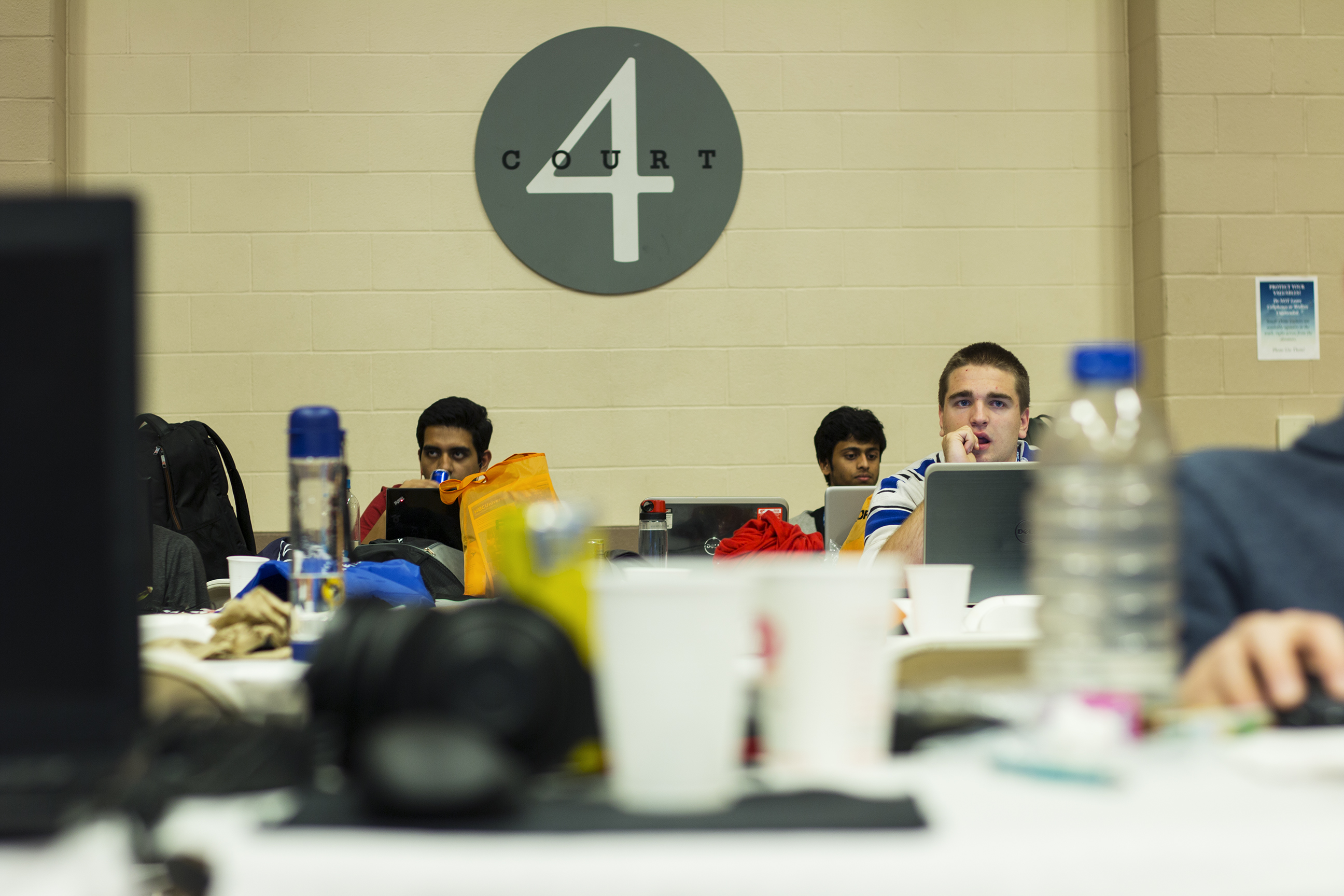
Spread out over several days, hackathons bring together programmers to collaborate and complete projects in a “sprint,” typically with the aid of caffeine and pizza and the goal of winning prizes and glory. They’ve long been a staple of startup culture in Silicon Valley — Facebook, for instance, has organized regular hackathons since 2007, as well as unofficial, informal ones since its founding in 2004 — and over the past several years, they’ve continued to grow in popularity, especially on college campuses.
(Robbie Short)

At Yale, hackathons have been part of the scene since 2012, when a group of students who called themselves the Yale Hackers organized a mini-hackathon that attracted just 35 people. One participant later said the experience “wasn’t great,” according to TechCrunch. The next year, YHack — renamed and revamped — drew nearly 1,000 students from the U.S., Canada and England to West Campus. And this year, the fourth iteration of YHack drew 1,500 participants from around the world to PWG, where hackers took over the Lanman Center and turned it into something that would have looked more at home at Stanford than at bookish, gothic Yale.

But my hometown is not far from Stanford, so I’m fairly familiar with that particular brand of techie culture. On my walk to PWG, I reflect on my experience of YHack last year, when I also went just to observe.

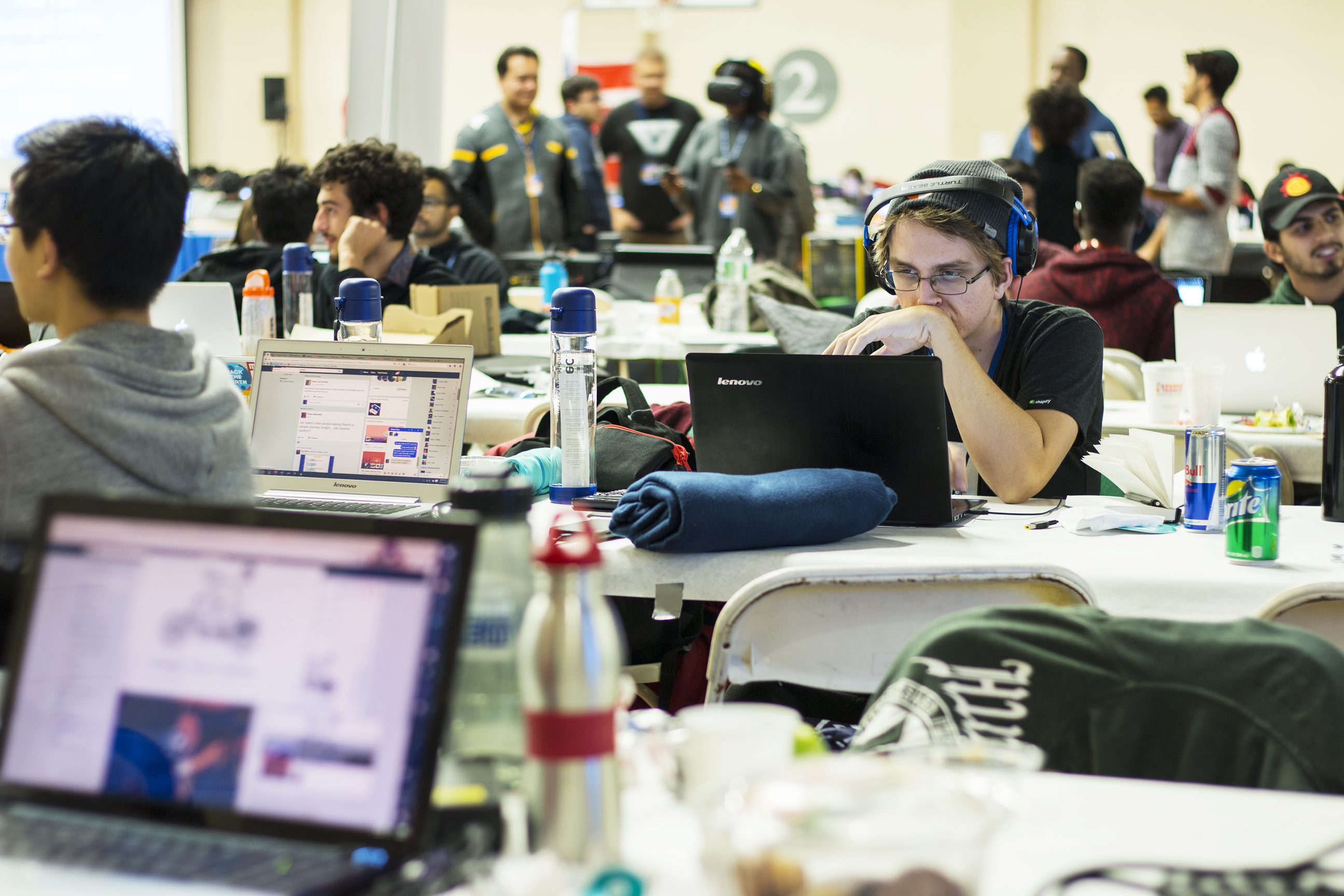
My principal recollection of last year’s event was of a pervasive energy — a not-unpleasant thrumming that appeared to both radiate from and sustain the hundreds of hackers, who were, with the exception of a few nappers, always busy typing away. I spent dusk to dawn at YHack last year, eventually retreating from Lanman to try to get some work done and passing out on PWG’s sixth floor around 3 a.m.

I do not plan to spend the night this time (PWG’s floors don’t do much for your back), but, seeing the sun begin to set over Broadway just before I enter, I guess I should expect something similar this year. And, 24 hours later, that’s about what I’d got.

(Robbie Short)
(Robbie Short)

5:24 p.m.
After dropping off my stuff along one of Lanman’s edges, I set up a tripod and spend about an hour walking around, getting photos of the hackers. Probably because my camera rig is quite large, I get a lot of looks — most curious, some slightly annoyed — which I find interesting. I begin to feel self-conscious — something to do with being turned into an object of interest by one’s objects of interest. But this is CS, so I try not to over-intellectualize it.

6:05 p.m.
Still walking around, I run into a friend, a known CS major at Yale, and ask him if he’s participating in the hackathon. “Not really,” he says. “I’m supposed to be. I just took a nap.” Apparently, one of the perks of participating in a hackathon, for college students, is getting universities to fund travel to different host campuses. This friend has some high school buddies in town, ostensibly for YHack, but “really, to party.” One part of me feels that this practice does a disgrace to the sanctity of YHack. Another, though, feels something akin to respect. Way to chip away at the ivory tower, you know?

7:02 p.m.
Dinner is delivered, courtesy of Brick Oven Pizza. Dinner for 1,500 consists of more boxes of pizza than I have ever seen — both at one time and collectively, in my life — except at YHack last year. Several floor-to-ceiling stacks of boxes quickly disperse to all corners of Lanman. I get excited by the prospect of infinite pizza, eat five slices and have to lie on the floor for a bit to recover.

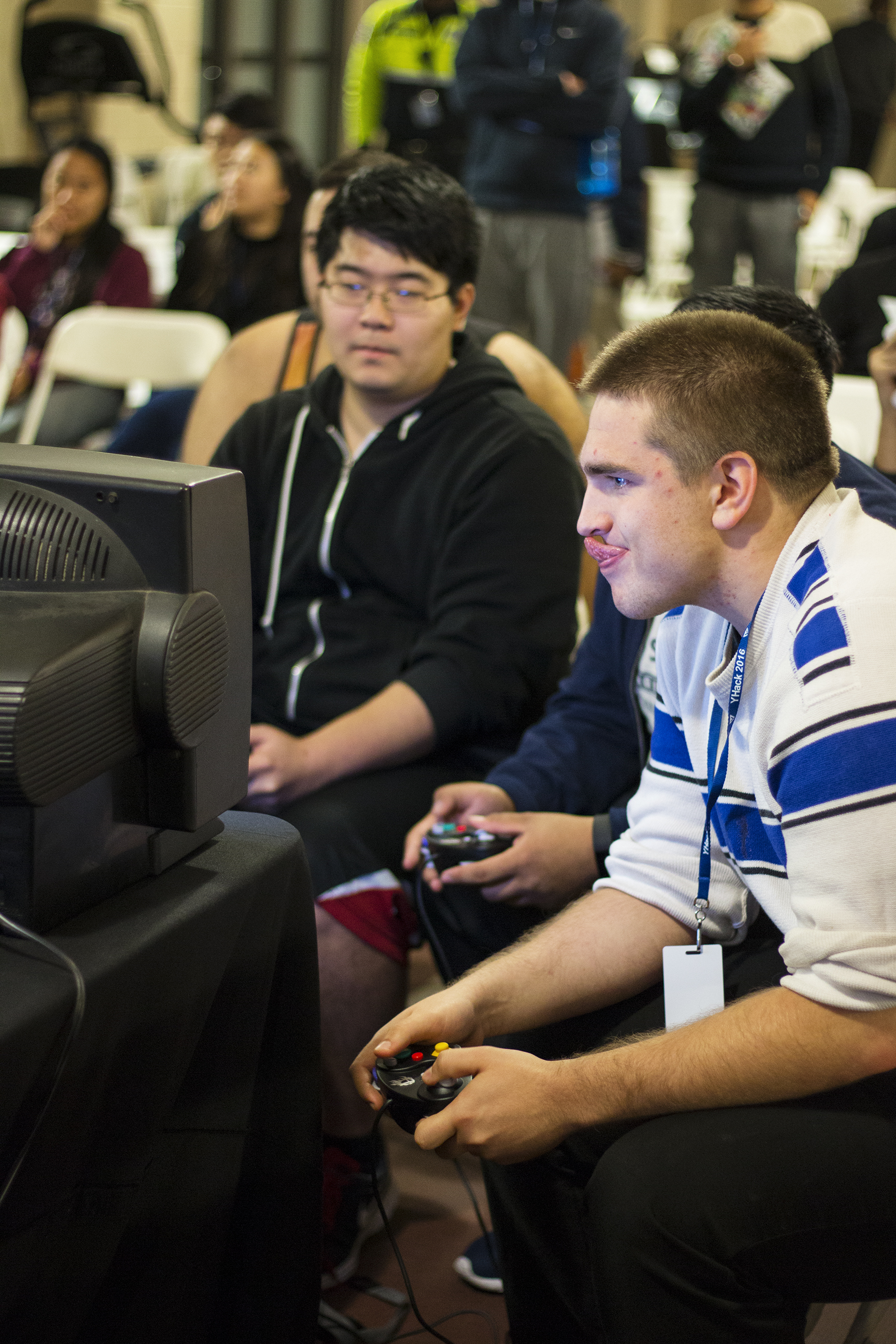
The Super Smash Bros. tournament. (Robbie Short)
(Robbie Short)

8:17 p.m.
Somewhat restored, I get up and walk over to the elevator and take it to Lanman’s upper level, where event organizers have started the annual Super Smash Bros. tournament. The scene is exactly what you’d expect. Wide eyes directed all at one screen. Button-mashing, not quite in sync but also not cacophonous in its harmony. Cheers that seem excessively loud to an observer not following the action. Picture it: A middle school boy’s sleepover relocated to a collegiate gym.

10:42 p.m.
Another friend drops by Payne Whitney to visit me during my quest. She’s never been to YHack, but listened to me hype it up enough to agree, perhaps somewhat begrudgingly, to attend its signature event: the Saturday-night rap battle. This is, in my opinion, the most underrated event in the Ivy League — even more underrated than YHack itself. These nerds are good. I’ve never heard a crowd erupt more at a diss than the rap battle audience does to a rhyme one competitor spits about his opponent’s GitHub. (Yeah, I don’t get it, either. But the atmosphere! You gotta love it.)

The rap battle. (Robbie Short)

SUNDAY, NOV. 13
12:33 a.m.

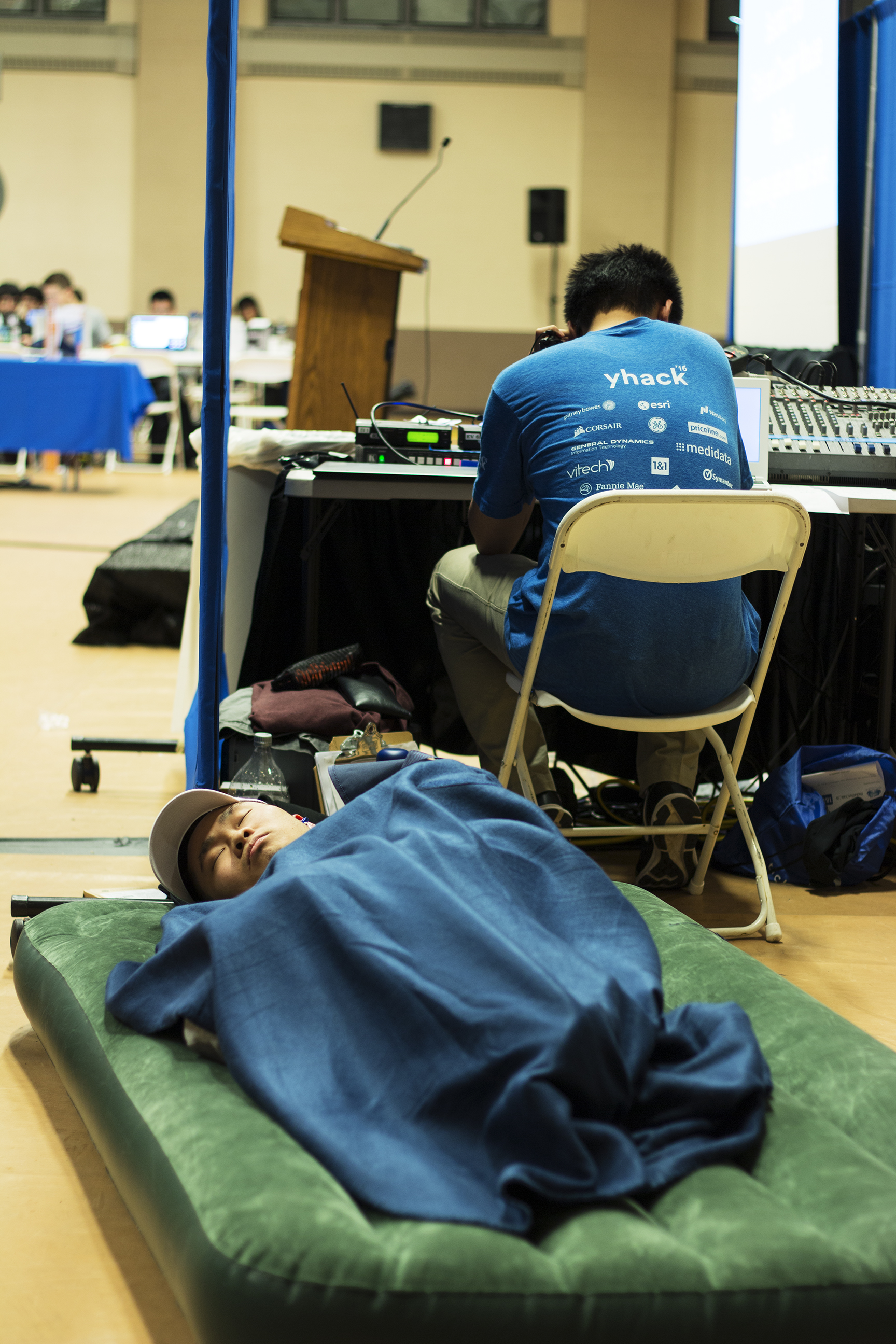
After watching the end of the rap battle and taking a short walk around the main floor of Lanman — during which I act as a sort of tour guide, pointing out to my friend the YHack detritus of sleeping bags, Red Bull pyramids and dead eyes — my friend and I decide to try to get some schoolwork done. My enthusiasm for YHack, though strong as ever, isn’t going to impress McKinsey. We decide to work upstairs, on the elevated track that runs along the perimeter of Lanman, where organizers have spread hundreds of communal air mattresses for YHackers who need a little shuteye during the 36-hour sprint. We each claim a mattress and settle in. We agree to work for a few hours, then head out.

12:44 a.m.
I pass out on my mattress.

(Robbie Short)

7:37 a.m.
The sound of someone walking past my head wakes me up. I look around, trying to collect myself, and see that my friend is still asleep a few feet away. I later learn she only lasted a half hour longer than I did the night before. I get up and look down at the floor of Lanman. It hits me that I am still at YHack.
(Robbie Short)

8:02 a.m.
While I’m still trying to process, my friend wakes up. She goes through the same awakening as I did a few minutes ago — disorientation, shock, denial and finally stunned realization — and then looks at me. “What the fuck?”

8:21 a.m.
We decide that we need to leave YHack immediately. Do not pass go, do not collect $200, do not stop to pick up a muffin. Okay, we pick up a couple of muffins. When we emerge from PWG, it’s been more than 16 hours since I entered the building. The sun is up. It’s another brisk day. My friend and I walk to York Street, saying little, then part ways to return to our respective colleges. Just a normal walk of shame for two. We will debrief about the experience some days later, but in the cold November morning, all I can think is: What the fuck?

8:46 a.m.
I make it back to my suite. My addled brain decides the best way to continue processing the experience is to sleep on it some more, so I change and get into bed. When I wake around noon, I realize I can still make it to YHack’s closing presentation of projects.

I opt not to. YHack continues, but my experience of it does not — at least not for the next 8,724 hours, after which YHack, and I, will be back.

(Robbie Short)

Credits

Powered by

Yale Reacts: A Post-Election Interview Series


Two weeks after Donald Trump’s upset win during the 2016 presidential election, students and professors at Yale are still reflecting on the significance of his victory. As those in shock grapple with the reality of a Trump presidency, many have started to contemplate the factors that contributed to the rise of Trump and consider concrete actions they can take in the next four years. In the Magazine’s interview series below, our reporters tried to offer a sample of different reactions and proposals for next steps on campus. Click on each headline to read the full piece.


Charles Hill urges students to be emotionally strong

“[I]f you’re going to be in the business of international affairs, diplomatic service or the military and you are upset or distraught by the result of this election, then you shouldn’t be in the business,” Yale diplomat-in-residence and International Studies lecturer Charles Hill said.

According to Hill, the election highlighted a deep division between elites and non-elites in this country.


Beverly Gage compares Trump’s victory with historical trends

“I’ve been thinking a lot about the period in American history, starting from 1917, when the United States entered the first World War, as an example of an extreme version of what we might be facing right now in terms of civil liberties, immigration, speech laws, press restriction,” Yale history professor Beverly Gage said.

In addition to the current polarizing atmosphere, she pointed to the Electoral College and the restructuring of party primary systems in the 1970s as structural factors that contributed to Trump’s rise.


Yale New Republicans troubled by Trump’s victory

In August, when the Yale College Republicans split into two groups over Trump’s endorsement, the newly minted Yale New Republicans looked to establish a different set of Republican ideals with the group’s formation. Co-Chairman Benjamin Rasmussen ’18 told the News that the group wants a Republican Party that can draw votes from different demographic groups in the country.

“However, this election has shaken some of the assumptions that we made in calling for that type of Republican Party, because Trump was gaining record numbers among some types of groups that more moderate Republicans had not done nearly as well with,” Rasmussen said. “So now we’re confused on where to go going forward.”


Yale Students for Hillary contemplate concrete next steps

As the organization considers its future options — remaining independent or folding back into the Yale College Democrats — Yale Students for Hillary co-president Delaney Herndon ’17 expressed a sense of loss and uncertainty in her interview with the News. But she also stressed the importance of planning and taking concrete actions.

“I’m thinking about going back [home] to North Carolina and working in politics or maybe education,” she said. “I doubt the Electoral College is going away anytime soon, so I’m trying to figure out concrete things that I can do.”


Yale College Republicans supported Trump but question his impact on campus

Emmy Reinwald ’17 told the News that the Yale College Republicans backed Donald Trump because the organization supports Republicans “up and down the ballot” according to its constitution. Still, Reinwald said Trump was not her first-choice candidate, and she doubts his election will make a big difference on campus.

“I think Yale will continue to be Yale,” she said. “You’re still going to see people protest and you’re still going to see people get involved even if Hillary [Clinton] was president.”


Yale College Democrats call Trump’s election “a major wake-up call” for the Democratic Party

Coming of age during the Obama administration, Yale College Democrats president Maxwell Ulin ’17 said the election of a candidate who is the antithesis of the progressive America that Obama has built is “dispiriting and disillusioning.” But Ulin also noted that this election has inspired many of his peers to care more about American politics.

“Now is the time to build the movement from the bottom up and we as young people can take back the country and take back the White House,” he said.


MSA aims to show beauty of Islam through community work

Trump’s win did not come as a surprise for Yale Muslim Students’ Association President Abrar Omeish ’18, but she admitted that she was disappointed. Looking forward, Omeish told the News that the healing process will bring positive outcomes. For one, the Democratic Party will have to “wake up.” For another, Omeish believes that people can channel their passion and energy into action.

“Islam, in a lived sense, is not just praying in a mosque. It’s being out there on the front lines, being active, fighting for social justice for all people, for equal representation,” Omeish said. “And that’s how we hopefully want to reclaim that narrative ourselves, in showing the beauty of Islam through work for the community and through activism.”


ANAY concerned about Native sovereignty, political landscape

Katie McCleary ’18, president of the Association of Native Americans at Yale, told the News that she is worried about Native populations and the treatment of sovereign nations with the new political change.

“Even though we’re sovereign nations, we’re also domestic dependent nations and what that means is that we are, in some sense, wards of the United States,” she said. “Because of that, everything is in jeopardy if we don’t have a good relationship with the federal government.”


Af-Am House students unpack the election outcome

Both Yonas Takele ’17, a student assistant at the Afro-American Cultural Center, and Af-Am House peer liaison Logan Lewis ’19 were surprised by the presidential election results, but they said they are now focused on moving forward and engaging in productive conversations.

“If anything, I will say that I have to double down and work harder than I ever have before to ensure that the work I do pays off for the people Donald Trump wants to target,” Takele said.


Progress on LGBTQ rights will stall, Goldberg says

Max Goldberg ’17, director of the Spectrum Fellowship director and a former peer liaison for the Office of LGBTQ Resources, told the News that progress on LGBTQ issues such as conversion therapy will halt under a Trump administration. But Goldberg is confident that past changes such as the legalization of gay marriage will stay.

“So it’s not necessarily that we’ll see a step backwards in LGBT issues, but we’re going to see a halt in progress,” Goldberg said. “Of all the issues that a Donald Trump presidency is really going to threaten, I don’t think progress already made on LGBT issues is a concern.”


After election, Liu urges AAPI millennials to remain politically active

Ryan Liu ’18 spent much of this semester on Hillary Clinton’s campaign as the national chair of the Asian American and Pacific Islander Millennials for Hillary. While he was disappointed at the election results, Liu said his “grieving period” was short, and he is ready to remain politically active.

“No matter what happens over the next four years, we have to understand that we’re going to have to work together to make sure that our rights as minorities are not infringed upon,” Liu said. “I grew up in California, a state that spearheaded the Chinese Exclusion Act of 1882, and I went to school next to an area that used to be a Japanese internment camp. So we’re surrounded by relics of the past — of the discriminatory system — and we want to make sure that this never happens again.”

Harvard-Yale 2016:
Scenes from The Game

Published on November 22, 2016

On Saturday, Yale’s football team stunned a packed Harvard Stadium by pulling out a win over its Crimson rivals, ending a nine-year losing streak most were sure would extend to a decade. The News had photographers on the ground for all the action.

The Yale Precision Marching Band warmed up the Yale crowd with a brief performance before kickoff. (Maya Sweedler)

Yale's side of the stadium was full of thousands of Yale fans, young and old. (Robbie Short)

Heading into the game, the Bulldogs hadn't won a game against Harvard since 2006. (Robbie Short)

Return man Jason Alessi ’18, a 2016 All-Ivy Second Team selection, recorded 40 yards on two kickoff returns against the Crimson. (Maya Sweedler)

Running back Alan Lamar ’20 scored Yale’s first points of The Game on a touchdown run at the end of the first half. (Robbie Short)

Defensive back Hayden Carlson ’18 recorded seven total tackles in The Game, and finished the season ranked third in the Ivy League with 95 on the season. (Robbie Short)

Quarterback Kurt Rawlings ’20 threw 17–28 for 131 yards and two touchdowns to go along with a game-high 74 rushing yards. (Robbie Short)

(Robbie Short)

The Yale Precision Marching Band continued its tradition of honoring Yale's 12 residential colleges during its halftime show. (Robbie Short)

The teams battled before a crowd of 30,000 in a sold-out Harvard Stadium. (Robbie Short)

Linebacker and captain Darius Manora ’17 tied Harvard’s Kolbi Brown for most tackles in The Game with nine. (Robbie Short)

Linebacker Matthew Oplinger ’18 energizes the Yale crowd at Harvard Stadium. (Robbie Short)

Yale head coach Tony Reno improved to 24–26 as Yale’s head coach with his first win over Harvard. (Robbie Short)

At the end of the third quarter, some students and friends of Saybrook College participated in the annual Saybrook Strip, causing a slight delay in the game. (Robbie Short)

Quarterback Kurt Rawlings ’20 found receiver Reed Klubnik ’20 for two touchdowns on the day, including the go-ahead score with 4:14 remaining. (Robbie Short)

Wide receiver Reed Klubnik ’20 celebrates after scoring the go-ahead touchdown. (Matthew Stock)

The Yale crowd began to celebrate as the clock ticked down at the end of the fourth quarter. (Robbie Short)

Yalies rushed onto the field to celebrate once the result was official. The final score: 21-14. (Matthew Stock)

(Robbie Short)

(Robbie Short)

(Robbie Short)

The Game 2016


Almost every November since 1875, the Harvard and Yale football teams have faced off in an epic rivalry as old as college sports itself. Use the links below to browse the News’ coverage.

Welcome to the 133rd rendition of The Game.

COVERAGE


IT HAPPENED

The streak is over.

A 2–7 Yale football team limped into Harvard Stadium on Saturday to face a Crimson squad that needed one win in order to lock up its fourth consecutive Ivy League title. But after 60 minutes of play, it was Yale that ended up celebrating on the field, a 21–14 victory in hand, while Harvard fans and players filed out of their stadium, shocked.

Scenes from The Game


Yale travels to Cambridge for 133rd iteration of The Game

From close battles to blowouts, the Yale football team has underperformed in 2016. But there remains one last chance to salvage the season: the Bulldogs will travel to Cambridge on Saturday for the Harvard-Yale football game, with a shot at preventing archrival Harvard from obtaining its fourth-straight Ivy League title.


Keys to The Game

The Yale football team (2–7, 2–4 Ivy) has one of its toughest tasks of the season ahead as it faces off against Harvard (7–2, 5–1) in Cambridge. In The Game last season, Harvard secured a 19-point victory thanks to 119 yards and three scores from then-freshman receiver Justice Shelton-Mosley. Yale quarterback Morgan Roberts ’16 threw for 410 yards, with 169 of those going to Christopher Williams-Lopez ’18, though his offense put up just 19 points. For the Bulldogs to break their losing streak against the Crimson, they will have to capitalize on Harvard’s mistakes, pass the ball effectively and stop the opposition’s ground attack.


BY THE NUMBERS: Harvard v. Yale

While the Elis are no longer in contention for the Ivy League title, they do have the chance to deny the Crimson a share of the conference championship. With Harvard, Princeton and Penn all currently tied at the top of the league, it seems likely that the title will once again be shared between at least two teams. All three teams need to beat their respective opponents to lay claim to a share of the title. According to the Elo model, there is above a 50 percent chance that all three teams share the title.


The history of the underdog

In the long history of this rivalry, Harvard has typically been the team to pull off the upset. Of those 13 wins by the unfavored opponent, the Crimson owns 10 of them, with only two coming in the past 16 years. The last time the Bulldogs won as the underdogs in The Game was in 1993, a year in which Steven Spielberg’s Jurassic Park was the highest grossing film, Bill Clinton LAW ’73 presided over the Oval Office and a gallon of gas cost $1.16.

Unless Yale is able to defeat Harvard this Saturday, the win in 1993 will remain one of only three victories for unfavored Bulldog teams since 1970, joining those of the 1973 and 1985 campaigns. That is the same number of times that, in the same period, the Crimson has upstaged an Eli team that entered The Game undefeated. Harvard delivered the Bulldogs’ only loss in 1974, 1979 and 2007, leaving 1960 as the last year in which Yale was perfect for an entire season.


Harvard’s season in review


Yale’s season in review


Across the board: Yale–Harvard in other sports

See how Yale compared to Harvard in the other fall season matchups this year.


Unit breakdown

Comparing Yale and Harvard football teams, unit by unit.


Five years of the Tony Reno era

On Jan. 12, 2012, Tony Reno stood up in front of a press conference hosted at the Yale Bowl and was introduced as the 34th head coach of Yale football. A former assistant at both Harvard and Yale, Reno promised he was the right man to do what his predecessor, Tom Williams, had not: win an Ivy League title and beat Harvard in The Game. Nearly five years later, Reno has amassed a 23–26 record, and though he has provided Yale football fans with some memorable moments, none of his wins have come against Harvard.


NEWS’ VIEW: For Yale football

Maybe this year’s Yale squad is not the team to finally top the Crimson. Maybe Saturday will be another uncomfortable, rainy day, but this time in Cambridge with the Elis stumbling on the turf of Harvard Stadium. Maybe the Bulldogs’ detestable losing streak will live another year.

But what will happen if Yale wins?


SENIOR COLUMN: My Yale career

My mother worked hard to get me into school. My brother and sister worked hard to set a good example for me. They suffered so that I may learn and better myself. Football was always an outlet for me where everything just seemed decent. I had little to no worries on the field because it was more peaceful than my home life. I had great teammates who were like family to me.

Yale football gave me an opportunity to have one of the world’s best educations and also play competitive football. If it weren’t for Yale football tracking me down, I can’t say I would be where I am. However, I have never once thought that I didn’t deserve to be here.


SENIOR COLUMN: My time here

I was a young African-American kid born and raised in a small beach city in Southern California. It was all that I knew and truly what I loved, but Yale football opened me up to much more than that.

I remember arriving on campus for the first time to start a strength program before freshman year. I met 29 strangers with whom I would go on this journey for the next four years. Although we were all different, we all held that same love and passion for a simple game that creates high morale and intense emotion that couldn’t be replicated by anything else.


YALE: Can you cuddle with a Crimson?

Why is it that Yale and Harvard students alike look forward to The Game so much?

Maybe it’s the history and tradition of the rivalry. It could be the Friday night festivities and the Saturday morning tailgates. Maybe it’s the chance to yell and scream while surrounded by thousands of your peers, whether you’re the football fanatic or the friend asking what a first down is.

All of these answers are possible. But I’ll tell you what the students don’t care about: one stretch of nine years — out of 132 — in which Harvard happened to come out on top.


HARVARD: For Yale, an inconvenient truth

Nine. The number of innings in a baseball game. The number of quarterbacks the Cleveland Browns are projected to start next season. The number of girls that have rejected me this week. The second-highest number the Yalies can count to seeing as we only have 10 fingers and all — math is hard, huh? But most importantly, nine is the length in games of Harvard’s win streak against the Bulldogs.

Can we take a second to think about just how hard it is to lose nine games in a row? There comes a point when it seems like the Bulldogs are just trying to be bad. It’s like they’re doing it on purpose. Like in 2009, when Yale attempted a fake punt on fourth and 22 in the fourth quarter. They went on to lose, 14–10.


After reinstatement, what next?

Published on November 15, 2016

In January 2015, a freshman named Hale Ross ’18 injured himself falling from the fourth floor of Bingham Hall, and then withdrew from Yale for mental health reasons, according to friends and family.

Ross, a cross country runner, was reinstated in fall 2015. But on the evening of Oct. 30, 2016, he committed suicide in his dorm room in Calhoun College.

The story of Ross’ withdrawal and reinstatement comes from multiple interviews with his father, John Ross III ’79, as well as a former teammate and two friends and classmates in Calhoun, both of whom raised questions about the level of mental health support Ross received after returning to Yale.

“I’m incredibly saddened and shocked by the fact that it seems his mental health was not made a priority and that he somehow slipped through the cracks,” said a friend and classmate of Ross’ in Calhoun, who wished to remain anonymous due to the sensitivity of the situation. “For someone who had been clearly unstable and unwell, it’s frightening to see such a tragedy still occur. It makes me all the more afraid that a student dealing with mental health issues who has not overtly expressed that he or she is struggling will have trouble finding the adequate resources at Yale to get better.”

Ross’ father — who said the Bingham incident was never formally deemed a suicide attempt — told the News that Ross was seeing a doctor outside of Yale at the time of his death. He added that although Ross had significant support from the Calhoun community, he did not know of “any other supports” his son received at Yale. Vice President for Communications Eileen O’Connor said she could not comment on the reinstatement of a specific student.

The University revised its withdrawal and reinstatement policies a year and a half ago following the suicide of Luchang Wang ’17, who, like Ross, had recently been reinstated. Those reforms focused on changes in terminology and adjustments to the timeline for withdrawal, among other issues.

But the circumstances surrounding Ross’ death have raised questions about another area of mental health policy: The support students receive following their reinstatement.

In interviews with the News, nine students who have gone through the reinstatement process for mental health reasons — some of whom withdrew after the 2015 reforms and many of whom said they hoped to shed light on a process few students understand — expressed distrust toward Yale’s Mental Health and Counseling program. Many of these students also shared concerns over the support mechanisms available to reinstated students like Ross, an aspect of the system that was not addressed in detail by the 2015 reforms.

Yale College Dean Jonathan Holloway cited the deans of the 12 residential college as the first line of support for students returning to campus, in addition to leaders of the cultural centers, Yale’s religious communities and others. But students interviewed reported a wide range of experiences with their deans, and many called for Yale to institute a more consistent support system.

“Those are the two suicides Yale has had — kids that have been gone before, not people who have never left,” said Rachel Williams ’17, who was reinstated in January 2014 after a mental health-related withdrawal, in reference to Ross and Wang. “So this whole theory that Yale has, that if [it sends] people home, they’re just going to get better, and everything’s going to be magical, and they’re going to have zero culpability, is bulls–t.”

(Ngan Vu)

A DECENTRALIZED SYSTEM

Under current Yale College policy, any undergraduate can petition for a leave of absence within the first 15 days of a new semester and later return to campus without much effort or expense. But students who withdraw — or are forced to withdraw, often for mental health reasons — after that 15-day period face significantly greater hurdles to reinstatement, including on-campus interviews and academic requirements. And once they return, the process of reintegration — going back to class, staying healthy, interacting with administrators — can present a new set of challenges.

All nine reinstated students interviewed by the News emphasized the role, positive or negative, of their residential college deans in the transition back to campus. Holloway told the News that deans are not required to meet with reinstated students, though the University has “the expectation” that they will reach out to students returning to campus.

According to student interviews, the University’s decentralized support system has led to a wide range of post-reinstatement experiences. Not every dean understands how to help students with mental health issues, students explained, and frequent administrative turnover — eight deans and heads have left their positions in the last year — can deprive students of consistent, familiar support.

Ray Mejico ’17, a member of Ezra Stiles College who withdrew for mental health reasons in the fall of 2014, described a disheartening return to campus that made him question the effectiveness of the residential college support system. When Mejico was reinstated in the spring of 2016 after a year and a half away from Yale, he said he received no institutional support from the University. Stiles was in the process of switching deans, and “there were no real resources when I came back,” he said.

Early in the semester, Mejico had coffee with the interim Stiles dean after she reached out, a gesture Mejico said he appreciated. But the new permanent dean, Nilakshi Parndigamage ’06, has not been in touch, and when Mejico met Parndigamage this fall to get his course schedule signed, she treated him like “just another face and another student that she has to push through the system,” he said.

In an email to the News, Parndigamage said she frequently meets with Stiles students who have recently been reinstated, and sometimes communicates with their parents and instructors as well. She did not comment on Mejico’s specific case.

By contrast, Eugenia Zhukovsky ’18, who was reinstated in the fall of 2015, said she had an overwhelmingly positive experience with her dean, Mia Genoni, who worked in Berkeley College until last semester.

“Me and my dean were very close and still are,” Zhukovsky said. “She reached out to me and made sure that I was OK every week. She called it a spider sense, she knew when something was wrong. She’d notice if I hadn’t talked to her for a while, she’d be like ‘are you OK?’”

Zhukovsky has stayed in touch with Genoni since the former Berkeley dean left Yale last spring to become dean of the University of Richmond’s Westhampton College. Still, Zhukovsky added that her experience with Genoni does not necessarily reflect those of most reinstated students.

“From what I’ve heard from other students and deans and their reinstatements, I think [Genoni] did that in good will, which was amazing for me, but may not have been the same situation for everybody,” Zhukovsky said.

Monica Hannush ’16, who was reinstated in the fall of 2013, had a much more difficult experience in Pierson College, where she butted heads with college administrators.

“I had a very poor relationship with my dean,” Hannush said. “We had a new [head] in Pierson at the time, but I was trying to stay maximally off his radar. The last thing I would have done was make a meeting with him.”

Holloway told the News that students who prefer not to approach administrators in their residential colleges can reach out to other advisors at the University, such as coaches, chaplains and cultural center directors.

“There’s no doubt there’s variation [among deans], because we aren’t robots,” Holloway said. “For students who really did have a difficult time with their dean, it’s important to remember that they have other resources. It’s not that it’s easy for an individual who’s not having a positive experience with an adult on campus to go to another adult and say this isn’t working, but every student has options.”

None of the 12 residential college deans other than Parndigamage responded to emails or phone calls requesting comment for this story.

According to former Saybrook College Dean Paul McKinley — who now works as director of strategic communications for Yale College — college deans are highly attentive to the needs of reinstated students.

“There are people standing by 24/7 who are also paying attention 24/7 to how people are doing,” McKinley said. “There is a tremendous amount of outreach that is going on all the time. They are very mindful of people who have come back and work with them closely.”

Assistant Dean of Academic Affairs Pamela George — the chair of the committee that evaluates reinstatement applications — told the News that residential college deans help reinstated students plan their semesters, and refer them to other campus resources. She added that the deans receive “extremely thorough training.”

“It always takes some time for reinstated students to establish a personal connection if the dean is new, but because the deans live in and take their meals in the college, they have many opportunities to meet with reinstated students,” George said. “All deans, veteran or new, know exactly whom to call when a student needs help.”

Still, Williams said that upon returning to Yale, she did not receive institutional support beyond Branford College, where she had a strong relationship with her head of college and dean. She added that the University should offer reinstated students broader support and recognition.

“Even making you feel like they know that you exist and that you are a student again after they kicked you out and took you back, and that they are aware of this [would have been helpful],” Williams said. “They’re going to make a whole big fuss about sending you home, and then you come back and it’s like ‘Oh, did that happen?’ It would have been helpful to feel like somebody was thinking about it.”

(Ashna Gupta)

AFRAID TO ASK FOR HELP

The University announced reforms to the withdrawal and reinstatement process less than two years ago, in spring 2015. They included an extended timeline for leaves of absence, policies designed to alleviate the financial burden on withdrawn students and the replacement of the term “readmission” with “reinstatement.”

But they did not directly address one of the central reasons that Wang — who had withdrawn earlier in her college career and committed suicide in January 2015 — was unwilling to use Yale’s mental health resources: a rule in Yale’s academic handbook allowing the director of MH&C to recommend students for withdrawal against their will.

“She was routinely lying to her therapist,” a friend of Wang’s told the News in January 2015. “It was very common for her to express suicidal ideations and then she immediately followed that up, explaining that if we reported her she would be kicked out of Yale and have no reason left not to kill herself.”

Nearly two years later, that concern seems to have endured, especially among students who have experienced Yale’s reinstatement system firsthand.

Five of the nine students interviewed said they have avoided interacting with MH&C for fear of being forced to withdraw. One student — who was reinstated in the fall of 2015 and asked to remain anonymous — said she instinctively “self-censor[s]” around anyone affiliated with the University.

Hannush said she initially got along with her clinician at MH&C, but later regretted sharing information that administrators ultimately used to force her to withdraw. Although Hannush recognized that the counselors at MH&C were trying to help her, she said the experience left her feeling “betrayed by the system.”

In February 2013, Williams’ freshman counselor — an important resource for her before her withdrawal — took her to Yale Health for treatment for self-inflicted cuts. The doctor called in clinicians from MH&C, and soon an ambulance was transporting Williams to a psychiatric ward at Yale New Haven Hospital. Shortly after, Williams was forced to withdraw in what she described as a “Salem witch trial situation.”

“That’s when I learned. I had been completely honest with my therapist at home, who I had been working with for two and a half years, because that’s how you make progress,” Williams said. “I was completely honest with her, so that’s what I thought you were supposed to do. You’re supposed to be honest. Nope. I would never go to Yale MH&C now and tell them anything.”

Yale College’s Academic Regulations state that the Yale College dean can require a student to withdraw if MH&C advises that the student “is a danger to self or others because of a serious medical problem or that the student has refused to cooperate with efforts deemed necessary by Yale Health to determine if the student is such a danger.”

According to Holloway, individual clinicians can report concerns about a student to MH&C Director Lorraine Siggins, who typically meets with the clinician or interviews the student before deciding whether to recommend a required withdrawal. Students’ conversations with MH&C clinicians are not shared with the deans of the residential colleges.

“It’s based on the clinician’s interpretation of the exchange that’s happening with the student, and all the information that the clinician has with the student,” Holloway said. “It’s not about a stray word, or some phrase that’s taken out of context.”

Siggins did not respond to multiple requests for comment. However, Holloway defended Yale’s withdrawal policy, saying that the University always has students’ best interests at heart.

“Our main thing is that we want students to be healthy,” he said. “It is not about reputation, it’s about students’ health and well-being. The best place people get healthy is to be at home or some facility close to home which can tend to their needs. For students who are struggling with these issues, we never want to kick them out. We want them to get healthy, we want them to come back.”

Alexa Little ’16, who was reinstated in fall 2014, said she recognizes that the policy is designed to keep Yale students safe. But despite those good intentions, she said, the University’s power over personal health decisions creates a “surrealist landscape” in which students are not given the benefit of the doubt “when it comes to handling their own health.”

One student currently working toward reinstatement — who requested anonymity for privacy reasons — said Yale’s withdrawal policy discourages students from reporting suicidal thoughts.

“This is an issue that administration and people who have been around the Yale scene for a while have known about,” the student said. “This has basically been a hush-hush, don’t ask, don’t tell situation for a long time.”

Last spring, the student reported suicidal thoughts to MH&C officials and admitted himself to the psychiatric ward at Yale New Haven Hospital. After a few days at Yale New Haven, the student believed he was well enough to remain at the University — but he was overruled by his doctors, who insisted that he leave campus.

“Yale does not care about a student’s well-being,” the student said. “The reality is, Yale does not care about the welfare of the students. Yale cares about whether or not there is a tragedy that occurs on their doorstep and whether or not they get the publicity for it.”

NEXT STEPS

A Yale College Council report on withdrawal policies helped drive the University’s reforms in 2015. Now, nearly two years later, the YCC is planning to make withdrawal and reinstatement a focus of its advocacy work once again.

In an interview with the News, YCC President Peter Huang ’18 said that this year the YCC will likely explore the support mechanisms available to students after reinstatement. In 2015, he explained, the YCC proposed a peer mentoring system — similar to the cultural centers’ peer liaison program — that would match recently reinstated students with older advisors who have been through the process. The proposal was not incorporated into the 2015 reforms, but Huang said the YCC may push to see it introduced in the near future.

“[Reinstated students] definitely feel a disconnect from the community,” Huang said. “I think that’s something that we need to look through again. We’re just trying to look into different avenues so that we include support. Especially for an issue as nuanced as this, there can never be enough support.”

Indeed, Hannush and Zhukovsky suggested initiatives similar to the peer liaison proposal. They said that they would have benefitted — both before and after their reinstatement — from the advice of someone who had been reinstated.

“It’s not the going at it alone that’s as hard as the idea that you are going at it alone when you’re not,” Zhukovsky said. “We’re in a place with a lot of people, a lot of resources. There’s got to be at least one person for everybody that can help support.”

George said she holds periodic lunch meetings with reinstated students to help them transition back to Yale. The lunches are not mandatory, but they allow students to stay in touch with George and ask questions about their return to campus.

“We are continuing to manage the implementation of this still newish system, which I do think is an improvement on the past,” Holloway said. “We’ll keep our eyes on it to see how we’re doing. This is a process that we’ll know a lot more about in a year’s time when we’ve had more cohorts come back.”

But Hannush, who did not get along with her college dean, said the University should still do more to support students reinstated for mental health reasons.

In her view, the University should not only make it clearer to students what resources are available upon their return; it should also allow students to more easily transfer out of colleges if they feel uncomfortable, even during the course of the school year or right before the start of classes in August.

According to Williams, the University must introduce a greater degree of choice into its withdrawal policy, given that once students return to campus they are often afraid of being forced to leave again by MH&C.

Regardless of potential changes, some students who have gone through the reinstatement process said they may never look at Yale in the same way.

“It’s tough to have had such love for a place and go through that difficult experience and come back fundamentally changed,” Little said. “No one was happier to go to Yale than I was, and now I have a very difficult relationship with Yale because I went through this process.”

Corey Menafee: Back to Work

Published on November 14, 2016

Everyone is waiting for Corey Menafee. I can see my breath in the air, and the wind is unrelenting, but no one is leaving. The facade of Woodbridge Hall looks stately in the fall sunlight. The organizers of the Change the Name Rally stand atop the building’s front steps, and a crowd of nearly 200 students, faculty, staff and other New Haven residents huddles below. Kica Matos, emcee of the rally and director of immigrant rights and racial justice at the Center for Community Change, says the guest of honor is running late but will arrive any minute now. In the meantime, a few speakers address the demonstrators, and some activists with megaphones lead call-and-response chants.

“Calhoun does not deserve this fame.”

Change the name.

“Eighty-three years of racist shame.”

Change the name.

“Racism lives and Yale’s to blame.”

Change the name.

“Take down those racist window panes.”

Change the name.

“Racist images cause us pain.”

Change the name

“Yale’s excuses are totally lame.”

Change the name.

The rally started at the corner of College and Elm, where protesters began to congregate on the New Haven Green over an hour before arriving at Woodbridge. Many carried placards with phrases like “JUSTICE CAN’T WAIT” and “CALHOUN=SLAVERY.” Most popular, perhaps, were picket signs calling on Yale to “Smash Racism.” Cameramen from FOX 61, NBC CT and other state TV news networks swarmed the outskirts of the scene. Students, activists and even a Yale professor — American studies professor Charles Musser ’73 — roused the crowd with brief but impassioned speeches. One speaker — a member of Unidad Latina en Accion — donned a homemade Corey Menafee costume consisting of a broomstick and an apron emblazoned in black and red ink with the words “CALHOUN [crossed out] STOP RACISM CHANGE THE NAME ¡NOW!”

From the Green, the crowd marched in a loop around campus, holding a 30-foot-long, traffic-cone-orange banner that read, “YALE: #CHANGE THE NAME!” and chanting all the way. Each time the procession passed a college, more students joined. A dining worker at Berkeley College swung open a back door to salute the demonstrators as they passed. The march came to a halt beneath the engraved roman numerals of Woodbridge Hall, where the protesters would submit a letter to University President Peter Salovey demanding that he change the name of Calhoun College, and where Corey Menafee was slated to deliver remarks during his half-hour lunch break.

Now, standing in the cold outside Woodbridge, I begin to doubt whether he is coming at all.

“He’s here!” A woman shouts from the back. “He just got here!”

(Ngan Vu)


Corey Menafee catapulted into first the local and then the national spotlight in mid-June when he smashed a stained-glass windowpane in the Calhoun College dining hall that depicted slaves picking cotton. For more than six months, Menafee had worked at Calhoun without noticing the imagery, in part because of his nearsightedness. When a visiting Calhoun College alumnus first told him about the windowpane, Menafee didn’t believe him until the man pointed it out. Menafee recalled feeling “hurt” and “shocked” as he looked at it for the first time.

“Like they say, a picture’s worth a thousand words,” he told me. “That picture might have been worth a million words. I don’t know, it just hit me. It just touched my heart to look up in 2016 and to see real — well it was a picture, but a picture depicting real slaves in a field picking cotton. There’s no real place for that in today’s society. It’s degrading, it’s disrespectful and it shouldn’t be there. Period.”

A week after the alumnus brought the imagery to his attention, Menafee climbed on top of a table and, reaching up with a broomstick, knocked the windowpane to the ground, where it shattered on contact. The Yale Police Department arrived soon afterward to arrest Menafee. In the aftermath of the incident, the YPD filed a misdemeanor charge of reckless endangerment and a felony charge of criminal mischief against Menafee.

Corey Menafee is no firebrand. According to the police report filed by Officer D.J. Rainville, both of Menafee’s managers at Calhoun said he was “a very good employee” and had “not given cause for serious discipline in the past.” Marquise Evans, a General Services assistant who worked with Menafee at the Davenport dining hall for nearly two years, attested to his former coworker’s work ethic and amenability. Above all, Evans said, he worked for the students.

When I asked Menafee what he does for fun, he first mentioned watching sports. Second, he listed working in the dining hall.

“I just enjoy it,” he told me. “As corny as that sounds, I love my job as a General Services assistant. Working with the staff, managers, students, I truly do enjoy it.”

Of course, Menafee doesn’t love everything about Yale. He firmly believes that the University should change the name of Calhoun College — hence his appearance at the Change the Name Rally. The name of one of America’s most ardent proponents of slavery “casts a shadow of oppression,” he said.

Still, he sympathizes with University President Peter Salovey. He admitted that he could not possibly know what it is like to occupy the president’s seat and face the predicament that Salovey faces regarding the Calhoun College name debate.

“The president’s a figurehead: he takes the fall when things go wrong, he takes the praise when things go right,” Menafee said. “So in that respect, I do kind of feel for him because I’m sure he has pressure from both sides to change it and to keep it.”

To those who had worked with Menafee in the college dining halls, his radical actions came as a shock. In the police report, both managers of Calhoun dining hall expressed their “surprise” at his behavior. Evans, too, remembered being “real surprised” when he heard what had happened. And yet he said his former coworker’s actions made sense. Menafee would not have done it without a reason — “he wouldn’t have did it if it didn’t bother him.”

Corey’s younger brother, Mitchell Menafee, echoed Evans’ belief that his brother acted with a clear purpose in mind. Unlike Evans, though, Mitchell wasn’t surprised at all when he got the call from their uncle — who, he told me, is “very animated” and prone to “exaggerate” — informing him that “Corey went crazy at work, broke something.”

“I wasn’t surprised because my brother is a smart guy, and I’m sure he has his reasons for everything he does,” Mitchell explained. “Not that he doesn’t make mistakes, but how we came up, every mistake is a lesson, and a lesson got taught the day that he broke that window.”

Five months later, everyone who advocates changing the name of Calhoun College is still talking about how Corey Menafee shattered that windowpane — everyone, that is, except for Corey Menafee. And that’s because he can’t.

In July, Menafee and his attorney, Patricia Kane, journeyed to New York City for an interview with Amy Goodman and Juan González of Democracy Now!. During negotiations over Menafee’s reinstatement, Yale requested that Menafee stop giving interviews, Kane told me. She “laughed at the suggestion.”

“Are you kidding?” she asked. “[Interviews are] the best tool we have in our pocket.”

When Yale announced that it would offer Menafee his job back, the University demanded that he sign a nondisclosure agreement as a condition of his reinstatement. The original agreement would have prohibited both Menafee and Kane from discussing the window incident or the ensuing case. Unwilling to forfeit her right to speak out, Kane withdrew as Menafee’s attorney for labor issues, although she remained his criminal attorney. With the backing of Yale’s blue-collar union, Local 35, Menafee signed the agreement. He now works at the Morse-Stiles dining hall.

(Nina Goodheart)


Kane believes the nondisclosure agreement is “antidemocratic” because it stifles conversation. The University, however, issued a statement in its defense.

“As with any sensitive employment situation that involves personal information and private negotiations, individuals, corporations and institutions like Yale agree to sign agreements binding both parties to confidentiality regarding the terms of the agreement and specifics of the negotiations to the benefit of all parties involved,” read a previous statement shared by University spokesman Tom Conroy. “Nothing in these agreements hinders their First Amendment right to free speech.”

While the nondisclosure agreement restricts his ability to speak on the events of the past five months, Menafee can talk about anything precedent or subsequent to the controversy — and that he did. Still, he was hesitant at first.

When I requested to speak with him, Menafee wanted to meet downtown rather than on campus. Sitting across from me at the corner table of the Starbucks on Chapel and Church, he looked nervous. Every couple minutes, he scanned the street as if on lookout. He craned his neck to peer out the window at his back, too.

Menafee grew up in New Haven with a single mother. Every three to five years, April Menafee moved the family to a new apartment in search of “a better quality of life for [her children],” he said. A home health aid and factory worker, April ran a strict household and held her children to high standards. It is to her that Menafee attributes his sharp sense of right and wrong.

“When I did right, she rewarded me,” he recalled. “When I did wrong, she reprimanded me. She was a strict, no-nonsense type lady. But at the same time she was a very loving and nurturing woman. So I had that balance.”

April Menafee administered justice with a heavy hand. When a second-grade teacher called to inform her that Corey had been misbehaving in class, she came into school, pulled her son’s pants down and spanked him in front of the class. He chuckled as he recounted the “traumatic” incident: “I fell in line after that.” Nevertheless, Menafee emphasized that his mother always gave him her love and support, despite her bouts of severity. By her example, she showed him how to live a “righteous” life. Mitchell described their mother in the same terms. Again and again, both he and his brother reiterated that they live “righteously” for her.

Menafee told me that the best times of his life were his high school and college years, although he didn’t appreciate it at the time. A lifelong football fan, Menafee played four years on the James Hillhouse High School varsity team. After playing receiver his freshman year, he became an undersized offensive lineman, standing 5 feet 10 inches tall and weighing just 140 pounds.

“I used to love that,” he reminisced. “I don’t know. I guess it’s like a microcosm of my life. I was undersized, wasn’t expected to do much, but I was able to block. I was able to block effectively and earn the respect of my teammates.”

In 1997, Menafee matriculated at Virginia Union University, a small historically black university in Richmond. At VUU, the football team’s 5 a.m. jogs were enough to deter him from trying to play at the collegiate level. Instead, Menafee devoted himself to journalism, serving as the sports editor for the school newspaper, the VUU Informer, and interning for the university’s sports information director. He also reported on the football team for the local radio station.

After graduating from VUU with a degree in mass communications, Menafee returned home to pursue a career in journalism and to care for his mother, who had diabetes and had gone blind when he was a sophomore in high school. In New Haven, though, he struggled to make inroads into the local news scene. All of the mainstream news sources he approached turned him away.

“You know, once I started hearing ‘no, no, no, no, no,’ I kind of lost interest in the field and became more focused on just securing employment,” he said. “I went down to WTNH [a local New Haven TV station] and couldn’t even get through the front door. Those revolving doors, they’re actually locked. You can’t just go in there.”

Both Menafee and Kane ascribed his difficulties to a lack of connections. Without “a network of contacts who could help him get to the next place,” she said, he had little chance to break into the insulated guild of Connecticut journalism.

(Nina Goodheart)


Menafee wrote a few articles for the West Haven Voice, a weekly publication, but eventually abandoned his hopes of becoming a journalist to work for Pitney Bowes Management Services, where he scanned paper insurance files into a computer database. After a brief stint in New York City, he returned to New Haven and took a job as a weekend pot washer in Yale’s Commons Dining Hall. Although Menafee appreciates his job at Yale, Kane said she believes that “his abilities are a lot more than what he’s doing at the moment.” In fact, Menafee’s journalistic acumen became apparent as soon as I introduced myself: when I broached the idea of writing this story, he immediately asked what my angle would be.

But when I asked Mitchell if he thought his brother regretted not becoming a journalist, he shook his head without hesitation.

“I don’t think Corey lives his life that way,” he said. “I don’t think he does regrets.”

To most people, Corey Menafee would seem to have ample reason to dwell in the past. In 2003, his mother passed away two weeks before her 45th birthday. He described her death as “one of the biggest things traumatically that happened to me in my life” and as “a game changer.” A freshman in high school at the time, Mitchell became dependent on his older brother in his mother’s absence. Both brothers told me that Corey became like a father to Mitchell from that point on.

“It was an emotional time inwardly, but I didn’t express that,” Corey said. “I kept my game face on.”

In 2009, while speeding away from a fight with his wife, whom he had married the year prior, Menafee lost control of his car and crashed into a tree. He came away from the wreck with a fractured right hip, dislocated left hip and shattered pelvis. Nonetheless, he stressed that the situation could have been worse.

With his pelvis stabilized by a configuration of plates and screws, Menafee began learning to walk again. A year into his rehabilitation, however, the screws became infected and required replacement. He had to restart the entire process. At the same time, he and his wife were separating.

“It was a total adjustment,” he said. “I just stayed with my brother at the time and then eventually went back to work like I always do. That’s funny. I never really thought about it like that. I never really thought about it like that, but yeah. I went back to work like I always do and kept moving.”

In total, the rehabilitation process lasted 20 weeks. Menafee still walks with a limp. The first two times we spoke about his life before Yale, he never mentioned the crash. Only when I asked Mitchell about the limp did I hear about the accident. When I raised the question with Corey, he said he had “forgotten all about that.”

Menafee told me that he tries to live according to the following credo, which he “composed in his head.”

“Life is constantly changing,” he said. “Five minutes ago, something’s different from right now. Strong people can adapt to the change. They can make the necessary adjustment they need to and keep moving. Weak people remain devastated forever about whatever just occurred that changed something dramatically in their life. They can’t overcome it. They become dependent on drugs, alcohol, whatever. They can’t make it in society. I’ll just finish that by saying I am not a weak person.”

Following the window smashing incident, presented with the choice either to resign or be fired, Menafee chose the former. Although his resignation agreement contains no quid pro quo, Kane said Yale assured her client verbally that he would not be prosecuted if he stepped down. But after his resig-
nation, the University did not initially recommend that the state drop criminal charges against Menafee. Kane claimed that Yale reneged on its offer. The University, however, denied agreeing to any quid pro quo.

(Ngan Vu)

Menafee showed up to court without a computer, a lawyer or any awareness of the media attention focused on his case. Having heard about the situation from a friend involved in New Haven activism, Kane met Menafee at the public defender’s office to offer her services pro bono, and he accepted. David Yaffe-Bellany ’19, a staff reporter for the News who covered the event for the New Haven Independent, was struck by the chaos outside the courthouse.

“It was like a media circus,” Yaffe-Bellany recalled. “When we walked out, it was like something that you’d see on TV news with a huge crowd of reporters like pointing cameras and microphones at this guy as he walks out of court and then down the steps.”

After much community activism on Menafee’s behalf and a series of negotiations between Kane and Yale representatives, the University recommended that the state not prosecute Menafee. Although the state dropped criminal charges, Kane thinks the University “really tried to make an example of him.”

Kane was not the only one critical of Yale. In court, Judge Philip A. Scarpellino spoke harshly of the University’s efforts to recover the 27 pieces of broken glass collected outside Calhoun College.

“Yale can wait for their glass,” Scarpellino told the crowded courtroom, “and hopefully won’t put it back together.”

If Yale was vilified, then Menafee was lionized. He was the keynote speaker at the Change the Name Rally. Numerous “Smash Racism” signs alluded to the shattering of the window. Edgar Sandoval — the man wearing the Corey Menafee costume at the rally — called Menafee’s actions “inspiring.” While Sandoval said he doesn’t plan to take such drastic measures as Menafee did, he will “try to follow his steps to make change.”

At the Morse-Stiles dining hall, though, Corey Menafee is an ordinary employee. Gwen Lockman, one of his coworkers at Morse-Stiles, said the window incident doesn’t come up at work. She added that Menafee is “a respectful kid,” “a good worker” and “just a good-hearted person.”

For Menafee, becoming a public figure has meant making adjustments. Mitchell told me that he and his brother are not “attention seekers” — they “just deal with the world as it comes to [them].” That’s how Corey has managed the scrutiny he has faced in the wake of the window incident.

“It’s a slight adjustment you have to make,” Menafee said. “You have to be mindful of how you conduct yourself in public because you never know who’s watching you or who’s listening to you, and people recognize you now, so you just have to be mindful of that. You have to speak in a way that’s not offensive to people because you don’t want to push people away from you.”

Menafee never expected to become the face of a movement. Before he broke the window, he had never participated in any sort of activism. Even now, he doesn’t consider himself an activist. He admits that his actions give “momentum to a movement.” But that, he said, was never his intention.

Whatever his intent, though, Menafee became an agent of our nation’s reckoning with a history of racism, his brother said.

“He’s a celebrity around here,” Mitchell said. He paused. “I’m just happy that he was able to get his job back.”

Hailed by a chorus of cheers, Corey Menafee limps through the crowd, which parts around him as he approaches the steps of Woodbridge Hall. He wears a beanie on his head and a parka over his black and blue dining hall uniform. Matos introduces him, and another demonstrator hands him a megaphone. “Thank you,” she tells him, for “opening our eyes.” At first, he can’t get the megaphone to work and, after fumbling with it for a bit, calls in assistance. Even when he begins to speak, it looks like he has never used a megaphone before.

“Thank you all for coming today for this purpose of demonstrating our discontent with the name Calhoun — John Calhoun — College,” he said. “We are here because we no longer want the name Calhoun casting a shadow on our University, the University we’ve all come to know and to love, and we are here because we want the powers that be to hear us, to hear us loudly and clearly, that the time for change is now. Not next semester, not the year after, but now. Thank you very much. God bless all of you.”

The speech lasts exactly one minute. Menafee doesn’t linger. As he hands over the megaphone and descends the steps, the crowd’s cheers and applause coalesce into a call-and-response chant.

“What do we want?”

Justice!

“When do we want it?”

Now!

The chant is one of a few that the demonstrators have cycled through since they assembled on the Green. They have probably repeated those words hundreds of times. But now, they seem to have a newfound urgency.

Meanwhile, Menafee wades through the crowd, accepting handshakes and pats on the back as he goes. He doesn’t stop to chat. He just continues through the crowd and walks down Wall Street, back to Morse and Stiles — back to work, like he always does.

THE ELECTION ISSUE


On Tuesday, Nov. 8, the country heads to the polls to cast votes in the 2016 election. While the presidential race between Democratic nominee Hillary Clinton LAW ’73 and Republican nominee Donald Trump has captured the most headlines over the past year, this year’s election means much more than the White House alone. See the News’ full coverage below.

COVERAGE


National projections


The election on campus


Clinton’s early years helped mold her political career

“Hillary’s life is really a reflection of coming of age in the 1960s,” said Alan Schechter, a political science professor at Wellesley and former academic advisor to Hillary Clinton LAW ’73. “The key to understanding Hillary in term[s] of why she went to Yale and what she did after Yale is really key to understanding her whole [life].”

Interviews with multiple individuals who knew Clinton in her college and law school years revealed a passionate women who has long been devoted to bringing on positive social change. Her time as an undergraduate at Wellesley and her professional development in New Haven, provided Clinton with the ground to enact such change in her later roles.


Candidates split on issues that impact college students

When they flock to the polls on Tuesday, most Yale students will cast their ballots without substantial consideration to how the presidencies of Democratic nominee Hillary Clinton LAW ’73 or Republican candidate Donald Trump might shape the future of American higher education. After all, the run-up to the 2016 election has attracted media attention more for sexual innuendos and ad hominem attacks than for concrete policy discussions. Amid debates over Clinton’s private email server and Trump’s border wall proposal, the two candidates’ plans for American higher education have gone largely unaddressed.

Still, just as on almost every other issue, Clinton and Trump have starkly divergent views on higher education, from the student loan crisis to the campus sexual assault.

Here, the News breaks down how Clinton and Trump differ on the major challenges facing American universities.


Election will direct country, make history

Today’s election marks the end of nearly 18 months of intense campaigning by Republicans and Democrats alike. A field of nearly 20 candidates was reduced to just two: Republican nominee Donald Trump and Democratic nominee Hillary Clinton LAW ’73. In the months following the primaries, an election laden with controversy has unfolded publicly, throwing the current divisiveness in modern American politics into sharp relief.

Much has been written of the mudslinging, drama and collective despair of the 2016 presidential election, but as two campaigns draw to a close, the historic nature of the 2016 election is increasingly evident to Yale professors and historians.


Blumenthal hopes for second term

Sen. Richard Blumenthal LAW ’73, D-Conn., is up for re-election for the first time, running against three-time State Rep. Dan Carter (R-2nd) in the Connecticut Senate election.

Though polling booths will be open until 8 p.m. on Tuesday, Blumenthal already has the race nearly locked up. Recent polls have the incumbent senator up by a large margin: FiveThirtyEight gave Blumenthal a 99.6 percent chance of winning and the most recent Emerson and Quinnipiac polls have the senior senator with a comfortable lead of 20-plus points. A second term would allow Blumenthal to build on the focus points of his first Senate term, which include consumer protection laws, tighter gun control guidelines as well as antitrust proposals.


Veteran DeLauro up against newcomer

This election day, residents of Connecticut’s third congressional district — a region that includes New Haven, Middletown and Stratford — will have the choice of voting for one of two candidates: incumbent Rep. Rosa DeLauro, a Democrat who has held the seat since 1991, and Angel Cadena, a Republican who has never before held elected office.

In an interview with the News, DeLauro highlighted her past achievements and hopes for another term in office. She said issues such as college affordability, employment opportunities, equal pay for equal work, child care affordability and wage stagnation continue to persist in the third district, and that she hopes to continue advocating for her constituents through a fourteenth term.


Yale affiliates lead in contributions to Democrats

This election cycle, Yale ranked 15th among American universities in total political donations, with University affiliates contributing $561,585 to candidates, parties and outside spending groups.

However, of the 20 universities who spent most on political contributions, Yale led in the percentage of direct donations to Democratic campaigns: 97.8 percent of Yale donations to candidates and parties were made to Democratic committees, while only 1.9 percent were made to the Republican Party and associated candidates.


Yale lobbies for financial aid support, immigration reform

In an email to the News, University Associate Vice President for Federal and State Relations Richard Jacob highlighted Yale’s lobbying priorities, including the funding of financial aid programs through Pell Grants, Federal Work Study and other programs.

Other priorities, Jacob said, include ensuring a “reasonable regulatory framework for online education that ensures quality without hindering innovation,” as well as maintaining stable and sustained growth in the budgets of agencies that fund University research. He said that the University lobbies for immigration reform that addresses the state of undocumented students.


Conservatives quiet on campus and in city

According to a survey conducted by the News in October, only 11.96 percent of Yale students categorized their political beliefs as “conservative” or “very conservative.” Only 275 of the survey’s 2,054 respondents said they generally support the Republican Party.
Figures for New Haven reveal an even larger gap between conservative and liberal presence. According to an October 2015 voter-registration document released by the Connecticut Secretary of State, New Haven has only 2,900 registered Republicans, compared to 53,133 Democrats. Moreover, all 30 of New Haven’s alders are Democrats.


At Yale, third parties appeal to some students

As the national election approaches, third-party candidates offer a viable alternative for a subsection of Yale voters dissatisfied with both major party candidates.

Because most students expressed support for Democratic nominee Hillary Clinton LAW ’73, Yale political science professor Eitan Hersh said he was not surprised by the News’ findings about the campus political landscape. There is a lot of public opposition and social taboo around voting for third-party candidates, Hersh said, particularly within the Democratic Party.


Yale dining workers side with Clinton

UNITE HERE, a labor union representing Yale food, service, maintenance and custodial workers, has endorsed Democratic nominee Hillary Clinton LAW ’73 for president of the United States.

Yale Dining staff interviewed indicated that they supported Clinton and the UNITE HERE endorsement. Some workers declined to speak to the News, citing the sensitive nature of the subject.


Student groups active in 2016 election

Student organizations have played a major role in nurturing political involvement and awareness among fellow Yalies in the lead-up to this year’s election.

Throughout this election season, many groups and publications across campus have hosted speaker series, debates and voter registration events at Yale, as well as in the greater New Haven and Connecticut communities. Some students have also gone to cities as far as Philadelphia to campaign for their candidate of choice. Regardless of political affiliation or inclination, members of Yale’s student groups said their activities have allowed them to provide an avenue for students to express and embrace respective political interests.


Campus events planned for election night

On election night, Yalies are planning a variety of events, from watch parties to seminars to detox spaces, to celebrate or mourn the results of an unpredictable election cycle.

Tonight, the Yale community will be viewing the results of the 2016 general election in dorm-room screenings and watch parties planned by various political groups, campus publications and cultural centers. There will also be seminars aimed at discussing the results as they unfold, as well as others that will educate students who are less familiar with the election process in the United States.


Elm City residents anticipate election

As polls open Tuesday morning, citizens throughout the Elm City are experiencing mixed emotions about the presidential election.

Residents interviewed in downtown New Haven run the gamut in terms of political engagement: some were undecided, others were apathetic and still more were steadfastly against one candidate or the other. Several people who have voted in all presidential elections for the past 30 years have decided to withhold their vote this year, citing hatred of both major party candidates. Others will enter the voting booth undecided. Yet for some, today’s vote represents an attempt to avoid an internal threat to the United States.


LEWANDOWSKI: For Donald J. Trump

I think most of us can admit that Washington, D.C. is fundamentally broken. We have seen our national debt increase to almost $20 trillion. We continue to see bureaucrats inside the Veterans Administration receive bonuses while our veterans suffer and do not get the care they deserve. Politicians on both sides of the aisle have forgotten about the people they represent and have increasingly become beholden to special interests and big money donors. This must end.

Donald J. Trump has achieved remarkable success in every aspect of his life, whether as a best-selling author, a television personality, a businessman or most importantly as a father and grandfather. Mr. Trump is a winner. He is the big game player that you want to have the ball when you are down by two with 15 seconds in the game.


DAVIS: For Hillary Clinton LAW ’73

I first met Hillary at Yale when I was in my third year at Yale Law School in September 1969, and she was an incoming first year. I was standing on line to register for classes, and I turned around and saw her right behind me. I recognized her from her photo in a national news magazine that I had seen the night before about a highly regarded speech she had given at her Wellesley College commencement the previous June. I introduced myself and asked her whether there was any advice I could offer her about Yale Law School — what courses to take, what professors were best, how to read cases and study, etc. Her response: “You could help me — where is the nearest legal services clinic that I could volunteer for?”


Abandoned buildings:
Ghosts of Elm City's past

Published on October 31, 2016

Though they have long since been abandoned, English Station, the Pirelli Tire Building and Five Mile Point Lighthouse once had clear purposes. Built over the course of two centuries, they once produced electricity, light and tires. Now, empty and unlit, these buildings dot New Haven’s landscape — a reminder of an industrial era that has long since passed.

Above Ball Island near the Mill River’s mouth, power plant workers arrived at English Station to burn coal and oil for much of the 20th century. The island and plant are now brownfields, contaminated with asbestos and an organic chlorine compound. Then throughout the 1970s employees at the Armstrong Rubber Company Headquarters arrived in the lot now owned by IKEA to work in administration, research, development and supply. The oldest of the three buildings, Five Mile Point Lighthouse was built in the 1800s and guided the way for sailors through the century. It’s now a recreational destination on the shore.

ON THE RIVER

A mill that once provided electricity for New Haven residents has now become a headache for its owners.

After several years of operation, the United Illuminating Company started construction on English Station in 1927 to meet the state’s energy demand. In May 1929, the first barges carrying thousands of tons of coal sailed through the Long Island Sound up the Mill River to deliver fuel to the plant’s initial two units for production. Over the next few years, the remaining four units began operation and increased English Station’s production.

Coal-burning at the plants continued into the 1950s and 1960s. But Mill River District residents complained about vibrations from the turbines and coal ash in the air. To cut back on pollution, United Illuminating swapped oil for coal in many of its facilities, with English Station converting in 1960. The oil was also laced with the chlorine compound polychlorinated biphenyl, which was still legal in the United States.


In 1992, financial issues brought English Station’s operations to a halt.

United Illuminating paid Quinnipiac Energy of Killingworth more than $4 million in 2000 to determine how best to use the building. Quinnipiac Energy also received nearly $2 million from the former owner for future cleanup.

Quinnipiac tried to resurrect the plant, but money, regulations and other issues stopped it each time. The energy company then sold the plant to Evergreen Power and ASNAT Realty in 2006.

Those two companies, which now own English Station, have desperately attempted to gain capital and rid themselves of the plant. The two companies attempted to sell an oil-recycling company approximately 4,300 gallons of the plant’s old oil in 2010, 99 percent of which was contaminated with PCBs. The recycling company reported the incident to the federal Environmental Protection Agency. During the same year, ASNAT and Evergreen tried to sell the property to Ball Island for $2.5 million, but the potential buyer backed out of the deal.

Still though, a future for the plant could be found, said John Herzan, New Haven Preservation Trust’s preservation services officer.

“There are solutions for remediation,” he said. “It’s not something you just throw up your hands and say, ‘This site is contaminated, we have to tear it down.’ It’s not that simplistic.”

Following negotiations and legal battles, Iberdrola — a Spanish electric utility company — agreed to purchase UIL Holdings, United Illuminating’s parent company, for $3 billion under the condition that it would also fund a $30 million project to clean up the English Station site.

But no cleanup efforts have been visible on the site and the entire island remains boarded off from the public.

Still, the barriers do not prevent nearby resident Aly Tatchol Camara from casting his fishing line off a Chapel Street bridge, and into the nearby Mill River. Although he worries about his well-being from being near a contaminated site, Camara comes to the river weekly to fish for striped bass and bluefish.

“Maybe even from this fish,” Camara said. “I’m going to die.”

Camara’s worries are not misplaced.

The Connecticut Safe Fish Consumption Guide recommends only eating one meal per month of striped bass and bluefish if they are caught in the Long Island Sound or a connecting river. Eating fish with a high concentration of PCBs may increase cancer risks, according to the guide.

Though Camara is aware that the nearby building contains toxins, he needs the food.

“We worry about everything, but we gotta survive,” Camara said. “We wish whoever was responsible would do something about it.”

OFF THE EXIT

Toward the end of his 16-year tenure as mayor of New Haven, Richard Lee took aim at the Long Wharf neighborhood. As part of Lee’s urban renewal program, Joseph Stewart, an administrator at the Armstrong Rubber Company, proposed a simple two-story structure for the neighborhood that would serve as the company’s headquarters. Unimpressed with the design, Lee recommended hiring a high-profile architect to create the building since it would be seen by many travelers on two major highways — Interstates 95 and 91.

Persuaded, Armstrong Rubber commissioned Marcel Breuer, the architect behind Yale’s Becton Engineering and Applied Science Center on Prospect Street, to design the headquarters. After more than two years, the $7 million building was completed in August 1970.

The headquarters consisted of a two-story structure, which housed the warehouse as well as research and development. To prevent the noises from those floors carrying to the administrative offices, which were in the upper section, Breuer designed a gap between the second and third floors. These upper and lower sections are connected by several small beams and three larger supports: The two outside supports house staircases while the central support has an elevator.

For nearly two decades, Armstrong Rubber kept its headquarters in New Haven even though it experienced economic slumps throughout. In 1973, the Organization of Arab Petroleum Exporting Countries placed an embargo on oil exports to the United States, leading production costs to spike and vehicle-driving levels to fall due to the higher gas prices.

In neighboring West Haven, where Armstrong Rubber ran a tire factory, 120 workers were laid off in 1979. By 1982, the plant closed.

Armtek Corporation, Armstrong Rubber’s parent company, decided to focus on other parts of automobile production instead of tires. So in 1988, the parent sold its subsidiary to Italy-based tire manufacturer Pirelli for nearly $200 million.

But several years later, Pirelli decided to move out and relocate its United States headquarters.

During the late 1990s, a handful of developers tried to make use of the Pirelli building, but most projects did not pass the planning stages. Some developers wanted to create a mall, while the city considered transforming it into a school.

None of these projects succeeded, but in 1997, members of the Alliance for Architecture submitted a proposal to put the site on the State Register of Historic Places. The application was accepted.

IKEA began to take interest in the site, and bought the Pirelli building and surrounding land to construct a 300,000-square-foot store. They wanted to tear down the building, but the city and preservationists objected to total destruction.

“At the time, we suggested that they consider using [the warehouse] for parking, and they could’ve gotten two levels of parking,” said Karyn Gilvarg ARC ’75, City Plan Department executive director.

After the Board of Alders approved plans in 2002, IKEA demolished the 64,000-square-foot warehouse section of the building to create roughly 150 more parking spaces and increase the store’s visibility. Only the upper section and the lower section beneath it remain.

Since the partial demolition, the building has remained unused, but Gilvarg said it could serve as an office building, a company’s headquarters, a hotel or residential space. She added that remediation is likely necessary since health hazards such as asbestos tiles and lead paint are typical of buildings from its era.

The Pirelli building now primarily serves to display IKEA signage.

But last week The New York Times said IKEA will rent part of the Pirelli to Bortolami Gallery Associate Director Emma Fernberger, to display Bortolami artist Tom Burr’s artwork by the winter. IKEA will charge the artist $1 for the year, according to the Times.

IKEA did not respond to multiple requests for comment.

ON THE SHORE

Two hundred years ago, Jonathan Finch, the keeper at Five Mile Point Lighthouse, trimmed wicks, restored fuel and cleaned windows as well as lenses. On a clear night, Finch’s light could be seen from nearly 13 miles away.

The U.S. Department of Treasury had funded the lighthouse’s 1805 construction to notify incoming sailors that they were approaching the Southwest Ledge and New Haven Harbor. The Southwest Ledge, located a mile offshore, and the New Haven Harbor are both natural formations and have been important components of New Haven development since Puritan colonists landed in the harbor in 1638.

In the 1830s, a home for a full-time keeper was installed next to the lighthouse. More changes followed: As sailors complained about the lighthouse’s poor light due to its short height and dimness, Congress allocated more funds to replace the building. The new lighthouse, which still stands today, followed its predecessor’s shape as octagonal, but was more than twice its height. The structure stands 80 feet tall and is built with sandstone and brick instead of wood and shingles.

It guided the way for ships for 30 years. But in 1877, Southwest Ledge Light replaced it, and that version of the lighthouse is still in operation today.

In 1924, New Haven received the lighthouse as well as surrounding buildings from the federal government and bought the parcel of land. One quarter of a century later, the city made the location a park and added amenities such as bathhouses, concession stands and an amusement park.

Facing cracking mortar and decades worth of bird-feces accumulation, the city spent $86,000 in 1986 to refurbish the lighthouse and brighten the park’s aesthetics.

Today, swimmers wade in the waters and children ride a carousel nearby.

Election 2016:
Politics transcend socioeconomics

Published on October 28, 2016

Students’ political and ideological views do not vary greatly with respect to race, class, family income level or gender, a News survey suggests.

Despite varying socioeconomic statuses, nearly 67 percent of the survey’s 2,054 respondents identified as either “liberal” or “very liberal,” and 80 percent of all respondents intend to vote for Hillary Clinton LAW ’73. The survey’s results were not adjusted for bias.

(Jacob Middlekauff)

 Indeed, the Trump candidacy is so overwhelmingly unpopular with the student body, just under 5 percent of Yale students said they support Trump, that it transcends divisions often found nationally along lines of class and race.

Among respondents whose parents or guardians had a combined income of below $100,000, about 5 percent of respondents said they planned to vote for Donald Trump. This figure was within two-thirds of a percentage point of students whose parents made between $100,000 and $250,000 and only about one-tenth of a percentage point higher than among students with family incomes greater than $250,000.

Similarly, filtering survey data by respondents’ ethnic backgrounds revealed no major difference among presidential candidate preferences. Among Caucasian and African-American students, roughly 5 percent of respondents of each ethnic background indicated that they will be voting for Trump, with approximately 80 percent of each group planning to vote for Clinton.

While about 5 percent of Latino/Hispanic-American students also indicated that they supported Trump, a slightly smaller proportion than the overall percentage — about 75 percent — will be voting for Clinton.

Asian-American Yalies were the least enthusiastic about Trump, with just under 3 percent supporting his candidacy. Eighty-six percent of Asian-American respondents said they were voting for Clinton.

The campus consensus surprised some students interviewed by the News, especially in the context of this election cycle, which was repeatedly cited as divisive and unconventional in survey comments.

“Most of my friends are unable to converse about Trump because it’s as if they think I’m a terrible person,” one anonymous respondent and intended Trump voter wrote. “But then again I think they’re terrible people for supporting Clinton as well.”

Daniel Flesch ’19 said he was surprised by the fact that socioeconomic background did not align with political views but noted that the insight was illuminating.

“Sometimes not finding something is as interesting as finding something, especially in a case like this” Flesch said.

Austin Wang ’19 said the fact that political differences could not be easily accounted for by socioeconomic differences did not surprise him. Wang cited an event he attended on campus led by Kathryn Lofton, a professor of religious studies at Yale and the inaugural Faculty of Arts and Sciences deputy dean for diversity and faculty development. At the event, Lofton presented statistics which suggested that Trump’s supporters could not be accurately identified by socioeconomic divisions, Wang said.

The News’ survey results align with the findings of national polls and political surveys: On the whole, college-educated voters tend to be more supportive of Clinton’s presidency than Trump’s. An August Pew Research Center poll indicated that nationwide, registered voters holding college degrees favor Clinton over Trump by approximately 23 percentage points.

The campus consensus seen in survey results also reflects the viewpoint conveyed in a Thursday William F. Buckley Jr. Program press release, which said it was “deeply concerning” that 75 percent of News survey respondents believe Yale is not welcoming to conservative students.

Seventeen survey respondents are voting for Green Party candidate Jill Stein.

Election 2016: Conservative views considered unwelcome at Yale

Published on October 27, 2016

Despite ongoing campus discussions about free speech, Yale remains deeply unwelcoming to students with conservative political beliefs, according to a News survey distributed earlier this month.

Nearly 75 percent of 2,054 respondents who completed the survey — representing views across the political spectrum — said they believe Yale does not provide a welcoming environment for conservative students to share their opinions on political issues. Among the 11.86 percent of respondents who described themselves as either “conservative” or “very conservative,” the numbers are even starker: Nearly 95 percent said the Yale community does not welcome their opinions. About two-thirds of respondents who described themselves as “liberal” or “very liberal” said Yale is not welcoming to conservative students.

“Anybody who supports Donald Trump or is a Republican is just hated,” said one respondent, who asked to remain anonymous for fear of backlash from liberal students. “I just get the general vibe that Republicans aren’t respected for their beliefs as much as maybe the liberal people are.”

More than 60 percent of the 103 Yale students supporting Republican presidential candidate Donald Trump said they are “uncomfortable” or “very uncomfortable” discussing their political beliefs at Yale.

The 2,054 respondents make up 37.58 percent of Yale’s undergraduate population, and results have not been adjusted for bias.

(Amy Cheng)

By contrast, more than 98 percent of respondents said Yale is welcoming to students with liberal beliefs. And among students who described themselves as “liberal” or “very liberal,” 85 percent said they are “comfortable” or “very comfortable” sharing their political views in campus discussions.

In an interview with the News, Yale College Dean Jonathan Holloway said the results of the survey were lamentable but unsurprising. Holloway attributed conservative students’ discomfort at sharing their views partly to the pervasiveness of social media.

“So much of your generation’s world is managed through smart phones. There’s no margin anymore for saying something stupid,” Holloway said. “People have been saying dumb things forever, but when I was your age word of mouth would take a while. Now it’s instantaneous, now context is stripped away.”

(Ashna Gupta)

Holloway added that Yale is one of many liberal arts universities where conservative views are highly unpopular, noting that in election years the political environment can become especially heated.

According to a 2015 article in the Harvard Crimson’s weekly magazine, many conservative students at Harvard College feel like their political opinions are neither respected nor appreciated. And in a recent article in The College Fix, a right-leaning online news outlet, a student at Columbia said that he feared he would be “physically assaulted” if he displayed conservative images or slogans on his clothing.

Still, Karl Notturno ’17, an outspoken Trump supporter, said he feels comfortable discussing his beliefs, even though he agrees that overall Yale is unwelcoming to conservative viewpoints.

“I have been very honest for most of my life. I’m not going to change myself to what others want me to be,” Notturno said. “I’m a little bit of an anomaly, but most Trump supporters I know don’t feel comfortable talking about it.”

Kevin Olteanu ’19, a member of the conservative William F. Buckley, Jr. Program, said his views make him a “rebel in the crowd” who keeps conversations in his friend group interesting.

Scott Smith ’18 said that while he would be considered a liberal outside of Yale, he is more conservative than most students on campus. Smith said his views have grown more conservative over the course of his time at the University.

“I think on social issues I’ve become somewhat less liberal mainly because of how incredibly liberal Yale is,” Smith said. “I’m not a fan of going along with the majority on everything. I think I’ve been pushing back against all of that mainly because it’s just frustrating to see only one viewpoint being expressed, and expressed loudly.”

But not all conservative Yalies feel as comfortable outside of the majority. Grant Richardson ’19 said it sometimes feels “intimidating” to voice conservative opinions during discussion sections.

“I have been very honest for most of my life. I’m not going to change myself to what others want me to be. I’m a little bit of an anomaly, but most Trump supporters I know don’t feel comfortable talking about it.”

—Karl Notturno '17

Claire Williamson ’17 said it became harder to express conservative viewpoints during the controversies surrounding Calhoun College and the title “master” last fall. Students who did not hold the “popular vocal opinion” of renaming the college and changing the title were seen not only as wrong, she said, but as bad people.

“I would say it’s a frustrating Catch-22 to be a conservative-leaning moderate or conservative on campus,” Williamson said. “You’re sort of airing your own political views and trying to talk about them with the risk that someone disagrees with you to the point of assuming you’re an immoral person because of them. You either stay silent or you risk alienating some of your friends and groups around you.”

Still, political science lecturer Jim Sleeper ’69 said unwritten rules about when one should and should not share controversial opinions have existed for decades and are “woven into the fabric” of the University.

“Some of what we call self-censorship is necessary and good,” he said. “What you disagree about productively depends on certain things you agree not to disagree about. Civility requires self-restraint.”

Clarification, Oct. 27: Describing the statement he initially provided the News as unintentionally unclear, Dean Jonathan Holloway issued the following: “In no way did I intend to imply that the views of any student or faculty were stupid or should be dismissed. I meant to lament the fact that meaningful conversations were too often reduced or misconstrued in the shortened messages of social media, leading to a lack of understanding. I apologize if my words were misconstrued and taken to mean anything otherwise.”