
SMOKE RISES


SMOKE RISES

Published on October 1, 2019

The KBT fire wiped out years of research. Scientists in the building say it could have been avoided.

It started in the basement.

Unnatural flames spread through the building’s electrical transformer, cutting off power to priceless biological specimens. Kline Biology Tower would soon go dark for days.

Floors above, the skyscraper’s dim, cramped hallways were unusually calm. On that Sunday afternoon in February, Michael Bond GRD ’22 had just finished grading papers for Biology 103 on the fourth floor when he decided to check on his experiment. 

He opened a freezing liquid nitrogen tank and, through his safety goggles, saw a worried colleague approach. “There’s a fire,” Bond remembered him saying. “We have to leave.” But Bond didn’t hear any alarms, and since drills were common in the aging skyscraper, it was hard to believe this wasn’t another false alarm. As he grabbed his coat and backpack, Bond figured he’d be back soon. 

He and other researchers gathered in front of a nearby building. When he looked back at the tower, he could see a plume of black smoke emerging from a grate next to it. The acrid stench of charred electrical equipment was overpowering, he wrote in an email to the News. He hoped the fire wasn’t serious. He’d left the tank open.

Firefighters arrived. They evacuated researchers and professors who were still in the building. Bond was startled to learn that until firefighters entered their labs, many scientists weren’t aware of the embers spreading in the basement at all. He would not be able to turn off his nitrogen tank; the fire department had closed the building.

The next time he’d be in his lab, it would be dark, and his lab’s freezers — which stored valuable animal cells and reagents at temperatures far below freezing  — would be warming.

Other specimens across the skyscraper were in jeopardy that night, too. A weeklong power outage — caused by the blaze — would eventually cause millions of dollars in damage.

But it all could have been prevented. Several scientists who worked in the building said they had concerns about the tower’s safety measures and lack of emergency power, but that the University failed to address them.
Marisa Peryer

“Yale never will”

From her ninth-floor lab in KBT, Nadya Dimitrova could see the entire city of New Haven; to the south, the Atlantic Ocean; the seemingly endless mass of green trees stretching in nearly every other direction.

The professor has since moved into the new Yale Science Building. But she misses her old view.

“KBT was a fantastic building,” she said. “But for biomedical research — where you need proper temperature control, airflow and other support — it was absolutely inappropriate.”

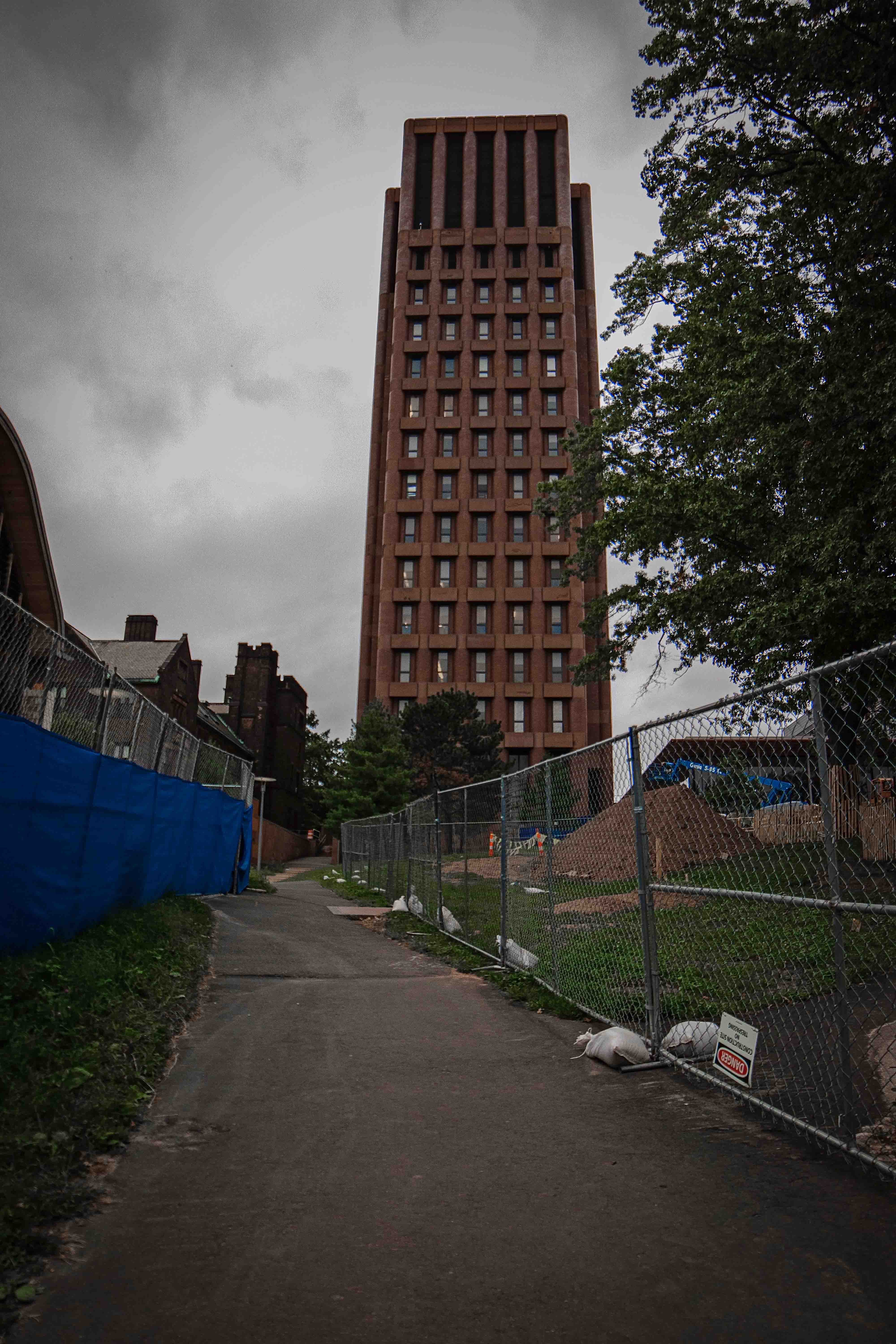
Designed in the mid-1960s by renowned modernist architect and Nazi sympathizer Philip Johnson, the tower was intended to command New Haven’s skyline and contrast with Yale’s prevailing Gothic Revival aesthetic. It was a monument to Yale’s scientific achievement and, briefly, the city’s tallest building. 

According to professor Joel Rosenbaum, who has been working in KBT since it was built, the tower has its problems.

“[It is] a tall, thin building where communication between floors is next to impossible,” Rosenbaum told the News. “The building was not built for science, but as an edifice to Philip Johnson himself.”

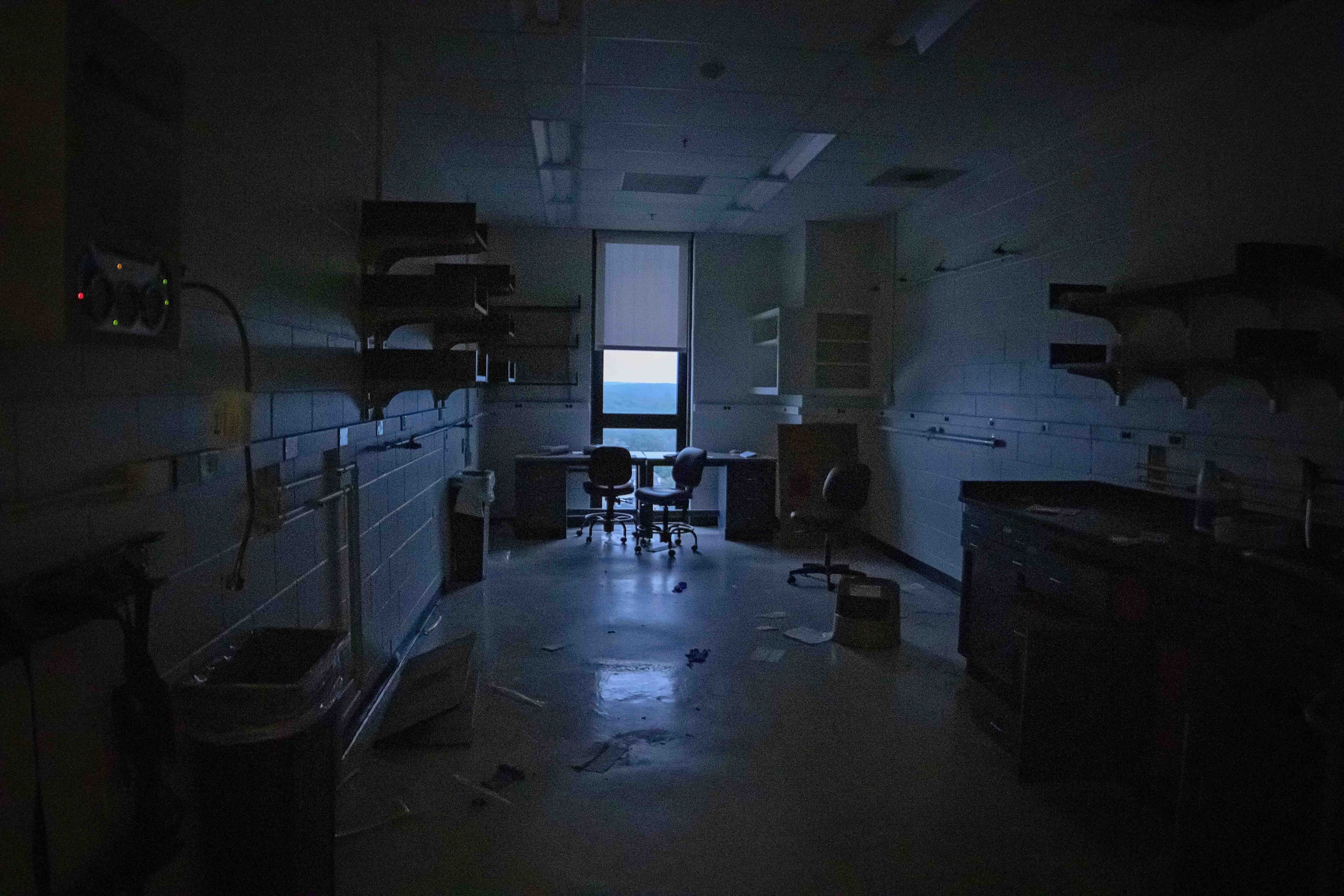
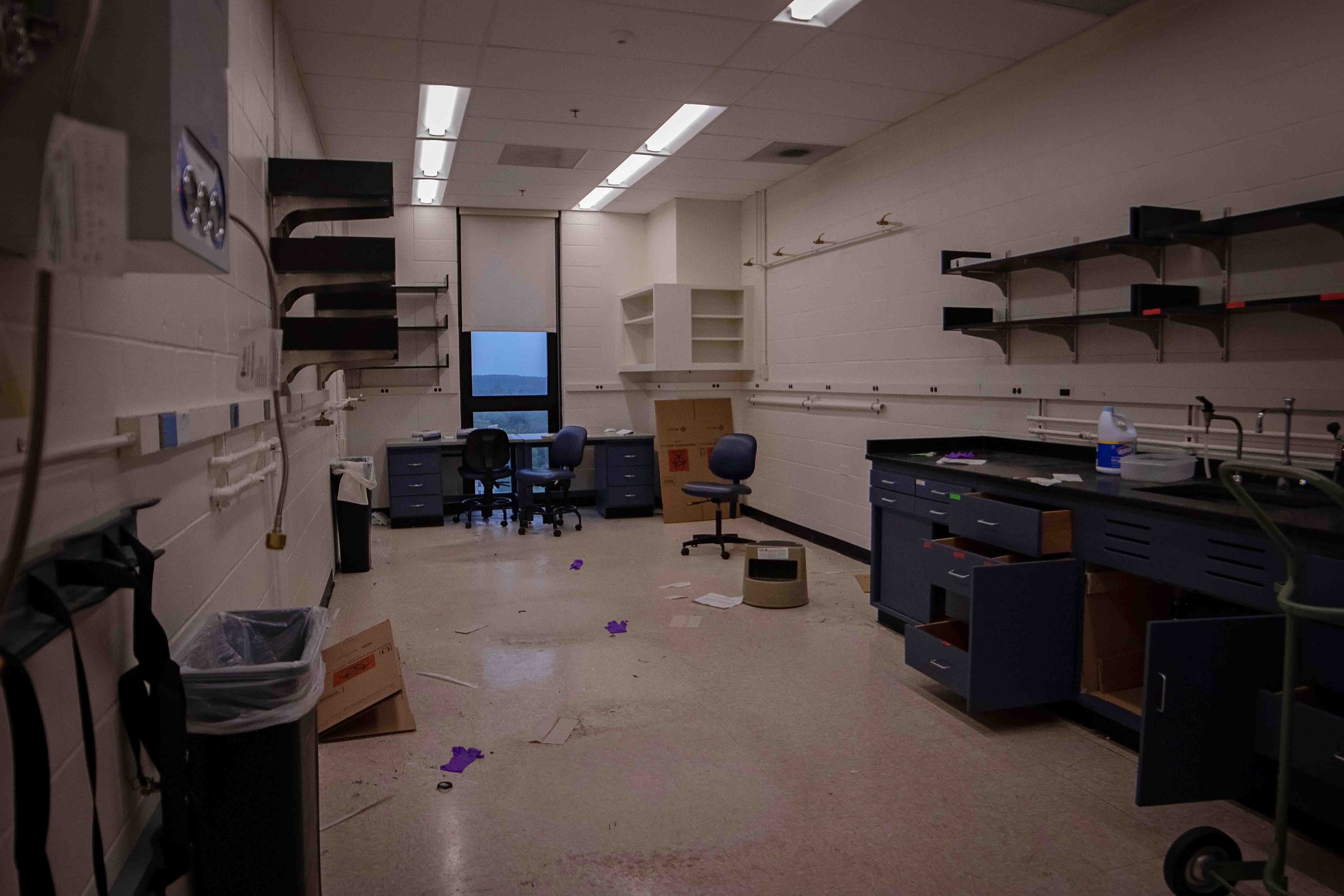
What lay inside KBT at the time of the fire was near-priceless: entire careers’ worth of carefully cultivated cells and custom-made reagents that would prove expensive to replace. Countless experiments were permanently preserved in freezers and incubators across the building — or so scientists hoped. Ph.D projects and endangered animals hung in the balance. Emergency power, they assumed, would kick in if a power outage were to happen.

But Dimitrova had been through too many emergencies to assume. Before coming to Yale, Dimitrova weathered Hurricane Katrina. Her lab lost power for three days but wasn’t impacted, she said. Later, at the Massachusetts Institute of Technology, her lab went dark for 24 hours. In both cases, none of her team’s research was affected, thanks to backup power.

At her previous jobs, she said emergency power was “a given.” But when she accepted an offer to work at Yale and explored her lab, she was surprised that KBT’s procedures didn’t measure up.

“I was shocked that nothing of what I had would be in any way protected in the event of either a natural disaster occurring or a malfunctioning of the electrical system,” she said.

As a junior faculty member, Dimitrova felt it wasn’t her place to question authority. But the thought of losing all her work to a preventable disaster pushed her to speak up, she said. At weekly meetings with a supervisor, Dimitrova remembers discussing the issue to no avail. “There’s no money,” she remembers being told. 

In fact, Dimitrova once tracked down an assistant provost at a cocktail party to ask him for improvements to the emergency power system. She remembers him laughing the request off, saying, “Yale never will.”
Marisa Peryer

The administrator referred the News’ request for comment to University spokesperson Karen Peart. Peart did not respond to questions regarding the discussion. Dimitrova said she did not keep records of her requests for additional power system improvements. But other scientists shared similar stories — and agreed that Yale wasn’t as prepared for a power outage as it could have been.

Scott Holley, who led a lab in the tower, blamed the lack of administrative action on the new Yale Science Building.

“Once the University realized we were moving out of KBT, they did not want to do more modifications for it,” he said.

The plumbing was also “terrible,” Holley said. Other scientists confirmed this, and spoke of frequent water leaks and weak, inconsistent air conditioning. Holley remembers his office reaching 85 degrees in the summer. But just one floor up, he said, the rooms would remain very cold.

Lucas Sanor GRD ’19 recalled noticing a hole in the window next to his desk in professor Craig Crews’ lab on the fourth floor. And in summer months, the heat was so extreme that he worried that his sweat would drop onto the specimens he was examining. 

Outside KBT

The evening of the fire, as the sun set over KBT, researchers like Giuseppe Militello weren’t focused on their dissatisfaction with the building’s maintenance. They just wanted to go back in. 

Hours past sundown, they still waited outside in the cold. With the firefighters came a hazardous materials crew, and the dark building — filled with expensive specimens and equipment — was closed to non-emergency personnel. What started in the basement of an aging tower had become a much larger crisis.

Militello, who works in Dimitrova’s lab, recalled that researchers began to worry out loud that night. “Okay,” he remembers someone saying, “I’m losing years and years of work.”

Militello could tell Dimitrova was nervous from her emails. She was on a bus headed to British Columbia and reception was poor. Their lab manager was in Boston. 

Then, at around 9 p.m., there was a rush.

Millitello, escorted by safety personnel armed with flashlights, finally climbed to his lab on the ninth floor and tried to stuff as many specimens as he could into each freezer. There wasn’t enough space, he said, and the dark floors could have been filled with nitrogen fumes from tanks like Bond’s — which, if inhaled, could make you faint. 

He could only save so much. The elevators worked, he said, which meant that movers could easily wheel freezers to other buildings. But time worked against him: Plenty of other scientists wanted to get in the building, too, and the movers were hard to locate on a Sunday night.

The building’s poor ventilation also posed problems. Without proper airflow, the blackout had raised the temperature in some of the rooms, killing animals and research materials that would prove hard to replace.

And when Sanor walked into his lab, he saw one of his axolotls — a critically endangered salamander species native to Mexico — laying dead in its enclosure. 

Sanor’s damaged axolotl embryos, central to his dissertation research, were arguably worse losses. They develop slowly and the regrowth process took weeks. “It’s not catastrophic,” he said, but “when you work for weeks and it just disappears, that sucks.”

Dimitrova’s worst fears were, in essence, confirmed: Emergency power didn’t save the day. Still, she remembers dozens of Yale researchers and movers working to save as much as they could from the building. By early Monday morning, rows of freezers stood in the basement of Sloane Physics Laboratory, full of critical research materials and finally connected to much-needed electricity. 

Yale Molecular, Cellular and Developmental Biology chair Vivian Irish, who served as the liaison between researchers in the building and the University administration, told the News that night that she was “cautiously optimistic” her team could move back by Wednesday. But it was too early to tell how much was lost, she wrote.

“Why the hell is that possible?”

Bond wasn’t the only one who didn’t hear fire alarms that day. According to him, and others across the tower, alarms on the fourth and ninth floors weren’t functional. 

But even if they had worked, he said, the alarms may not have gone off: KBT’s fire system was designed to only alert floors immediately surrounding the blaze in the event of a minor fire.

Yale Environmental Health & Safety advisor for the tower Josh Armstrong did not respond to several requests for comment on the fire system. Peart, the University spokesperson, denied accusations that fire alarms at Kline were nonfunctional. She wrote in her statement that KBT’s fire alarm system has since been reconfigured to evacuate all floors in the event of a fire due to faculty members’ concerns. The Office of the Fire Marshal had tested the alarms after the fire, she wrote, and found that the system “functioned properly, as it was designed, and is in good working order.”

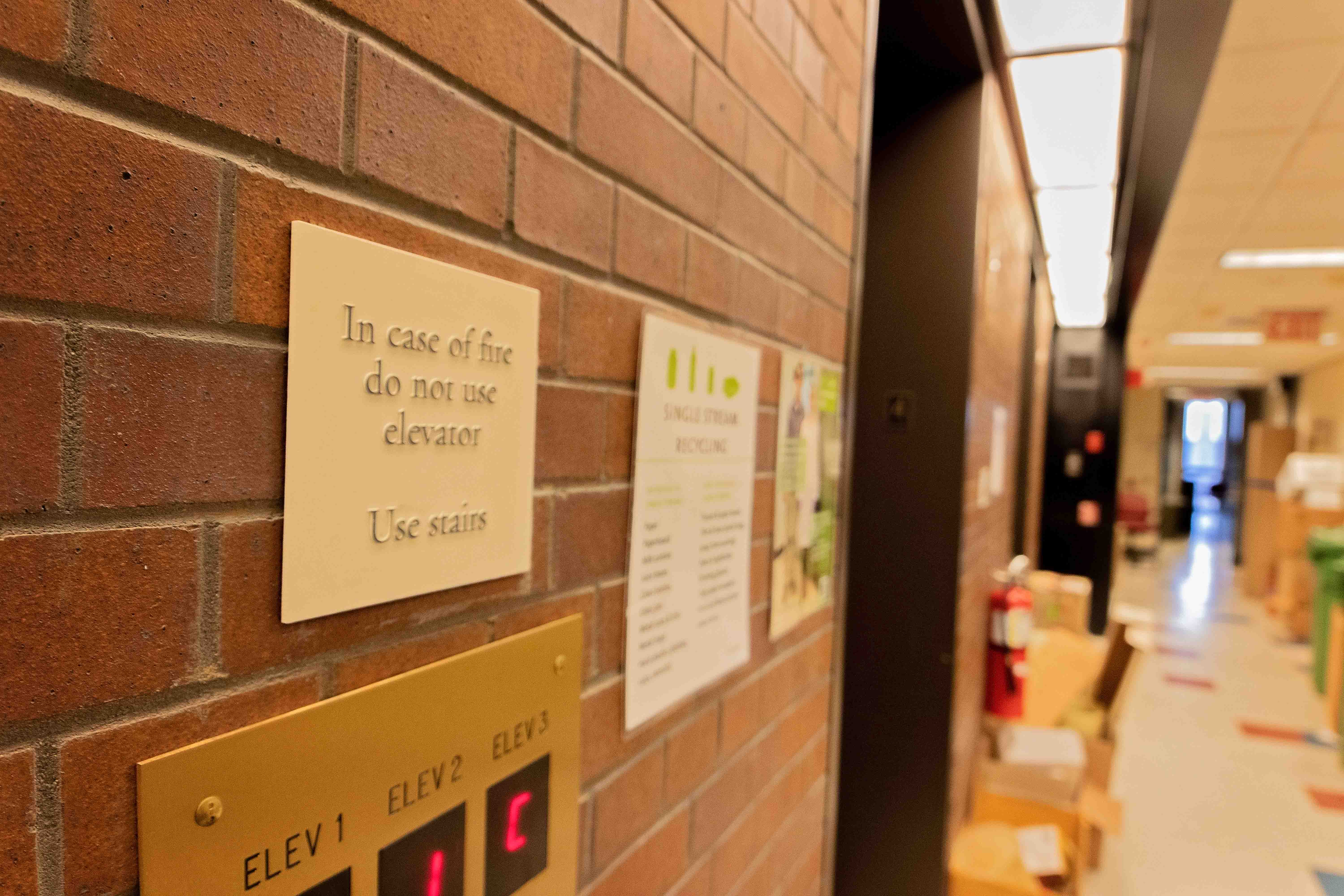
Scientists like Militello would later find that the emergency power they had assumed was present — and that Dimitrova knew was not — was hardly sufficient to handle the demands of an electrical fire. The elevators from the ground floor were working during the blackout, but the floors and their labs had gone dark. 

“Something I really did not understand was that we had no current in the building but the elevators were working,” Militello said. “Why the hell is that possible?”
Marisa Peryer

Dimitrova’s concern that there wasn’t enough emergency power turned out to be only part of the problem. The backup power in the building, said professor Thomas Pollard, came through the same transformer in the basement as the regular power. When that transformer burned, it knocked out both, he wrote in an email to the News.

“It boggles my mind that a university like Yale that invests so much in biological and biomedical research would not have [sufficient emergency power],” Bond said. “People could lose half to all their Ph.D. in a day. It’s a little scary to think about.”

The Recovery

The fire was just the beginning of the scientists’ woes.

Then came the recovery process.

Once evacuated, scientists were forced to deal with freezer failure and unconventional recovery methods for days until they were able to fully return to their labs. Pollard said power in his cold room failed twice after returning to the tower. 

Even though Pollard’s lab “did not lose irreplaceable materials at any point,” other scientists were not as lucky. Bond said emergency freezers in the tower’s 11th floor, which could be used in the event of a minor fridge breakdown, were stuffed with samples from several different labs — making inventory disorganized and difficult to sort through. Freezer units in Dimitrova’s lab were also scattered across buildings on Science Hill, delaying her work for “very, very long periods of time.” 

Researchers spent hours documenting and testing what they had — and what they didn’t — to determine what was salvageable. According to Bond, coordinating with the insurance company was difficult, tiring and time consuming.

Experiments that were months in the making had to be revived, replaced or redone, delaying research to the detriment of young scientists’ Ph.D. projects. For one graduate student in Dimitrova’s lab, this meant significantly limiting the scope of their project.

“Scientifically, of course, that also affected all of us,” Dimitrova said. Custom-made genetic sequences had to be relabeled and replaced before work in Dimitrova’s lab could resume. Work returned to normal about five or six weeks after the fire, she said.

In sum, the total damage to KBT’s labs reached the millions — the Crews Lab alone may have lost as much as $400,000 in precious antibodies, Bond estimated. 

“There is the element of loss that’s not easy to recover,” said Dimitrova. “You’ve lost a little bit of the excitement when you do it the second time.”

“What if?”

For Militello, who came to Dimitrova’s lab in January, the move to the Yale Science Building was a welcome change. Instead of a “dirty, old, ugly” tower, he said, the new location is sleek and clean.

Thanks to the insurance payout and $200,000 from the University, Dimitrova’s lab has bounced back from the disaster with enough money to hire new staff and replace what her team had lost, Dimitrova said. And in the Yale Science Building, the lab has an outlet connected directly to an emergency power system. Dimitrova made sure of it. But there’s only one, Militello said. “There should be more.”
Lukas Flippo


Peart wrote in her email to the News that improvements are to come. “We are confident that the YSB building has state of the art systems, and we are working with the faculty to place additional alternate power outlets in their YSB labs in an abundance of caution,” she wrote. “The fire impacted a number of investigators from our MCDB department. We regret that this happened and have worked hard to get the groups back to full operations.”

But original plans for the Yale Science Building mirrored KBT’s problems, including insufficient emergency outlets. According to Pollard’s recent email, the new cold rooms have none.

The move itself put a great disadvantage relative to her competitors in research, she added. And even though the Yale Science Building’s plans have been updated in response to scientists’ concerns, her worries remain.

“What if something else comes up, and I try to warn people and explain why that would be important for science and it’s not taken into account?” she said. Dimitrova thinks that the new building may not have sufficient emergency power if the fire didn’t happen.

“I definitely do not have the trust that our view as biologists is taken into account when making decisions,” she said.

From the windows of the new Yale Science Building, one can follow the dirt-brown columns of KBT floor by floor. First, there’s the ground-level cafe. Then, rows of laboratories, layered one on top of the other, much emptier than before. Finally, its summit, windowless and plain.

For Yale’s Astronomy Department, which will soon move into the skyscraper, the empty space presents a new opportunity to conduct research.

But for many of its former occupants, the building is a reminder of what was lost, of a loss that  could have been prevented. It looms over Science Hill as a makeshift mausoleum: Here lie cell cultures, DNA molecules and years of work. Here lies Ph.D. projects and views of the Atlantic.

Seven months after Bond stopped grading Biology 103 papers to evacuate from a building he didn’t know was burning, students taking this semester’s Biology 103 in the new Yale Science Building Marsh Lecture Hall followed suit. They gathered outside on Science Hill, cautiously optimistic. This time was different. There was a fire alarm, but there were no flames. Within the week, class picked up where it had left off. Business as usual. 

When the alarm rings again, will Yale heed it?

Lukas Flippo

Lukas Flippo

Credits

Powered by

Looking back:
When Yale students couldn't vote

Published on September 20, 2019

Last November, hundreds of Yale students and New Haven residents waited in line at City Hall in the hopes of registering to vote in the 2018 midterm elections. The hours-long wait forced many potential voters to give up on registration or be turned away, stirring up controversy about same-day registration in the Elm City.

But this was not the first time that registration workers managed a seemingly endless line of Yalies. In 1971, over 500 students queued half an hour before the registrar opened, attempting to vote in New Haven for the first time. Until a federal court’s ruling on Sept. 13 of that year — three days before the deadline to register to vote in a contentious mayoral primary — students in the city were effectively barred from participating in municipal elections.

Yale students were and still are separate from New Haven in more ways than one. As is true today, town and gown issues — such as Yale’s tax exemption and the University’s growing presence in the Elm City — played a defining role in local politics half a century ago.

While some things have not changed, today’s New Haven is markedly different. In 2019, the city is a Democratic stronghold — the Board of Alders has not had a Republican representative since 2011. But in the 1970s, the city, like the state, was relatively more conservative. In the 1972 and 1976 presidential elections, the Greater New Haven area voted for Republican candidates Richard Nixon and Gerald Ford, respectively.

Student enfranchisement became one among many democratizing forces in the politics of the time, challenging a conservative political machine and liberalizing the electoral process. Looking back, students’ legal fight for enfranchisement in the Elm City exemplifies how student activists have the power to enact real and sustained change in New Haven.

FROM THE CLASSROOM TO THE COURTHOUSE

In 1971, two Yale undergraduates enrolled in a course called “Law and Social Change” taught by Richard Abel. Before leaving campus, they wrote a final paper that catalyzed a series of court cases that ultimately gave Yale students the right to vote in the Elm City.

Joseph Rubin ’71 and Mark Lecinger ’71 did not plan on instigating the process that eventually took New Haven to court. But, when the pair learned that the city frequently refused to let Yale students register to vote on the basis of failed residency requirements, they interviewed dozens of graduate students — most of whom had been denied by the registrar — and wrote their final paper on the subject.

“We were only undergraduates, but we did some research on it, and it seemed to us that they [the city’s conservative political machine] didn’t want people with more liberal views registering to vote,” Rubin said in an interview with the News. Their decisions, Rubin continued, had “no rhyme or reason.”

With Abel’s help, they then took the paper to Yale Law’s Stephen Wizner, who ran one of the school’s legal clinics. In the months that followed, graduate students, Yale Law School professors and the Connecticut Civil Liberties Union combined their efforts to give Yalies the fundamental right to vote.

Rubin, who now serves as Assistant Deputy Attorney General in Connecticut, described the late 60’s and early 70’s as “a time of great social and political activism in New Haven and elsewhere.”

In 1969, the University welcomed the first women to Yale College, ending well over two centuries of single-sex undergraduate education. And two years later, Congress enfranchised 18-year-olds, responding to the Vietnam War-era argument: “old enough to fight, old enough to vote.”

The amendment became law on July 1, 1971, less than two months before Yale students would return to campus in the midst of a hotly contested mayoral election. The election — the first for which most students met the voting age requirement — would bring to light New Haven’s machine politics, the town and gown relationship and Yale students’ will to have a say in the Elm City. The legal fight for enfranchisement began with two dozen of those students.

THE INITIAL RULING

After Rubin and Lecinger brought their paper to Wizner, a clinic at the law school partnered with the Connecticut Civil Liberties Union to represent 24 student plaintiffs who sued the City of New Haven in federal court for denying them the right to register to vote.

On Sept. 13, 1971, Judge Joseph Blumenfeld ruled in favor of the plaintiffs. At the time, then-Secretary of State Gloria Schaffer deemed the case one of “national significance,” for it was the first time a federal court ruled on the issue of residency requirements for student voters.

The lawsuit charged the Elm City with discriminating against student voters by presuming students “not to reside at the place of their physical habitation” while not making the same presumption of other voters. Despite the fact that Yale students lived in New Haven for the majority of the year, the city did not regard them as permanent residents.

To vote in New Haven in 1971, applicants were required to be United States citizens, at least 18 years of age and city residents for at least six months. The plaintiffs claimed that the Board of Selectmen, New Haven’s voter registration authority, created excessively strict requirements for students, essentially preventing them from voting by forcing them to prove that they regard New Haven — and no other place — as their home.

The case, Kennedy v. Meskill, was originally brought before a three judge panel, as is required when challenging a state law, Connecticut’s definition of legal residency. Federal records of the case have since been destroyed, but the case is well-documented in newspapers from the time, and — through a series of interviews — the News has been able to reconstruct the narrative.

Early in the proceedings, the State of Connecticut determined that New Haven had been “misapplying the state [residency] statute,” and ceased its participation in the litigation, leaving the city to continue defending the case by itself. Immediately after this decision, two of the panel judges dropped the case, citing its local nature. This left the students’ fates in the hands of Judge Blumenfeld, who was nominated by President John F. Kennedy in 1961.

The students’ lawyers in the case included Richard Snyder, Eugene Sosnoff and Wizner, who is currently the William O. Douglas Clinical Professor Emeritus of Law at Yale Law School.

The case centered around the definition of permanent residency. Like most students, the plaintiffs possessed legal documents — such as drivers’ licenses and draft registrations — that used their parents’ addresses, and they often returned to their parents’ homes during academic breaks. The city argued that this made them transient residents and therefore undeserving of a say in municipal matters.

In an interview with the News, Wizner recalled a cross examination by Corporation Counsel Thomas Keyes Jr., the main lawyer representing the City. According to Wizner, Keyes asked each of the student witnesses to present their drivers’ licenses and requested that they read their listed addresses to the court.

In an interview with the News, Snyder recalled Blumenfeld’s warning to the counsel: “Mr. Keyes, you’re not a state trooper.”

In their redirection, the students’ lawyers asked whether the students intended to return to the addresses recorded on their licenses, to which they responded, “I don’t know.”

To Wizner and his team, the case boiled down to the legal concept of domicile — the place to which a person always plans to return. A person cannot have multiple domiciles, and because the students had no set plans to leave New Haven upon graduation, they were legally permanent residents, Wizner told the News.

In his final opinion, Judge Blumenfeld said that it appeared from the testimony that students “were subjected to a special line of inquiry,” including more extensive and discriminating questions than those asked of non-student applicants. He also noted that many rejected students had qualifications identical to those of non-students.

While the State of Connecticut did not issue an official position on the matter, then-Gov. Thomas Meskill expressed his opinion that students should vote in their parents’ hometowns. Then-Secretary of State Schaffer seems to have echoed this sentiment by ordering Connecticut towns to issue absentee ballots to college students, enabling students from the state to vote at home.

Ultimately, Judge Blumenfeld ruled in favor of the plaintiffs and ordered the City of New Haven to treat student applicants as it would any other prospective voters and to register the 24 plaintiffs as well as all others who met the deadline that Thursday.

THE ELM CITY’S REACTION

The ruling ignited a spirited debate in the Elm City. One resident submitted a letter to the New Haven Register accusing the ACLU of a “fishing expedition.” The author argued that by asking prospective student registrants to identify “anything out of the ordinary” in their registration processes, the organization was engaging in a “spurious, most unliberal attempt to entrap voter registration officials in wrong-doing.”

Another New Havener detailed a number of “considerations for the college voter” in a letter published in the Register. Chief among these was that “the privilege of voting, now as always, carries with it a wide variety of citizen obligations.” Judge Blumenfeld’s decision, the author continued, left questions surrounding these obligations — including jury duty, car registration and local property taxes — unsettled.

This letter touched on a theme central to the student voting debate and the impending mayoral primary: Yale itself.

Given the fraught town-gown relationship, Yale became a focal point of a contentious primary election, with incumbent Mayor Bartholemew Guida and the Democratic party organization linking his strongest challenger, “reformist” Democrat Henry Parker, with University interests. It was broadly believed that Yalies would support Parker — buses decorated with Parker stickers carried droves of students to the Hall of Records to register for the primary, and Yale English professor George Lord circulated a letter to his colleagues encouraging them to vote for the challenger.

Attorney Edward Reynolds, Guida’s campaign manager, told the Register that “the student voter movement is the end result of the ultra-liberal university community’s attempt to knock out Guida since he has taken Yale to task on the tax issue and sponsored zoning changes which restricted its land acquisition.”

In the late 1960s and early 1970s, Yale was magnifying its presence in the city, buying more property on Chapel Street and planning to construct two new residential colleges — today’s Benjamin Franklin and Pauli Murray. As a consequence, the University reduced the proportion of city property eligible for taxation. Per the Connecticut Constitution, Yale enjoys a tax-exempt status and instead makes an annual voluntary payment to New Haven. Today, that payment amounts to about $11.5 million per year — only a $2.5 million increase from what Mayor Richard C. Lee requested in lieu of taxes fifty years ago. According to current Mayor Toni Harp, if Yale paid property taxes, it would owe the city $194 million today.

While the University’s fiscal relationship to the Elm City has always been a point of contention, it took on new meaning when Yale students gained the right to vote. This enfranchisement, many city residents and local politicians charged, was an instance of representation without taxation.

Candidates for the Board of Alders, New Haven’s legislative body, were among the most vocal objectors. Democratic Ward 23 candidate Stanley Rogers claimed that black property owners and tenants already pay the price for Yale’s tax immunity and that the University’s students, for all their support of lavish appropriations, “would not be around to pick up the tab for the heavy taxes that such programs would require.”

Joseph Carbone, chairman of Students for Guida, pointed his finger at Yale faculty, whom he charged with trying to dictate voting — and thereby exacerbate an already-burdensome taxation program — rather than trying to eliminate the University’s practice of free riding.

The rhetoric became, at times, quite heated. Samuel Kropp, Democratic candidate for Ward 28, contended that students are vocal in their demands but not in their offers to contribute to city finances. He also called their residency claims into question despite the federal court’s decision. If students are in fact residents of New Haven, he said, “their ability to make themselves invisible during the summer months should be patented.”

There was, however, another side to the debate surrounding residency and representation. As noted in a 1971 issue of the Yale Law Journal, the U.S. Census Bureau decided in 1950 to count students as college-town residents rather than as residents of their parents’ towns. This had significant implications for legislative apportionment that played out on the national stage — by 1964, 43 states included out-of-state students in their populations for apportionment purposes — as well as in the local arena.

In 1971, each of New Haven’s alders represented approximately 4,600 residents. Given that Ward 1 housed 3,800 Yale undergraduates, the alder for this ward represented only 800 bona fide, voting “residents.” As a result, Ward 1 residents enjoyed almost six times the voting power of residents of all other wards, which were populated by 4600 voters and no Yale students.

The issues were not clear cut, but there were clear sides. Students found allies in reformist Democrats who anticipated benefitting from their votes. Meanwhile, members of the party machine, including Mayor Guida himself, opposed potential enfranchisement. The debate over Yale students’ right to vote that was not just one about registration, but rather one over the role the University plays — and the one it ought to play — in the Elm City.

NEW HAVEN’S FAILED LEGAL RESPONSE

Following Judge Blumenthal’s initial ruling, the case was as unsettled as residents were.

On Wednesday, Sept. 15 — a day before the deadline to register to vote in the primary election — the City of New Haven appealed the decision to the U.S. Second Circuit Court of Appeals in New York. Corporation Counsel Thomas Keyes Jr. argued that federal courts do not have jurisdiction in local elections, citing the Supreme Court case U.S. v. Arizona, which established that 18-year-old voting provisions were constitutional and enforceable when pertaining to federal but not local elections.

His attempt fell flat almost immediately. The three-judge panel dismissed the case before hearing the ACLU’s rebuttal, leading Sosnoff to remark to the Register, “This must have been one of the shortest court sessions I have ever seen.”

Sosnoff was the only one of the students’ main lawyers to witness the session. In an interview with the News, Snyder reminisced about a delayed train that left him and Wizner “huffing and puffing and running into court” only to be told by the chief judge that their arguments would be unnecessary.

The two joined a defeated Keyes for their train ride back to New Haven.

The circuit court’s dismissal affirmed Judge Blumenfeld’s earlier decision that the Elm City could not ask student applicants any questions beyond those asked of all prospective voters. Keyes interpreted Blumenfeld’s ruling to mean that the registrar could ask detailed, personal questions to student applicants — provided that those same questions were also asked of everyone else.

On Wednesday morning, before the appeal was dismissed, Keyes had instructed the registrar to ask all prospective voters a list of 13 court-approved questions. At 2:40 p.m. that day, he doubled the list and required that the new questionnaire be administered on paper rather than orally.

In addition to 22 other queries, applicants were asked whether they regarded New Haven as their home, whether they had claimed any other addresses in the past six months, whether they or their spouse own a car registered or taxed in another city, and where they are registered for the draft, if applicable.

According to Keyes, even if a student regarded New Haven as their home, they were not entitled to vote if any of their other responses indicated ties to a different jurisdiction. The Yale students and their lawyers criticized Keyes’ questionnaire as inconsistent with the spirit of the law.

“The questionnaire is unreasonable and is burdensome on the registration process,” Sosnoff told the Register in 1971. “Further, it operates as an English literacy test and hurts groups like Spanish-speaking people.”

Keyes, defending his 26 questions, told the News at the time, “We have never quarrelled with the contention that anyone who makes New Haven his home for six months or longer is entitled to vote. These questions are simply designed to find out whether this is permanent residence or not.”

TROUBLE AT THE POLLS

At the very least, Sosnoff was correct about one thing. The questionnaire was undoubtedly burdensome, increasing the time to process a registration application from mere minutes to over an hour. With a line that began forming outside the Hall of Records half an hour before it opened on Sept. 16, 1971, the registration deadline, this time increase was significant.

Progressive candidate Parker’s backers claimed that Keyes drew up the questionnaire to harass prospective student voters. Registrar workers responded with a similar accusation.

“It’s the Parker workers,” a Board of Selectmen spokesperson told the Register at the time. “They’ve disrupted our attempts to help people, they’ve called the ladies here MFers, and then they charge us with harassment.”

More than 1,000 new voters registered on Thursday, and more than half of them were Yale students. On Sept. 21 — just one day before the primary — over 100 students received notices informing them that their applications had been called into question on the basis of failed residency requirements. Deputy Town Clerk Sal Franco told the News that the Board of Selectmen invited applicants with only a driver’s license from outside of New Haven to return for further questioning, but outright rejected those applicants with both a driver’s license and draft registration outside of the Elm City. Of the 114 invited to return, 56 showed up on election day and were added to voter rolls.

Those 56 voters were a minority among their peers. Five-hundred-nineteen students who met Blumenthal’s qualification standards attempted to register; of these, 309 — or 59 percent — were rejected. Only 32 of the more than 1,000 non-student applicants met a similar fate.

The students’ lawyers criticized the city for engaging in illegal disenfranchisement. Eighty-one percent of rejected students were turned down on the grounds of out-of-state drivers’ licenses, while more than half of similarly situated non-students were accepted. Blumenthal’s opinion had specifically ruled out drivers’ licenses as a permissible justification for rejection.

“The procedures read like a Southern voting case with blacks in the early 1960’s,” Sosnoff told the Register. “They were clearly discriminating against students.”

The plaintiffs’ legal team charged the Elm City with contempt and moved for supplementary relief. They sought to compel the city to allow students who had been denied registration to vote after the polls closed. That day, Federal District Court Judge Robert Zampano signed an order directing the City of New Haven to provide reasons why it should not be charged with contempt of Judge Blumenfeld’s order, which required the city to register students who demonstrated a clear intent to reside in New Haven. A hearing for the issue was set for Sept. 30.

THE PRIMARY AND THE MACHINE

In the meantime, New Haven witnessed the end of a fierce three-way contest for the city’s top office. The 1971 race featured incumbent Mayor Bartholemew Guida and his two challengers, community organizer Parker and labor leader Vincent Sirabella. Guida, who emerged victorious, remarked that the primary was unlike anything he’d experienced in his 35 years of political life.

In essence, it was a competition between reform Democrats — led by Parker — and the party establishment. Guida’s administration had been marred by scandal and his challengers liberally used words like “graft,” “corruption,” and “bossism” to describe his tenure. In the general election, Republican candidate Paul Capra would decry the mayor and Democratic Town Committee chairman Arthur T. Barbieri as the “Barbeiri-Guida Machine.”

Guida ran on his prior record of preventing the collapse of urban renewal programs sponsored by the federal government and managing a volatile political environment in the Elm City. He also cited efforts to address the “nagging problem of what to do about large tax-exempt institutions in our midst which receive all the essential municipal and protective services without contributing their fair share towards the cost of that service,” clearly referring to the University.

Parker, who finished second to Guida in the 1969 mayoral contest, built his campaign around four key issues — economic development, education, Yale’s role as a “city within a city” and taxation — as well as voter registration efforts. His campaign registered nearly 5,000 voters in advance of the primary election.

Guida’s campaign also pushed for voter registration, but unlike Parker, it did not concentrate on the recent additions to New Haven’s electorate.

“If we don’t [turn out]” Guida’s campaign manager warned, “the university-student movement may, ironically, teach New Haveners their first lesson in the politics of the 1970s.”

Indeed, Parker was the clear favorite among Yale students and faculty, and managed to flip Ward 1, which houses the majority of the University campus. Just two years earlier, he lost the ward and the primary to the Mayor. While Parker did not go on to win the day in 1971, reform Democrats captured 11 seats on the Board of Alders.

The relationship between Guida’s campaign rhetoric, the Elm City’s machine politics and the Board of Selectmen’s rejection of student applications was not lost on Wizner.

“They [the selectmen] seem to be thinking, ‘let’s win the election and then worry about the judge’s order,’ which is disgraceful,” Wizner told the News.

THE PUBLIC DEBATE CONTINUES

The Sept. 30 proceedings did not go the students’ way and their motion for contempt was denied, according to the court docket. As such, no student votes were added to the election totals. However, even if they had been, Guida’s margin of victory was too broad for the student vote to have made a difference.

The court did, however, affirm that the Board of Selectmen was prohibited from rejecting any of the plaintiffs or similarly-situated applicants except upon “clear and convincing evidence of non-residency.” With the primary election in the past, the students turned their attention to an Oct. 9 deadline to register to vote in the 1971 general election on Nov. 2.

In response to a letter published in the New Haven Register encouraging students to vote in their hometowns, graduate student Joseph Minarik submitted his own letter criticizing the “paternalistic attitude of college town people for students, which can best be expressed as ‘we’ll take your money in our stores and for rent, but try to vote.’”

The original letter, entitled “Should Vote Absentee,” expressed a fear that college voters would upset the “political balance” of the Elm City. In repudiation, Minarik cited a Supreme Court ruling that disenfranchising segments of the population based on how they may vote is unconstitutional.

A MAYORAL RACE IS DECIDED — THE COURT CASE ISN’T

The debate, rampant in city newspapers, also continued in the courtroom.

After several hours of litigation on Oct. 6, Judge Blumenfeld ruled that the proceedings — which focused on the 26-question form — had become “too repetitious.” He ordered the plaintiffs to return only when they had collected all the facts.

Wizner and Charles Kleinberg GRD ’72, a third-year graduate student, drew up a summary on Oct. 7. Kleinberg told the News that they were trying to prove “a systematic bias, or any type of bias” against prospective student voters. They specifically cited the case of two Jonathan Edwards students, both of whom had out-of-state drivers’ licenses, out-of-state parents and Jonathan Edwards College recorded as their New Haven address. One of these students was able to register for the primary election, while the other was not.

Fifty-nine percent of qualified student applicants were rejected, as compared to less than three percent of non-students. New Haven’s Board of Selectmen judged the majority of rejected student applicants by standards — specifically, out-of-state drivers’ licenses — which were ruled illegal in September.

Neither the News’ nor the Register’s articles indicate that students experienced significant difficulties in registering for the general election. The general was also marked by increased voter mobilization efforts as students and city officials organized registration drives on Yale’s campus and throughout the Elm City.

The race featured Guida and Republican Paul Capra, who criticized, among many things, the Guida administration’s “lackluster” efforts to tax currently exempt property like that of the University.

Guida did, however, meet with members of the Yale Corporation in October to discuss the University’s financial relationship with the Elm City. At the meeting — the first of its kind since 1937 — Yale administrators acknowledged that tax exemption poses a legitimate financial problem for New Haven and Guida urged the institution to “recognize [its] responsibilities to the urban center in which [it is] located.”

Parker, the overwhelming Yale student favorite in the primary, endorsed Capra. The Republican hopeful called on young people, including Yale students, to make their voices heard in the general election.

“The big question facing us at this moment is whether the [26th] amendment is merely a paper tiger — a bone thrown to the wind in the hopes it will go unused,” he said at a campaign rally. “The majority of legislators who passed this amendment are undoubtedly certain that youth will register and participate in no greater numbers than the majority of their elders, who are content to let the few do the job of the many.”

Ultimately, this call to action was not enough. Guida handily won the election by a margin of 5,815 votes, and the Democrats gained five seats on the Board of Alders. Fifteen minutes after polls closed, a disappointed Capra sighed and whispered, “They’re unbeatable.”

Guida would go on to serve another two terms as mayor until, in 1975, the New Haven Democratic machine took a hit with the election of reformist Frank Logue, who served as mayor of the Elm City from 1976 to 1979. Guida died by apparent suicide in 1978.

THE RIGHT TO VOTE, SECURED

Kennedy v. Meskill was finally closed on April 28, 1972 — 228 days after the initial ruling.

The same year, the Supreme Court ruled that durational residency requirements — like New Haven’s six-month requirement — violate the 14th Amendment’s Equal Protection clause. Six years later, the Supreme Court ruled that denying students the presumption of residency afforded to other prospective voters violates the Constitution.

This year marked the 24th mayoral primary in which Yale students were eligible to cast a ballot. In 1971, over 500 students attempted to become New Haven voters in the three days between the court’s initial ruling and the registration deadline for the fiercely contested primary election.

In contrast, a mere 106 people voted in Ward 1 last Tuesday for this year’s tight race between Mayor Toni Harp and progressive challenger Justin Elicker SOM ’10 FES ’10. Ward 1 is the only district which has an overwhelming Yale-student majority as it encompasses eight of Yale’s fourteen residential colleges, as well as Old Campus.

Yale students’ right to vote is the culmination of a hard-fought legal struggle. Nearly 50 years have passed since Rubin and Lecinger originally interviewed Yale students who were denied that right. Theirs was a simple idea: New Haven students are New Haven citizens.

Editor’s Note: Research for this article was primarily conducted via Yale Daily News and New Haven Register archives from 1971. News archives have been digitized and are published online through the Sterling Memorial Library. New Haven Register archives can be accessed on microfilm at the New Haven Free Public Library. Court records of Kennedy v. Meskill have been destroyed, but a limited docket is available via the Federal Records Center.

Life after suspension:
A look at Yale’s protocols

Published on September 18, 2019

The first day of class in fall of 2018 was a reunion of sorts for many members of the prestigious Brady-Johnson Program in Grand Strategy — a selective two semester-long course that studies challenges of statecraft, politics and social change.

While most students knew one another already from the spring semester, anyone who had taken time off from Yale was new to the group.

One such student explained to the class that his sojourn from Yale was spent on a gubernatorial campaign.

But another classmate recognized this student, not for his accomplishments nor for his leadership positions on campus. Instead, she recognized him as the student who had been suspended and barred from campus for sexual misconduct.

She contacted other Yalies to report what she knew. She reached out to the director of the Grand Strategy Program, history professor Beverly Gage, who said she had been unaware of the allegations until earlier that morning. Gage promised to look into it and emphasized that she takes these matters seriously, according to an email obtained by the News.

But by the time the semester had begun, the class’ roster proved more or less finalized. Regardless of the suspension, Yale allowed the student to remain in Grand Strategy. The News has decided not to name the student found responsible for sexual misconduct given that he is not a public figure on campus and will instead refer to him as Tyler.

Per University policy, a suspended student is allowed to participate in all the academic offerings on campus once they return, according to an email from Gage obtained by the News. Gage declined to comment on the specifics of her dealings with Tyler and other students in the class. When a News reporter called Tyler to ask for comment, he hung up the phone immediately after she identified herself as a reporter. He did not respond to requests for comment over email or Facebook messenger.

As alleged perpetrators readjust to life on campus, the Yale community is forced to grapple with how, in the classroom and in social spaces, it will continue to hold its members accountable.

Several students were upset by Tyler’s presence in the course, which involves intense group work and a number of dinners with an open bar. One student, who preferred to stay anonymous for fear of retribution, told the News that in conversations with Title IX administrators, their message to her was clear: They would not even meet with Tyler to discuss the possibility of taking another course or modifying his participation in Grand Strategy.

“They said they had to be careful and couldn’t even meet with him to discuss it because they didn’t want him to feel uncomfortable,” the student said. “But I wondered — whose discomfort is being prioritized here? There were survivors of sexual assault in the class, who were uncomfortable attending dinners at an open bar with a student found responsible by Yale to have committed penetration without consent. What about our discomfort?”

FROM SPRING FLING TO GS

During Tyler’s sophomore year, he took time off to deal with his mental health, according to a source close to the individual who filed the complaint against Tyler. But despite his first leave from campus, Tyler still made appearances at Yale to visit friends — including members of his fraternity, Sigma Phi Epsilon. He attended Spring Fling in 2016 — the weekend of the alleged sexual assault, according to the source close to the complainant.

The complainant does not want to be interviewed for this story, according to the source. The News could not obtain documents from the University-Wide Committee on Sexual Misconduct — a body composed of students, faculty and administrators that addresses sexual misconduct complaints across the University. But two sources with knowledge of the situation — the source close to the complainant and the anonymous Grand Strategy student who spoke to Title IX administrators — corroborated that Tyler had been at the center of a sexual assault allegation.

The complainant initially filed an informal complaint with the Title IX office. Such procedures often mean that the individual can pursue boundary arrangements to limit contact with an alleged attacker. The individual later filed a formal complaint during the 2016-2017 academic school year. Towards the end of the spring semester, the UWC found Tyler responsible for penetration without consent, according to the source close to the complainant. But the UWC did not immediately announce the corresponding punishment.

“It’s very unusual for them to announce the punishment and the verdict separately,” said Helen Price ’18, founder of United Against Sexual Assault at Yale.

She added that the committee may have done so in order to allow Tyler to complete his semester, so he could receive credit for his work, including his completion of the first semester of Grand Strategy. In an email to the News, Yale spokesperson Karen Peart said that once the UWC panel provides its decision to the parties involved, decision-makers generally issue the verdict — determining if a violation was committed and if so, what the penalty should be — within seven days.

Tyler was suspended from campus for the following academic year, effective fall of 2017. According to his LinkedIn, he spent his year away from the University working in consulting and as a campaign manager.

In addition to the student who first recognized Tyler, the source close to the complainant also emailed Gage on Sept. 6 to express concerns for students in the class who had already voiced dissatisfaction with Tyler’s presence. The individual said several students worried for their safety, as well as Tyler’s ability to “be a part of Yale’s most prestigious program, one that is intended to groom future leaders.”

“One of the students who has been re-admitted to the Grand Strategy program, [Tyler], has just returned from a year-long suspension from Yale for raping another student,” the source wrote.

On Sept. 9, Gage followed back up with the student.

“The university’s policy is that students who return to campus are considered full members of the Yale community, with the right to re-engage all educational opportunities, including selective programs such as GS,” Gage wrote.

Several students in the class were dissatisfied with this response, calling for Tyler’s removal from the class or that he complete GS as an independent study.

The anonymous student said she met with Title IX administrators, who seemed more concerned with protecting Tyler rather than students in the class.

“Title IX accommodations primarily address the needs and rights of complainants and respondents,” wrote Vice Provost for Health Affairs and Academic Integrity Stephanie Spangler in an email to the News in response to the anonymous student’s criticism. “That said, the Title IX coordinators are also available to all members of the community, even if they are not party to a particular case, to understand their concerns and explore possible ways to address them.”

Tyler did one of the three mandatory assignments for that semester — the briefing group assignment — on his own. Still, he attended GS dinners throughout the semester. In the fall of 2018, Grand Strategy offered six dinners — three of which were mandatory. The two anonymous sources — the GS student and the person close to the victim — told the News that one student in the course abandoned the events altogether because of Tyler’s presence. The final module is a crisis simulation, in which some students act as Presidential cabinet members, dealing with a crisis. Individuals receive mock roles to play for the assignment. Tyler was designated Senate majority leader.

“This was the semester of the Kavanaugh hearings,” the anonymous student said of the casting. “So at least the simulation was realistic.”

WHAT HAPPENS ONCE SUSPENDED

When a student who has been suspended returns to campus, they may have restrictions placed on their leadership opportunities, depending on specific organizations’ rules. SigEp, the fraternity Tyler was a member of, declined to comment on specific cases. But Jeremy Uys ’21, president of SigEp, said suspension from Yale for sexual misconduct would result in expulsion from the fraternity, and the two anonymous sources — the anonymous student and the source close to the complainant — told the News that Tyler was, in fact, expelled from the frat.

According to Facebook posts and his LinkedIn, Tyler had also served as a member of the Black Men’s Union’s leadership prior to his suspension. Current president of the BMU, Cameron Luther ’21, also said that he cannot discuss individuals and the particulars of sexual misconduct cases. The organization’s constitution regarding membership requirements, which has been in place since their creation in 2007, states that officers who leave Yale College for longer than a semester for any reason must withdraw from Board. But if a student violates the University’s regulations, the individual cannot regain their leadership position or even membership.

Still, the anonymous student and the source close to the complainant told the News these restrictions do not extend to academics, even for, at the time, prestigious programs like GS.

The University would only inform a professor of a student’s record of sexual misconduct if the faculty member had “legitimate educational interest,” as defined by the Family Educational Rights and Privacy Act. Peart said this reasoning could allow the University to share such information with a professor if the complainant and respondent were together in that faculty member’s class.

Price, who has met with administrators and members of the Title IX committee on numerous occasions, said the University rarely expels students for sexual misconduct. Recent exceptions include Saifullah Khan, expelled in 2019 for sexual assault, and Jack Montague, expelled in 2016 for penetration without consent.

While the requirements for reinstatement are clearly outlined for students who withdraw from Yale for medical, personal and academic reasons, the same cannot be said of students suspended for misconduct, sexual or otherwise, who wish to return to campus.

For medical, personal or academic withdrawals, Yale clearly delineates procedures for applicants seeking reinstatement. These students must carry out an interview, which may be in-person or via Skype, with the chair or another member of the Committee on Reinstatement, should the chair be unavailable. The chair has conducted all such reinstatement interviews over the past two years. They must also submit a personal statement, typically 500-700 words in length, explaining the circumstances leading up to the withdrawal, an account of the student’s activity since then and why the student wants to and feels prepared to return to Yale. Submitted with this statement is a reinstatement application form. All students must submit two letters of support from “instructors or other professionals,” and students who withdrew for medical reasons must also obtain a letter from a health professional.

But in the case of reinstatement after suspension for sexual misconduct, the procedures are thinly explained.

Peart said the reinstatement process is “the same for all students, regardless of the reasons for leaving.” She added that when a student is suspended and a reinstatement application is required, the Committee on Reinstatement can reach out to the disciplinary body that imposed the sanction for more information on the reason for the penalty. They may also consult academic records or withdrawal records for students looking to apply for reinstatement.

If the respondent is an undergraduate, the decision-maker, the dean of Yale College, may also deem that fewer or more requirements are needed on a case-by-case basis.

“All situations are unique,” said Peart when asked what the reinstatement process entails for students suspended for misconduct. “Suspension may require application for reinstatement, training or other imposed conditions that must be met in order to return to the university.”

In the Yale College Undergraduate Regulations 2019-2020, the rules do state that “suspension may require petition for reinstatement,” but, unlike for returns from withdrawal, they do not share specifics of what this petition entails.

In the application for the 2019 program, Grand Strategy added a “Disciplinary History” question. The prompt requests students to provide information concerning any “penalty of probation, suspension or expulsion,” incurred either at Yale or at another college or university. According to the question, students must email Gage directly to indicate that the penalty incurred, what disciplinary body imposed that penalty and a description of the misconduct. The prompt states that this information “will be considered in the context of your entire application.” According to Gage, the Yale general counsel’s office advised the Grand Strategy program on “the wording and scope of the query.” The Office of the General Counsel did not respond to a request for comment, instead redirecting the News to Peart, who had no further comments on the matter.

“We added this question to ensure that we have a complete understanding of applicants’ records,” Gage wrote in an email to the News. “Any disciplinary information will be considered in the context of a holistic review of a student’s full application.”

To Price, Yale’s willingness to grant full academic privileges to those found responsible for sexual misconduct is just another example of the University’s pursuit of self-preservation and self-interest over all else.

“It really speaks to their priorities,” Price said. “My years of experience of Yale dealing with sexual misconduct is that they would rather not hear about it, and if they do hear about it, they are going to try and create an outcome that is best for Yale, not the victim.”

New Haven and lead:
What has the Elm City done to combat its lead crisis?

Published on September 9, 2019

When Nyriel Smith was two, her mother began to notice troubling changes in her behavior. It was how Nyriel interacted with language, Nichelle Hobby said, that alerted her to the fact that something was wrong. It wasn’t that Nyriel was mispronouncing certain words but rather that she seemed to be forgetting what they meant entirely.

“It’s like, I can tell her ‘hey, can you get your towel?’ And she looks at me like, ‘Towel, okay.’ And walks past the towel,” Hobby said.

In July 2018 — about four months after Hobby first moved into the apartment — a blood test detected elevated levels of lead in Nyriel’s blood. According to Hobby, prior to the move, Nyriel had a normal blood lead level. Hobby said she notified her landlord about Nyriel’s blood test but was shut down and told there was no lead in the apartment. Over the next several months, Nyriel’s blood lead levels fluctuated. In February 2019, she tested at 11 micrograms per deciliter of blood, 6 micrograms higher than the Centers for Disease Control and Prevention reference level of 5 µg/dl. This reference level identifies children “who have been exposed to lead and who require case management,” according to the CDC website.

“There is no purpose for lead in the body,” said Mellisa Pensa, a pediatrician in Fair Haven and the associate program director of the Yale School of Medicine’s Occupational Health & Environmental Medicine Program.

In children, exposure to even small amounts of the toxic metal can cause neurological problems, drops in IQ, behavioral issues and learning disabilities. And the damage caused by lead accumulates over time — it doesn’t simply go away when a child is removed from a hazardous environment. Hobby said she’s noticed that as Nyriel, now three, has gotten older and talks more, she “still doesn’t really have a clear complete sentence too many times,” she said.

In 2015, the water crisis in Flint, Michigan drew national attention to lead poisoning after lead from the city’s pipes seeped into the city’s water supply. But in New Haven, the primary source of lead is from lead-based paint.

Years ago, paint manufacturers started adding lead to paint in order to make it brighter and more durable, said Carl Baum, a Yale pediatrician and the director of both the Yale Lead & Healthy Homes Program and the Center for Children’s Environmental Toxicology. Lead paint was not banned in the U.S. until 1978. According to Baum, houses built prior to that year are assumed to have lead-based paint until proven otherwise.

Like much of Connecticut, New Haven has an older housing stock. Old houses with deteriorating paint — paint that is chipping, peeling, or otherwise damaged — are more likely to be dangerous. According to the U.S. Environmental Protection Agency’s website, lead-based paint also has the potential to be hazardous when it is present on surfaces children can chew, like window sills or door frames. And when houses with lead paint are improperly or incompletely remediated, lead can settle in the soil, spreading further harm.

“Lead dust,” Baum said, “is very environmentally sticky.”

Furthermore, children are more vulnerable to lead poisoning than adults. This is partly because they are built to absorb metals like calcium for their growing bones, Pensa said. Their bodies cannot distinguish between a metal like calcium and a metal like lead, so children absorb lead at a higher rate than adults do. Additionally, developmental behaviors — like children’s tendency to put their fingers in their mouths — put them at higher risk of exposure.

Children with elevated blood lead levels are not treated medically until they reach 45 µg/dl, nine times the CDC’s reference level. Traditionally, prior to that level, doctors recommend removing the child from the harmful environment — but this environment is almost always their home.

“The problem starts in housing, and the solution starts in housing,” Baum said.

THE LEAD WAR IN THE ELM CITY

Currently, New Haven’s lead ordinance defines lead poisoning as 20 µg/dl or “any other abnormal body burden of lead as defined by the Center for Disease Control and Prevention.” Since 2012, the CDC has used a reference level of 5 µg/dl to identify children whose blood lead levels are “much higher than most children’s levels.” Prior to last November, the New Haven Health Department had inspected the homes of children with blood lead levels above 5 µg/dl.

Nyriel is one of two plaintiffs — the other is a 5 year old named Muhawenimana Sara — who represent a class of what Marx estimates is about 300 children in New Haven: children under six whose blood lead levels are between 5 µg/dl and 20 µg/dl. The class-action lawsuit that Marx and her team at New Haven Legal Assistance Association filed this May alleged that New Haven’s health department stopped inspecting and ordering abatements for the residences of children who tested below 20 µg/dl.

The difference between 5 µg/dl and 20 µg/dl is significant, Marx said. She estimates that in New Haven, there are about 300 children like Nyriel — children at or under age 6 with blood lead levels over 5 µg/dl but below 20 µg/dl. At 20 micrograms, that number drops to 12 children. “The New Haven Health Department’s dropping the ball on over 200 children,” she said.

Prior to filing the lawsuit, Marx said, “we sort of knew that [these inspections weren’t] happening, but we didn’t know it was a concerted, determined policy decision.”

In 2009, the Connecticut state legislature mandated that all children between nine and 36 months old be tested annually for lead exposure. The Connecticut State Department of Public Health is notified every time a child tests with an elevated blood lead level in both a finger prick and a venous blood draw. The department then reports all blood lead levels above 5 µg/dl  back to the New Haven Health Department, which receives a computer notification within about 48 hours of the blood draw, according to Marx.

“From our experience, it appears that this system works perfectly,” said Marx, who has litigated a number of previous cases involving lead against the city. “And then what happens from there has been very variable and very inadequate.”

The complaint, which names the City of New Haven, Mayor Toni Harp, former Health Department Director Byron Kennedy and former Director of Environmental Health Paul Kowalski, argued that in November 2018, the health department violated the city’s lead ordinance by shifting its policy to only conduct inspections of residences of children with elevated blood levels above 20 µg/dl. In June, then-Director of Health Byron Kennedy and a Health Department lead inspector admitted in court that the city had in fact loosened its lead policy in hopes of saving money, according to the New Haven Independent. In court, city officials added that they reduced the number of New Haven lead inspectors from five to two due to budgetary issues.

The complaint specifically accuses Harp of either instructing or agreeing to allow the change in policy, an allegation that mayoral spokesperson Laurence Grotheer denied in a Thursday interview with the News. Attorneys for Kennedy and Kowalski could not be reached for comment.

The lawsuit also accuses Harp, Kowalski and Byron of violating New Haven’s separation of powers by changing the city’s lead ordinance without going through its legislative arm, the Board of Alders, and of violating the city charter by changing the law with no public notice or comment.

Per the city’s current lead ordinance, the department is required to take action when a child tests with an “elevated blood level” — inspecting residences and issuing abatement orders to landlords.

Hobby said she never received any type of notification from the health department after Nyriel’s early blood tests. The class-action complaint filed in May alleges that the department made no effort to contact her after Nyriel’s July 2018 test. It also states that the department called the family twice in September 2018 after Nyriel had an additional test in August. But the department was not able to reach the family and made no further effort to contact them.

A month before the class action was filed, after a series of blood tests showing Nyriel’s elevated blood level, her attorneys requested a lead hazard inspection of her apartment. According to the complaint, the health department’s attorneys responded that they would not schedule an inspection.

Previously, Marx and New Haven Legal Assistance Association had litigated a number of other lead cases in New Haven, which alleged that the health department was failing to properly conduct inspections and issue abatement orders to landlords, among other charges. In each of the early lawsuits, Marx said, the judges ruled that the family should be moved to a hotel and that the city should take over abatement of the property.

Marx said that prior to the class-action lawsuit, the association offered to work collaboratively with the city to address the lead problem. Instead, she said, “the city turned and walked in the total opposite direction” by changing its lead policy on the advice of outside counsel. In an interview, Grotheer denied that the association had offered to work together with the city prior to the lawsuit.

Marx called the city’s position — which she said was to not act in cases in which children tested above 5 µg/dl but below 20 µg/dl — “outrageous.”

“It not only conflicts with the  plain language of the statute,” she said, “but it conflicted with the health department’s own interpretation of the statute. The health department for years prior had protected kids at 5.”

In June, Judge John Cordani ruled in favor of Nyriel and Sara, the two plaintiffs representing the class in the lawsuit. Though he did not address the class action in this ruling, Cordani agreed that New Haven’s definition of lead poisoning was in fact 5 µg/dl. He ordered the city to conduct inspections and ensure abatements of Nyriel and Sara’s apartments.

In July, Mayor Harp announced that the city would revert back to its practice of conducting inspections for children with blood levels above 5 µg/dl. At a press conference, Harp said that the health department would conduct full inspections for such children. But Roslyn Hamilton, who had been appointed to serve as the city’s interim director of health, contradicted her, according to the New Haven Independent.

“We’re not doing full inspections. We’re not using the XRF machines, I don’t think,” she said.

Harp fired back, the Indy reported. “Yes we are,” she said at the press conference.

Also in July, Kowalski retired after being placed on administrative leave. Kennedy had departed from the health department in April, after taking a job at the Connecticut Department of Corrections.

After Cordani ruled in favor of Nyriel and Sara in June, the city continued to fight against class certification in the lawsuit. In August, Cordani certified the class, meaning that children under 6 years old with blood lead levels between 5 µg/dl and 20 µg/dl can sue the city jointly. The order excluded children living in public housing from the class, a decision NHLAA has continued to fight, including in a motion issued on Aug. 21. Counsel for the city replied on Sept. 6, opposing the New Haven Legal Assistance Association’s motion for reconsideration of the class definition.

“Unfortunately, I’m not rich. I can’t just move like this and that,” Hobby said sitting on the stoop of her Fair Haven apartment, paint peeling at the edges of the front steps. “I had to stay here. And if the landlord and the state wasn’t trying to do what they had to do, I had to go and find a way to make them do what they had to do. And it’s a shame it took a year.”

LEAD’S LOADED HISTORY

Lead started being identified as a toxin around the turn of the 20th century, said David Rosner, who studies sociomedical sciences and history at Columbia’s Mailman School of Public Health and in 2013 co-authored the book “Lead Wars: The Politics of Science and the Fate of America’s Children.” By the 1920s, he said, the substance was understood as a “serious neurotoxin for children.”

At the time, children were suffering from convulsions, comas and even dying from lead exposure. In 1921, 25 countries — including France, Germany and Sweden — signed an accord which banned the use of lead-based paint. The U.S. refused to sign, which Rosner said was mainly because “the lead industry was much more powerful than the U.S. government.” The paint industry then embarked on a PR campaign dedicated to marketing lead paint to children, giving them toys, coloring books and costumes in the hope that children would encourage their parents to buy paint. All the while, Rosner added, the industry was aware that children were dying from lead exposure, but placed the blame on parents for not watching their children well enough, a narrative assigned particularly to parents of children of color.

The U.S. did not ban lead paint until 1978. And though some experts noted that lead levels have dropped dramatically since, Rosner added that research has continued to identify further harms from lead exposure.

“Every time we look we find new kinds of neurological and subtle problems that are plaguing children,” he said.

Though lead poisoning can affect all children — particularly in a city with aging housing stock — poor children are particularly vulnerable. Their houses are more likely to have chipping or peeling paint, and their parents are less likely to be able to relocate when lead hazards are discovered in their homes. Lead poisoning, Baum said, “has a strong association with poverty.”

Experts cautioned that that the consequences of lead exposure — including developmental delays, behavioral issues and drops in IQ — can be difficult to separate from other consequences of poverty, including other environmental health hazards more likely to affect poor children. “Brain development and intellect and creativity and everything else the brain does is very complicated, and it’s actually multifactorial,” Baum said, noting that factors such as nutrition and other resources can also affect brain development.

Pensa noted that children of color and poor children are “much more likely” to live in areas with environmental hazards, including but not limited to lead. “And their voices are less likely to be heard,” she added.

“Lead is a major indicator of a much larger problem we have in our culture and the racism that pervades it,” Rosner said, adding that governments claim it is too expensive to address lead because it primarily affects poor children. “It’s only because it’s so bound up with race and racism that it’s allowed to fester.” 

The fact that the Elm City shifted its lead standards shocked a number of experts outside of the city. Emily Benfer, an attorney who specializes in health justice issues, noted an increasing trend of cities and states requiring lead hazard inspections in accordance with the CDC reference value of 5  µg/dl.

“It was unethical and illegal for New Haven to move in the opposite direction; in fact, it flies in the face of reason and guarantees harm to the children the city is duty-bound to protect,” she wrote in an email to the News.

The CDC changed its lead reference value from 10  µg/dl to 5 in 2012. The new reference level was based on the number of children under 6 with blood levels higher than 5  µg/dl — only 2.5 percent. Experts agree that no level of lead is safe for children.

A few states, including Maine, Rhode Island and New Hampshire have passed legislation adjusting their lead threshold down to the CDC value. Connecticut’s state-wide standard is still 20 µg/dl, although the state passed legislation in 2007 to include 15 micrograms as an additional threshold if a child tested at that level or above in two tests taken three months apart. A bill pending in the Connecticut state legislature would bring the state’s standard down to the CDC reference value if passed.

Rosner noted that even 20 µg/dl has not been defined as safe since the 1980s or 1990s.

“The idea that at any point in New Haven’s history 20 [µg/dl] was considered okay is horrendous,” he said.

THE FUTURE OF LEAD IN NEW HAVEN

In August, the Harp administration submitted proposed amendments to the city’s lead ordinance to the Board of Alders. Harp has touted the proposed ordinance to demonstrate that the city has taken steps to conduct inspections and ensure abatements for children with blood levels above 5 µg/dl. At a mayoral forum in Yale’s Sudler Recital Hall on Aug. 30 with primary challenger Justin Elicker, Harp said that as it stands, the city’s current ordinance is “very, very, very, very broad.”

The city’s proposal states that the city’s “actionable blood level” would be 5 µg/dl. But critics argue that the proposed law actually guts the city’s existing ordinance, which Cordani ruled in June already defined 5 µg/dl as an action level via its dependence on the CDC reference level.

The city’s proposed ordinance “writes into city law what the city made out to be its policy back in November of 2018,” said Shelley White, a New Haven Legal Assistance Association attorney who works with Marx on the class-action lawsuit.

Proposed amendments to the lead ordinance give the health department more discretion in terms of how it conducts inspections and issues abatement orders of homes, White said. The proposed ordinance, for example, removes language from the current ordinance specifying how much time a landlord has to make an abatement plan and begin the process of abatement after an inspector discovers lead at a residence. The proposed amendments also state that the director of public health is “authorized” to inspect residences frequented by children, and that those inspections “may” include an epidemiological investigation for sources of lead.

After the forum, Harp responded to criticism of the proposed amendments by noting that the city has to make decisions about which apartments to inspect, and whether it should first target residences with the highest amount of lead.

“We want the health director to be able to make those decisions,” Harp said.

In response to a moderator question during the Aug. 30 forum, Harp said, “Look, we have made some mistakes when it comes to lead.” She stated once again that the city had reduced its number of lead inspectors due to a budget shortfall, but that her administration was in the process of hiring five more inspectors.

But Marx described the lead inspectors issue as a type of strawman: “The problem was not just a workload problem for the individual inspectors, the problem is with policies and protocols within the health department,” she said.

Hamilton, the interim health director, said that in addition to “perfecting policy,” the health department was figuring out how to coordinate between itself, the housing code inspector unit of New Haven’s Livable City Initiative and the housing authority.

“We need to hash it out internally,” she said. “But I don’t believe in hashing things out in public.”

In an interview last week, Hamilton said that the department was “working at five” p.m. — contacting parents and “looking at visible signs around the house” during inspections. She did not confirm whether or not these inspections were “full inspections.”  She added that what constitutes a “full inspection” should be defined by the health department. The New Haven Legal Assistance Association describes “full” inspections as physical inspections with X-ray fluorescence machines, dust wipes and soil samples.

Elicker, Harp’s challenger in the mayoral primary, criticized the city’s proposal at the mayoral forum on Aug. 30.

“The new proposal that Mayor Harp has suggested continues to loosen the already strong city lead level that we used to have that Mayor Harp dismantled,” he said.

Elicker also criticized the city’s “lack of enforcement to ensure that our children, who evidence shows are disproportionately brown and black, are not exposed to permanent brain damage.”

In an interview after the forum, Elicker disputed the mayor’s initial argument that the city had lacked the resources to inspect houses of children at 5 µg/dl, citing the mayor’s “$50,000 trip to China” and “credit card spending on fancy meals and trips.”

When Harp’s credit card spending came under fire last fall, Grotheer told the News that the charges fell within the scope of authorized government spending. “There is no wrongdoing alleged,” Grotheer said at the time. “These are all budgeted and approved and authorized expenses.”

The newly proposed ordinance would also allow the mayor to appoint members of the Lead Paint Advisory Committee — which has already started its meetings, though it is not an officially formed committee. At the panel’s first meeting in July, members criticized the city’s decision to draft legislation without input from the committee, the New Haven Independent reported.

“I think we currently have a lead advisory committee that’s not playing a role in helping to craft the legislation or make decisions about how the city should approach the issue of lead poisoning,” said Ward 21 Alder Steve Winter ’11 in an interview with the News.

White also criticized changes to the current lead ordinance which removed a requirement that “legal services” be present on the committee. When the New Haven Legal Assistance Association was created in 1964, she said, “it was under the auspices of city government.”

“So that’s why I feel very strongly that if the city is referring to legal services, they’re referring to us,” she said.

In an interview in August, Marx also expressed concern that the Harp administration was hoping to avoid the class-action lawsuit if the new law passes. “They’re hoping to pass an ordinance that will boot out everything anyway, because once you change the law, there’s no longer a case about the law,” she said. On behalf of the city, Grotheer disputed this claim.

“The proposed amended ordinance is consistent with a comprehensive remedy proposed by the court,” he said.

The legislative committee of the Board of Alders will hold a public hearing on the ordinance at 6 p.m. on Sept. 12.

Lead poisoning advocates say that the gold standard is primary prevention — inspecting homes for lead before children under 6 move into them, not after. “And yet we aren’t moving toward primary prevention for many reasons, especially lack of local and federal funding dedicated to it at this time,” Benfer wrote in an email to the News.

On Thursday, Nyriel’s attorneys filed an amended complaint in court, alleging that though the health department had conducted an inspection of her apartment in June and found lead hazards, it had not properly followed up on the inspection.

The amended complaint alleges that the abatement order the department issued to Hobby’s landlord did not specify which parts of the home required abatement, and that the city did not enforce the requirement that the landlord create an abatement plan or complete the abatement. Hamilton and Grotheer did not respond to requests for comment on behalf of the health department and city.

Back in Fair Haven, Nyriel was  getting ready to attend her pre-K orientation at Dr. Reginald Mayo Early Childhood School, New Haven’s public preschool.

In addition to the pre-K classes she will soon attend, Nyriel attends semi-monthly Early Childhood Assessment Team classes to help with developmental delays.

“I’m going to keep doing the things that I need to do to make sure my daughter is growing the way that she needs to grow,” Hobby said. “That’s all I can do.”

First years weigh in on residential colleges

Published on September 5, 2019

Although most first years have been on campus for less than two weeks, a recent survey by the News shows that members of Yale’s newest cohort already have a healthy dose of residential college pride.

To learn more about the freshest class of Yalies, the News distributed a survey last week to members of the class of 2023. Of the 1,554 first years in Yale College, 726 responded to the survey — a 47 percent response rate. Survey results were not adjusted for selection bias.

When asked which residential college they would most prefer to be a member of, 69 percent of 696 question respondents chose their own residential colleges, while 28 percent chose a college different from their own.

Camilla Ledezma ’23, a member of Ezra Stiles, said she loves her college, but was also struck by the amount of residential college spirit she saw so early in the year at Saturday’s “Yale Up!” event, the annual beginning-of-year pep rally for first-year students.

“We’ve been here for maybe two weeks or less than that, and people … identify with their college already so much,” Ledezma said. “That’s kind of surprising to me … it’s interesting that it’s so easy for people to become so attached to this totally arbitrary sense of identity and place of residence.”

Of the 199 students who did not select their own residential college as their most preferred college, 25 percent preferred one of the two new colleges (12 percent chose Pauli Murray, while 13 percent chose Benjamin Franklin), 24 percent said they would prefer to be in Silliman and 11 percent chose Branford.

Mpilo Norris ’23, a member of Trumbull College, said that he can understand why many of his fellow first years would prefer to live in their own colleges, due to the social circles that many new students form within them. While he prefers Trumbull’s social atmosphere, Norris said that Benjamin Franklin has better amenities that are not present in his own college. Between the two of them, the new colleges boast a black-box theater, a student-run coffee shop and a ballroom dance studio, among other things.

Of 710 respondents, 57 percent responded “yes” to the question, “Do you believe your college is objectively the best residential college?” Twenty-nine percent were unsure, and 14 percent disagreed.

Among each of the residential colleges, a plurality of first years said that their college was objectively the best. Silliman, Ezra Stiles and Pauli Murray colleges performed strongly on this question, with 84 percent, 72 percent and 70 percent of first year members, respectively, believing theirs is the best.

Joaquín Lara Midkiff ’23, a member of Saybrook College, responded that he would prefer to be in Saybrook but — along with 32 percent of all Saybrook first years surveyed — was “unsure” whether his college was objectively the best.

“It is true that though I have heard, even from my fellow Saybrugians, that the food is better elsewhere (I’m thinking now of colleges like Pauli Murray), I must admit that I’ve had no direct experiences with other colleges in this capacity,” Lara Midkiff wrote in an email to the News. “Indeed, I’ve chosen to eat all my meals [in Saybrook] these last two weeks — never disappointed with the quality of food, by the way. So, other than preferences in architectural aesthetics, I’m very suspicious of any claims to objective superiority put forth by any one college.”

Lara Midkiff added that the community and culture at Saybrook is what he believes sets his college apart, and is the main reason he wants to stay in the college throughout his four years at Yale.

Dean of Yale College Marvin Chun said he is not concerned by perceived imbalances among the colleges, particularly in terms of facilities.

“We know that community matters more and that every college has different strengths, and that students come to love their strengths as they spend more time in the colleges,” Chun said. “This is really based on initial impressions of a college, and we know from happiness or satisfaction research that people’s actual long-term experience will differ from their first impressions. A very common finding is that it evens out — if there is disparity at the beginning, it becomes very steady and equalized over time.”

The Yale College Dean’s Office sent out a survey last spring to all students asking for feedback on their residential college experiences. While Chun said that his office has reviewed its results and will be sharing college-specific feedback with the leadership of each residential college, he noted that the results are intended to remain private and for internal use only.

Looking at the residential college system holistically, the vast majority of first years surveyed by the News said they viewed the system favorably when they were deciding whether to attend Yale. Ninety-one percent of 710 question respondents saw the residential colleges as a positive factor, 0.3 percent viewed it as a negative factor and 9 percent viewed it neutrally.

“I really like it,” said Isabel Shim ’23, who did not know a lot about the system before she committed to Yale but later familiarized herself with it. “It kind of makes the campus smaller so it’s not so overwhelming.”

Class of 2023 unfazed by admissions scandal

Published on

Last March, when federal prosecutors charged nearly 50 people, including former Yale women’s soccer head coach Rudy Meredith, for their involvement in a college admissions scandal, most members of the class of 2023 had yet to receive their acceptance letter to the University.

The March scandal — touted to be the largest admissions fraud ever prosecuted by the Department of Justice — raised questions about the meritocracy of the college admissions process. Yale administrators, including University President Peter Salovey, were quick to label Yale “the victim of crime” and emphasized that no member of the University other than Meredith knew about the conspiracy.

To learn more about where the newest members of Yale College stand on various issues, the News distributed a survey to members of the class of 2023. Of the 1,554 first years, 726 responded to the survey — a 46.7 percent response rate. Survey results were not adjusted for selection bias.

Out of the 719 students who answered a question on Yale’s admissions process, 11 percent said they believed that Yale’s admissions process is “very meritocratic,” while 62 percent said it is “somewhat meritocratic.” On the other hand, 15 percent and 4 percent said the process is “somewhat non meritocratic” and “very not meritocratic,” respectively. The remaining 10 percent of students said that they were not sure how meritocratic the University’s admission practices are.

In addition to most students indicating that they believe Yale’s application process is more meritocratic than not, a little over a majority of respondents said that the recent admissions scandal “didn’t have an impact” on their perception of Yale. Forty percent of the 718 students who answered the question said it had a negative impact, while the remaining 2 percent said the event had a positive effect.

Several students interviewed by the News who said that the scandal did not impact their perception of Yale noted that they did not think it was a Yale-specific problem. While Isabel Shim ’23, who was admitted in early December, said people at her high school joked around with her about it, she was not surprised by it, and her opinion of the school did not shift because “there’s gonna be corruption anywhere.”

“To be completely honest, I think the scam is awful, but I think stuff like this happens at most elite colleges,” said Rosie Rothschild ’23. “I don’t think that Yale is unique in that way. … I was happy to see the University was taking the proper steps to address it. It’s unfortunate that colleges in general have back routes and stuff like that.”

Meanwhile, Mpilo Norris ’23 said that although he does not like the school any less, the admissions scandal negatively impacted his view of Yale because of its potential to impact the perceived value of a Yale education.

“[I] consider Yale to be … a place where those who graduate from the institution have qualifications conferred on them by the mere fact that they went there,” Norris said. “With the scandal, a lot of notions we take for granted were called into question.”

Out of the 704 students who responded to the question, an overwhelming 91 percent of students said their parents have never made a donation to Yale. Only 7 students indicated that their parents had made a donation exceeding $100,000 to the University. Twenty percent of 713 respondents said they received help from a private admissions counselor during the college application process, while the remaining 80 did not.

According to Dean of Undergraduate Admissions and Financial Aid Jeremiah Quinlan, the class of 2023 is the most diverse Yale class ever, with a record 51 percent of the class identifying as a racial or ethnic minority. It is also the second class in a row to have more than 20 percent of its students qualify for Pell Grants — subsidies the federal government provides to students with high financial need.

When the admissions scandal broke last March, many members of the University community voiced concerns that revelations about the admissions bribery scheme would discourage first-generation low-income students from applying to an elite university like Yale. In an op-ed published by CNN, former Dean of Admissions of the Yale Law School Asha Rangappa wrote that she worried about potential FGLI applicants being dissuaded from applying to colleges like Yale and “believing that the deck is already stacked against them.”

Under the University’s current application process, the admissions office considers certain facets of the student’s application as “plus factors” — such as identifying as a first-generation college student, being a recruited athlete, having legacy status or being a child of past and prospective donors. According to Quinlan, considering the plus factors allows the admissions committee “to build a class that both individually and collectively benefit the most from and give the most back to Yale.”

Among 714 first years who answered the question, 70 percent said that the University should not consider being a child of a current or prospective donor as a “plus factor” in admissions. Sixteen percent said that the University should, and 14 percent had no opinion. When asked if they believed the University should consider “being a legacy student a ‘plus factor’ in the admissions process,” 60 percent of 714 question respondents answered “no,” while 19 percent answered “yes” and 21 percent had “no opinion.” Legacy students are defined as students who have at least one parent who attended Yale.

Meanwhile, of 714 question respondents, 47 percent of students were in favor of having “recruited athlete” status be a “plus factor” in admissions. Thirty-two percent were against the practice and 21 percent had “no opinion.” Of the 60 student athletes surveyed, 93 percent supported admissions using being a recruited athlete as a “plus factor.”

Several first years interviewed by the News said that it makes sense for recruited athletes to receive an edge in admissions because the advantage has to do with their own merits, just in a nonacademic area. Still, many of those same students questioned the validity of giving students an edge for legacy status or family donations.

“One baby has a stronger chance of getting into Yale than another baby whose parents went to a different college,” Miriam Kopyto ’23 — who opposed “plus factors” for legacies and the children of donors and had no opinion on giving an edge to recruited athletes — said. “People who didn’t grow up in more privileged households don’t get as equal of an opportunity. … I don’t think it should be based on birth at all.”

2,269 students were admitted to the class of 2023. 1,554 matriculated to Yale, denoting a 70.1 percent yield rate.

Class of 2023:
By the numbers

Published on

On Aug. 23, Yale  welcomed the largest and most diverse class in University history.

“Be open to different viewpoints and experiences, and see them as opportunities to learn — even if sometimes you get your hand bit,” University President Peter Salovey told first-year students during the annual opening address. “Your time at Yale is an unparalleled opportunity to engage with a wide range of people, ideas and experiences. More than at any other point in your life, you will have the means and the opportunity to hear from — and converse with — world-renowned experts in many fields.”

To learn more about the newest batch of Yalies, the News distributed a survey to members of the class of 2023 to learn more about their background as well as their stances on issues on campus and beyond. Of the 1,554 first years in Yale College, 726 responded to the survey — a 46.7 percent response rate. Survey results were not adjusted for selection bias.

According to Dean of Undergraduate Admissions and Financial Aid Jeremiah Quinlan, a record 51 percent of the newest class identifies as a racial or ethnic minority, such as African American, Asian American, Mexican American/Chicano or Native American. The newest undergraduate class represents all 50 states and 57 countries and graduated from more than 1,100 high schools. They speak more than 60 foreign languages, and 46 percent of the class speaks a language other than English as their first language or in their home, Quinlan said.

In the News’ survey, of the 722 students who answered the question, 18 percent have a family member who has attended Yale, while almost one-fourth of respondents identify as a first-generation college student.

Out of 721 students who responded to the question, 36 percent matriculated to the University from the Northeast. Sixteen percent of the students came from the Southeast, 15 percent from southwestern U.S., 7 percent from the Northwest and 14 percent from the Midwest. Eleven percent of the respondents came from outside the U.S.

While a majority, 59 percent, of the 721 respondents said they come from the suburbs, 33 percent said they live in an urban area. The remaining 8 percent said they live in a rural community.

Among the 721 students, almost three-quarters identified as heterosexual, and 14 percent said they are bisexual. Six percent of the respondents are gay or lesbian, and 1 percent said they are asexual. The remaining 8 percent said they are questioning their sexuality or declined to answer.

Sixty-three percent of 722 first-year respondents attended a public high school, while 35 percent went to a non-denominational or parochial private school. Two percent of respondents  indicated that they were either homeschooled or went to “other” types of high school.

FIRST YEARS TALK STEM

The class of 2023 arrives at Yale as Salovey seeks to bolster the University’s STEM resources, as recommended by the University Science Strategy Committee last year.

Among members of the class of 2023 surveyed by the News, the most popular fields for potential majors included social sciences, biological and physical sciences, as well as engineering and applied sciences. Meanwhile, survey respondents expressed the most confidence in Yale’s ability to excel strongly in the humanities and social sciences.

Thirty-four percent of 720 respondents said they plan to major in a social science, 26 percent expressed interest in majoring in a biological or physical science and 21 percent said they plan to major in engineering or applied science. Fewer students — 13 percent — reported planning to pursue humanities major, while just 2 percent wished to major in arts or theater.

When asked to indicate to what extent they believe Yale excels in particular academic fields, 92 percent of around 700 respondents said Yale was “strong” in the social sciences and 93 percent said the University was strong in the humanities.

Meanwhile, just 46 percent called Yale strong in the biological and physical sciences and 30 percent said it is strong in engineering and applied science. Still, 42 percent and 43 percent of respondents said the University is “somewhat strong” in each of the fields, respectively.

Of 685 question respondents, around 40 percent said that Yale should focus specifically on investing in engineering and applied sciences versus other disciplines.

“I think we have traditional strengths in the areas in which students perceive us to be strong,” said Dean of Yale College Marvin Chun. “These are strong numbers, especially if you average the first two, ‘strong’ and ‘somewhat strong’ … we’re still coming across strong. If there are relative discrepancies within our own rankings, that is something we are aware of and it’s one of the motivations for the public and official commitment from Yale, President Salovey and Provost Polak to invest in STEM, so it’s very much consistent with that.”

Chun highlighted the new Yale Science Building — which he said improves STEM facilities and plays a role in attracting new STEM faculty members — as physical evidence of the University’s commitment to strengthening its STEM programs. He also pointed to the building projects at the former Hall of Graduate Studies and the Schwartzman Center as evidence of Yale’s continued commitment to building its strength in the humanities and the arts, respectively.

Rosie Rothschild ’23 plans to major in engineering and responded that she perceived Yale as “strong” in all fields except for STEM, which she perceives as “somewhat strong.” Rothschild, along with several other first years interviewed by the News, said she based her responses off of Yale’s high-profile reputation in the humanities and social sciences.

Rothschild emphasized that her own experiences with the engineering department so far at Yale have been positive and that upper-level students  have expressed similar sentiments.

“When I was applying, it was something that I thought about,” she said. “But after visiting … and taking an engineering tour, it seemed just as strong as every other place, and the community aspect is something I really loved about Yale, so I definitely thought it was the best place for me.”

FIRST YEARS HAVE NOT HAD SEXUAL INTERCOURSE, USED JUULS

Among 707 students who responded to the question, 62 percent said they have never had sexual intercourse. Twenty percent said they first engaged in sexual intercourse in 12th grade or after high school, while 9 percent first had sex in 11th grade. Seven percent and 2 percent of the respondents reported that they first had sex in 10th grade and 9th grade, respectively.

The News also surveyed first years about their substance and alcohol usage. Only 36 percent of respondents said they had never drank alcohol, while 13 percent and 10 percent reported they drink “very rarely” and “few times a year,” respectively. Eight percent said they drink alcohol once a month, and the remaining 27 percent said they drink more than once a month.

Meanwhile, 28 percent of first-year respondents said they have smoked marijuana, while just 16 percent said they have used a Juul or vaped. Only 3 percent have taken study drugs like adderall, and 10 percent have previously used tobacco products.

STUDENTS CONTINUE TO LEAN LEFT, OPPOSE TRUMP

For the most part, students in the class of 2023 lean left on politics, oppose U.S. President Donald Trump and are in favor of sanctuary cities and the #MeToo movement.

Of the 716 survey respondents who chose to answer the question, 74 percent characterized their political leanings as leaning left, with 41 percent calling themselves “somewhat liberal” and 33 percent characterizing themselves as “very liberal.” Fifteen percent said they were centrists, 9 percent identified as “somewhat conservative,” and 3 percent said they were “very conservative.”

Looking at first years’ stances on hot-button political issues, 72 percent of 708 first years “strongly opposed” Trump, while only 1 percent were “strongly in favor” of him.

The majority of 704 question respondents supported the #MeToo movement, with 49 percent strongly favoring it and 31 percent favoring it somewhat. Universal health care saw broad support as well. While 12 percent of 702 respondents opposed or strongly opposed to the policy and 12 percent remained neutral, 26 percent were in favor and 49 percent were strongly in favor.

On the issue of sanctuary cities, student opinion was distributed among levels of favor and neutrality, with 44 percent of 702 respondents strongly in favor, 23 percent somewhat in favor and 24 percent neutral.

Annie Giman ’23 said that the high proportion  of liberal students “doesn’t surprise” her.

“Yale and northeastern private colleges, in general, have a reputation for left-leaning political climates,” Giman said. “I imagine it would be uncomfortable if you’re not liberal. It’s uncomfortable if you’re liberal but don’t agree with the masses on every single issue.”

Joaquin Lara Midkiff ’23 also found the figure unsurprising, but finds it a “troubling reality that three-fourths of the student body is committed to a similar ideology.” He said he applied to Yale hoping to see his own ideological values challenged, but he doubts that he will get the chance to engage with many students who identify as conservative, adding in an email to the News that he hopes “these demographics will change — and soon!”

Still, Mpilo Norris ’23 — who considers himself politically independent but has some conservative views — said that he does not mind being on a campus where he is in the political minority. In fact, he welcomes being in an environment where many opinions differ from his own.

“As long as everyone can express their views in a respectable manner and learn from one another, I have no problem with an imbalance, if you want to call it an imbalance — that’s just sort of how it is,” he said.

Yale has 5,964 undergraduates.

Miye Oni '20 Pursues the Pros

Published on May 15, 2019

The once-overlooked Ivy League Player of the Year went from no looks to New Haven. Now, he might soon find himself in the NBA.

Miye Oni ’20 did not make the Viewpoint School’s varsity basketball team until his junior year of high school. A 5-foot-8-inch point guard on the junior varsity team his freshman year, Oni had sprouted into a 6-foot-4 center by the time his junior season began in November.

In March, Oni — now 6-foot-6 — hired an agent and declared for the 2019 NBA draft. After three seasons as Yale’s starting guard, he ranks tenth among the Elis’ all-time scoring leaders, with 1,308 points. Amid speculation that he might become the first Ivy League athlete selected to an NBA team since 1995, Oni’s 17.1 points, 6.3 rebounds and 3.6 assists a game helped guide Yale to March Madness, earned him this season’s Ivy League Player of the Year award and lured NBA scouts to Ivy League gyms throughout the Bulldogs’ 22-win campaign.

Most draft pundits project that Oni will be selected as a mid-to-late second-round pick. He now finds himself in a unique position for an Ivy League athlete: withdraw from the draft and return to Yale for his senior season or kickstart a professional career by remaining in it. The upswing has been dramatic, but his NBA dream — no matter his size, scoring average or how few considered it realistic — has always been the same.

Varsity Orchestra, JV Basketball

Oni’s father Oludotun (Dot), who immigrated to the United States from Nigeria, took an interest in basketball watching Nigerian American center Hakeem Olajuwon play for the Houston Rockets in the 1990s. When his son was 2 years old, Dot bought Miye and his older sister Oluwatoniloba (Toni) a toy hoop, and the Yale guard has been shooting ever since. But for much of Oni’s high school career — and especially before his post-sophomore year growth spurt — his community viewed him as more of a violist than a competitive basketball player. Oni began playing viola in fifth grade at Viewpoint, a Los Angeles–area independent school that runs from kindergarten to 12th grade.

Initially, Oni’s sister was the basketball star of the family. Coaches at nearby basketball powerhouse Sierra Canyon School recruited Toni, who stood at 6 feet in eighth grade, for her precocious performance on the court. Sixth-grade Miye followed his phenom sibling there. Oni’s family had moved to the Porter Ranch neighborhood of Los Angeles when Miye, whose full name is Olumiye, was born in 1997, and Oni had earlier enrolled at Viewpoint as a first grader. But, discouraged by the size and skill of his classmates at Sierra Canyon, he returned to Viewpoint in ninth grade for its academics and what he and his parents considered his only chance to play high school hoops.

Oni’s viola teacher, Kristin Herkstroeter, who is also Viewpoint’s music department chair, was happy to see him back. She considered him “someone who was focused on academics who also played the viola and then did some basketball” for years. “I knew he played basketball, but usually [if] kids do well, you hear about them, and his name really didn’t float to the top until senior year,” Herkstroeter said.

Even once he towered over the 5-foot-2 Herkstroeter and played a viola so big that she struggled to help him tune it, Oni enjoyed playing in Viewpoint’s orchestra — where he earned “varsity” affiliation long before he made the basketball team as a junior. Orchestra met during the school day as much as a math or science class, and Oni played at most concerts, including one at Disneyland, always combing his “already perfect” hair just before the curtain opened, Herkstroeter recalled.

In the offseason, he worked to gain lower-body strength with air resistance squats and box jumps at Dune Citi, a basketball facility near his house. Oni began his Amateur Athletic Union (AAU) season with the Basketball Training Institute (BTI) program soon after, but as practically its last man off the bench, he played inconsistently and lacked confidence. Starting the recruiting process with only a few games of varsity film and scattered play from his summer AAU was difficult. His strength program hadn’t come into full effect and he was still growing. But he did have one definite asset: academics.

“Basically once my sister got into Cornell, I knew that I wanted to go to an Ivy League school,” Oni said. “There was no question. … My mom wouldn’t even take me to the gym until I finished all of my assignments for the upcoming week.”

Oni sought a spot at a top academic program, expressing interest to Division III schools like UChicago, NYU and Washington University in St. Louis. Emphasizing strong test scores, burgeoning athleticism and versatility on the floor, he hoped, would catch some coaches’ attention. But his emails, which he also sent to all the Ivies and Patriot League schools, barely received responses. Yale’s associate head coach Matt Kingsley sent him one, Oni said, that basically wished him luck with the process. It wouldn’t be their final correspondence.

From no looks to New Haven

Underestimated for so long, Oni initially committed to Division III Williams College after Ephs coach Kevin App invited him on an unofficial visit to Massachusetts. Williams, which offered a historically strong basketball program alongside the small school’s academics, suited Oni well at the time.

Then everything changed.

“His five month upward trend [afterwards] was essentially one that I really haven’t seen before or since,” Viewpoint head coach JJ Prince said. “He went from a very good player to a great player very quickly.”

Oni exploded during senior year, finally able to realize the potential that had accumulated with his growth and strength training. Division I coaches were often at Viewpoint contests to recruit Oni’s fellow starter, best friend and current Harvard guard Christian Juzang, and they started to take note of Oni too.

Although Yale had already completed its recruitment of seniors — the Yale class of 2019 — Kingsley attended a game in December to watch Juzang and remembers being intrigued by Oni during warmups. Those in the know could glance at a box score — his average stat line that season, said Prince, was 20 points, 10 rebounds, four or five assists, a couple steals and a block a game — and sense Division I potential interest in the Viewpoint senior.

A few months after Kingsley’s visit to LA, once Oni had started dominating competition en route to a Gold Coast League MVP honor, Robert Icart — the founder and director of Oni’s BTI — clued the Yale coach in on Oni. Icart attached an updated highlight tape that Oni’s father, Dot, had prepared, and Prince sent Viewpoint game film. Yale’s Kingsley and head coach James Jones became the first of many impressed Division I coaches. Oni soon secured an offer from Jones a couple weeks before his graduation, becoming the first player whom Jones has offered without watching in person.

“I was just amazed at how well he passed the ball, at his court vision, at his size, and then his athleticism was really quite outstanding in the tape,” Jones said. “He ended up having a transition dunk in somebody’s face … and he’s an excellent student, really smart young man, and it was just kind of a no-brainer.”

Pursuing the Pros

Oni’s senior spring became some of the busiest months of his life, as he fielded phone calls from Division I coaches around the nation on his way out of class. His late commitment to Yale meant Oni would need to reclassify and spend a year at prep school, but he thought sacrificing one year while all his friends started college as opposed to playing at a local UC program — or playing DIII — was worth it if he could compete at an Ivy.

Even after he committed to Yale in late June, the offers flooded in. Yale coaches helped him land a postgraduate spot with coach Jeff Depelteau at Suffield Academy, a prep school in Connecticut, for the 2015–16 school year, and with his arrangements in order, the swingman could finally focus on basketball. Over the summer, Oni played so well with the BTI on AAU circuits — and especially at the Fab 48 tournament in Las Vegas — that the Bulldogs feared other coaches would lure him away from New Haven.

“It was unbelievable,”  Yale coach Kingsley said. “Your heart’s like, ‘Oh my god, who’s at this game?’ You’re looking around.” Oni led underdog BTI to wins over sponsored programs like Canada Elite, who featured future Milwaukee Bucks pick Thon Maker and Phoenix Suns selection Josh Jackson. A coach on Kansas’ staff told Yale assistant Justin Simon he was going to have Jayhawks head coach Bill Self give Oni a call.

It became clear that Oni, just nine months removed from sending emails to DIII schools in vain, could play on nearly any college team in the country. And to anyone who watched sponsorless BTI take down AAU powerhouses backed by Nike, Adidas and Under Armour, it also became clear that Oni could compete with — and beat  — soon-to-be lottery picks in the NBA draft. His confidence grew while his desire to attend Yale endured.

He arrived in Suffield as the team’s top option. “Supposedly I was the first person to coach him that ever told him that he could play in the NBA, and that stuck with him,” Depelteau said. “I said listen, ‘You have the athleticism that these guys have, and that’s usually what most people are missing. You can shoot the ball. You can finish at the rim … It’s everything in between that you’ve got to work on.”

Oni responded well, developing his play and dropping 52 points in one game against Kentucky commit Wenyen Gabriel and his Wilbraham Monson teammates. He acclimated to life on the East Coast, trained before dawn with former Suffield strength coach Harry Melendez and incorporated feedback from both Depelteau and the nearby Yale basketball staff on how to improve his game.

Oni discussed the Yale offense with Kingsley on the phone for about two hours one time and asked his future coaches to send along game film to pair with clips he found on YouTube.

“I didn’t want anything to hold me back basically from playing right away,” Oni said. “I didn’t want to be that freshman that didn’t know the plays, so I made sure I was on top of that stuff.”

Once he got to Yale, consistent improvement helped him impact virtually every facet of the team’s game. Oni averaged 12.9 points a game as a first year and scored 24 in his first game as an Eli, a season-opening win at Washington. There, NBA scouts watching future No. 1 overall pick Markelle Fultz likely first took note of Oni. He started 28 of 29 games as a first year, earning five Ivy League Rookie of the Week awards and an invitation to the Nike Skills Academy the summer before his sophomore season. Former professionals Rasheed Wallace and Robert Pack helped coach the camp, and Oni learned how several pros approached their basketball at the Nike Academy.

“This is what I want to do for hopefully the next 20 years, so I know I have to put the time in,” Oni said.

After the Nike camp and another successful season that saw Oni receive Yale’s MVP award and a unanimous selection to the All-Ivy First Team, his summer workout routine reached a new intensity. From 6:00 a.m. skill workouts in the San Fernando Valley to daily physical therapy at Live Athletics in Thousand Oaks, Oni was regimented, making sure to grab breakfast at Chick-fil-A most mornings in between. He focused on addressing specific weaknesses with each workout, making them shorter and more efficient. He’s seen NBA players like Jimmy Butler, whom Oni said starts his workouts with lifts at 4 a.m. and shooting at 5 a.m., and Victor Oladipo completing their own early summer workouts. “Seeing them finishing up a workout, that’s what you’re supposed to do.”

Oni transported his early-morning habit to Yale this past fall, occasionally driving from Benjamin Franklin College to John. J Lee Amphitheater for sunrise workouts in the offseason.

“He’s gentle. He’s kind. He’s a little shy. He’s a little reticent,” Franklin Dean Jessie Hill said of Oni’s off-court presence. “I think he really looks to the residential college as a place to be off-duty. He’s just like a big kid there, you know, with his bowls of cereal and kind of low profile. He’s never the center of attention when he’s in the college environment.”

Hill explained that Oni, who has played under bright stadium lights at arenas from Shanghai and Memphis to Jacksonville and Miami this season, may not have time to appear at most college events or teas, but he dutifully appears at any Chick-fil-A study break she sponsors.

The Draft

Kingsley estimated at least two-thirds of the NBA’s 30 franchises sent personnel to watch Oni live at either practice or a game this season.

The Golden State Warriors dispatched scout Mike Dunleavy Jr. to sit courtside during Yale’s win over Columbia. Boston Celtics general manager Danny Ainge did the same when the Bulldogs visited Harvard, simultaneously watching his Celtics play the Knicks at Madison Square Garden with AirPods and a smartphone. More than 10 scouts took in that contest against the Crimson, and a little less than two dozen received credentials to attend the conference tournament Ivy Madness in mid-March.

Kevin Stacom, a Mavericks scout based in Rhode Island, said the NBA attention Oni has garnered is rare but not completely unprecedented for an Ivy League hooper. Despite going undrafted, Harvard’s Jeremy Lin, who remains the only active Ancient Eight alumnus in the NBA, generated some buzz during his senior year in 2010. Cornell guard Matt Morgan and Brown guard Desmond Cambridge drew scouts to some of their games this season. Recent Yale alumni, such as two-time Ivy League Player of the Year Justin Sears ’16, attracted similar interest, along with current forward Jordan Bruner ’20, but coaches said the attention on Oni has been more intense.

Guard Alex Copeland ’19 was proud to hear his teammate declare for the draft on a Friday morning in late March. “Obviously as basketball players, we all were five-year-old kids that would write in class … ‘I want to be an NBA basketball player, I want to be a pro.’”

If drafted, Oni would become the first Ivy League player chosen since the Minnesota Timberwolves selected former Penn shooting guard and current Boston Celtics assistant Jerome Allen with the 49th pick in 1995. NBA franchises have only ever drafted seven Yale alumni — most recently Chris Dudley ’87 and Butch Graves ’84  — and none since the league adapted its current two-round format in 1989.

In declaring, Oni emphasized that he had made arrangements to complete his degree if he did indeed decide to leave Yale and commit to the draft. Especially towards the end of the season, Jones — who said he, Miye and Oni’s father Dot discussed the draft throughout the year despite keeping the talk at a minimum — continually complimented Oni’s concentration on college basketball and Yale’s successful season.

By the time No. 3-seeded LSU had eliminated No. 14-seeded Yale from the NCAA tournament, Oni’s Ivy League Player of the Year season had practically made the decision for him. The star guard broke out for a career-high 29 points in a comeback December win over Atlantic Coast Conference (ACC) squad Miami and scored 31 (and grabbed nine rebounds) in a big win at Dartmouth in February. And in Yale’s next game against Princeton, he did it again, scoring 35 points (plus 12 rebounds) to increase his own career best for the third time this season. After guiding Yale onto college basketball’s biggest stage, Oni declaring for the draft early in order to test his professional chances made sense.

In 2011, Jones said he suggested Greg Mangano ’12 declare early after the forward’s junior season before he removed his name before the deadline. Guard Makai Mason ’18 did the same after his sophomore year. Cornell’s Morgan declared as an early entrant the past two years before returning to the Big Red both times. Declaring early, coaches agreed, allows prospects to field professional interest, collect feedback from the NBA Undergraduate Advisory Committee on their projected draft position and increase their own name recognition.

Even though Oni has signed with sports agent Harrison Gaines of SLASH Sports, he could still return to Yale. New NCAA policies updated late last summer allow basketball players who sign agents to maintain their collegiate eligibility by requesting an evaluation from the Undergraduate Advisory Committee. If Oni is not satisfied with the prediction he receives, he can withdraw from the draft and return to Yale for his senior season up until May 29. The 2019 NBA draft occurs on Thursday, June 20 at the Barclays Center in Brooklyn.

Immediately after Oni declared, Jones told the News he would drive the wing to New York himself if NBA teams project taking him between one and 40. But “if he’s someone that they’re thinking is going to be from 45 to 60,” Jones said, “most of those young men end up in the G League, and it would probably be better for him to come back to Yale and graduate in his normal time.”

On the eve of the NCAA tournament, ESPN’s Mike Schmitz and Givony predicted Oni as 51st (of 60 total draft picks), and The Athletic ranked him as high as 39th. Duke head coach Mike Krzyzewski, meanwhile, declared him a first-round pick — before complimenting Oni on his grades as the teams shook hands postgame — when Yale played at Cameron Indoor Stadium in December. In any case, scouts have already begun their research.

“These teams invest so much in their draft picks that they ask a million questions,” Simon said. “And what’s nice is that Miye is such a great kid that you can give them the straight truth. He’s phenomenal. He’s a worker. He’s a good practice guy, pushes his teammates.”

While some might assume playing in the Ivy League as opposed to facing lottery picks in the ACC detracts significantly from a prospect’s stock, many teams might actually see the maturity and off-court development Oni has amassed in the Ivy League as a positive. Oni, an August baby, was always young for his grade until he reclassified at Suffield, but he would enter the NBA draft as one of its oldest prospects among several “one-and-done” players that spend one season in college before playing professionally.

But no matter what he decides this spring, Jones, and many others at  Yale, will be excited.

Benefitting from another season of production that ranked top 10 in nearly every Ivy League statistical category this past year? Fantastic.

And hearing Oni’s name called in June?

“It’s a wonderful thing for all of us,” Jones said. “Miye told me years ago that he wanted to try to get to the NBA as soon as he could, and my job is to try to help him get there as soon as he can. If you had a science student who had a cure for cancer, are you gonna hold them back? If you had a violinist or a dancer or an artist? No, you don’t hold true greatness back. You allow true greatness to flourish and move on and do whatever it is that they intend to do.”

Voices on Justice

Published on April 26, 2019

Reflections after the officer-involved shooting of Stephanie Washington and Paul Witherspoon

In the early hours of Tuesday, April 16, 22-year-old Stephanie Washington and 21-year-old Paul Witherspoon were shot on Dixwell Avenue in New Haven’s Newhallville neighborhood by two police officers, Devin Eaton and Terrance Pollack of the Hamden Police Department and Yale Police Department, respectively.

On April 18, more than 500 New Haven residents, Yalies and community activists closed down the intersection of Broadway and York Street for hours, as they gathered in a large circle and sang, chanted and shared stories to demand justice for Washington and Witherspoon. Afterwards, they marched through New Haven streets, shutting down major thoroughfares as they moved and rallied until midnight.

Since then, community members and activists have continued to organize.

The News is publishing the unedited reflections of invested and involved individuals and groups on what the shooting — and the community response in its aftermath — means to them.

***

Barbara Fair

The recent police shooting which occurred in New Haven could easily have turned deadly for two young unarmed people. Police violence is becoming too familiar in Black and Brown communities across this state. Policing in suburbia mirrors “protect and serve” while in urban centers it’s strictly about enforcing the law. The history of policing in the South sheds light on why Black and Brown people are policed differently. Policing there began as “slave patrols.”  Although later professionalized, the practice of controlling Black people has not changed. Reforming policing in America is equivalent to putting lipstick on a pig and pretending it’s no longer a pig.

On any given day in the media we witness unarmed Black men, women and children being beaten, shot and killed. The common narrative that police lives are at risk should mirror the reality that the lives of people of color are at risk each time they interact with police. Police are supposed to be trained professionals and yet what we witnessed a week ago were two out of control, highly impulsive officers who, within seconds of leaving their patrol cars, fired multiple shots into a car where two young people sat. Did he think he was in a war zone? Luckily there were no deadly consequences.

There are many questions left unanswered in the investigation. Changes need to be made immediately. Yale needs to be stripped of badges that give them the power to police New Haven. They need to police Yale. We may need to take another look at regional policing. Too many times it has run amok. The officers should not be sitting at home with pay waiting for the completion of an investigation that could take three months. The videos are all the evidence they need to be fired. They are liabilities and dangerous for the city. Neither was in compliance with body cam policy. They should be charged with reckless endangerment and treated like the criminals they are. We can’t allow any community to become a war zone, and we can’t allow officers to avoid consequences of misconduct. To do so undermines respect for the rule of law. We should not accept anything less than justice for these two people and countless others who have experienced police violence.

Barbara Fair is a New Haven activist.

***

Black Students for Disarmament at Yale

Justice for Stephanie Washington. Justice for Paul Witherspoon.

Black Students for Disarmament at Yale (BSDxY) would like to take the opportunity to thank the YDN for giving us the chance to speak directly to the Yale and greater New Haven community in an unedited manner, thereby allowing our message to be conveyed in the most effective way.

BSDxY is a group of Black undergraduate students who, in the late hours following a 7+ hour rally on Thursday April 19, 2019, deemed it necessary to take a strong stance alongside New Haven in its fight for justice for Stephanie Washington and Paul Witherspoon. We were moved by the spirit of New Haven organizers and sought a means of using our privilege as Yale students to uplift the voices of those affected by this injustice.

We have been working to mobilize Yale students to support the efforts of neighboring community activist organizations such as People Against Police Brutality and Black Lives Matter New Haven, with the common goal of securing justice for Stephanie and Paul. Also, in recognizing the role that Yale has continuously played in perpetuating injustice in New Haven’s predominantly Black and Brown communities, we have made 3 public demands of the Yale Administration and Yale Police Department:

1) Immediately terminate the employment of officer Terrance Pollock.

2) Disarm the Yale Police Department.

3) Restrict the Yale Police Department’s patrol area to a reasonable definition of “campus.”

A 16-year-old veteran of the police force who fails to employ proper de-escalation tactics or understand the necessity of turning on a body camera should not be allowed to carry a lethal weapon and deserves to be fired. The city of New Haven has its own public police department that serves as a model of community policing around the country and does not need an additional private armed police force in the form of YPD. Yale law enforcement’s tenure of endangering and encroaching on a community whose land it already intrudes upon must come to an end.

We as BSDxY will continue to pressure the Yale administration until it fully recognizes the abuses it has perpetuated on the New Haven community and speedily moves toward remedying this specific incident and instituting comprehensive and effective policy reform.

No Justice. No Peace.

Black Students for Disarmament at Yale is a group of Black undergraduates formed in the wake of the shooting of Stephanie and Paul.

***

Chris Garaffa

On April 14, a few dozen community members gathered on Grand Avenue to mark the 22nd anniversary of the murder of Malik Jones at the hands of East Haven police, who chased him into New Haven and killed him just a block from his mother’s home. Emma Jones’ work since 1997 has been a centerpiece of the movement against police terror in the city and the state. Because of her work and the tireless struggle in our community, New Haven is finally in the process of putting together a Civilian Review Board to oversee the NHPD.

Two days later, New Haven woke up to the news that Hamden and Yale police had shot up a car on Dixwell Avenue — far from Yale’s campus, and not in Hamden. As others have said, this area is under a triple occupation: The NHPD, YPD and HPD routinely terrorize the neighborhood.

When we talk about justice for Stephanie and Paul, we are also calling for justice for every victim of police brutality. There are countless stories of police misconduct in Black and Latinx neighborhoods across the city. These stories need to be told, and people need to listen to them.

Over the course of the last week, hundreds of people took to the streets night after night to question not only why Hamden PD were in New Haven to begin with, but why Yale needs its own police department — complete with armed officers and even a SWAT team.

In a just world, a university in the middle of a city would not need a militarized presence. Yale has a $29+ billion endowment built on the backs of people of color locally — indigenous people and slaves — as well as those in exploited nations in the global South. Yale does not contribute to creating a just or equitable world. The YPD exists as an extension of the NHPD as an oppressive force, aiding in the gentrification of the city for the benefit of Yale and its partner landlords.

In 1970, when members of the Black Panther Party were on trial in New Haven, Yale students and workers forced the campus to shut down normal business and open its doors to accommodate tens of thousands of protesters for May Day. “That Panther and that Bulldog gonna move together!” was a popular slogan of the movement. This spirit is being revived today.

The Yale Police Department must be recognized for what it is — a terrorist force for gentrification. It must be dismantled entirely. The YPD budget should be spent on creating jobs programs and building adequate housing in the neighborhoods that Yale has impacted the most. It’s well past time for Yale to give back to the city it has taken so much from. Our mobilizations have been a bright light in a dark time, but we cannot let that spark burn out. We must turn this moment into a united, powerful, multiracial movement for real justice.

Chris Garaffa is a member of the Party for Socialism and Liberation, which helped organize rallies in the wake of the shooting.

***

Joshua Cayetano

As Yale students, we must ask ourselves, “Is my safety ensured at the expense of someone else’s?” In light of this shooting, the answer should be an unequivocal yes.

Does Yale Police Department serve us? They are (supposed to be) committed to our protection and our well-being. They are a full-fledged police force —  armed, equipped with a license-to-kill, and offered the full protection of the state. Yet, unlike a normal police department, YPD is not accountable to the people it professes to serve. There is no requirement of transparency. There is not even an enforced requirement of community engagement.

This week I learned that, over the course of the year, the Graduate and Professional Student Senate asked Chief Higgins to participate in a public forum in response to multiple incidents of racist policing on campus. He did not do so.

Even if we do receive a public hearing, there is no guarantee our voices will be heard. If the University does not show up to a meeting without a commitment to reform its policing practices, there will only be more broken promises, more expansion of YDP into neighborhoods already fighting gentrification and more incidents of police brutality that could have been prevented.

I, for one, will not allow my safety to be ensured at the expense of my fellow neighbor.

Joshua Cayetano DIV ’20 is a first-year student at the Yale Divinity School.

***

Kahlil Greene

Police brutality has been an important topic on campus and in national conversation. Unfortunately, New Haven and the areas nearby have a history of incidents like this — notably the cases of Malik Jones in 1997, Jayson Negron in 2017 and Jarelle Gibbs in 2018. It’s especially disheartening to students to see Yale officers perpetrate this violence against members of the New Haven community.

Because this problem affects both Yale students and New Haven residents, I believe that the solution will stem from both of these groups coming together, and I am so proud to have seen students and residents standing side-by-side last week. I hope that discussions surrounding the role and tactics of the YPD continue to be pushed and that the administration begins to actively engage with those leading these discussions — especially the Black and brown residents of New Haven that have been doing so for years.

The way the University deals with the case of Stephanie Washington will play a critical role in the relationship between New Haven and Yale moving forward.

Kahlil Greene ’21 is the incoming President of the Yale College Council and a sophomore in Timothy Dwight College.

***

Contact angela.xiao@yale.edu and sammy.westfall@yale.edu with any questions about this piece.

UP CLOSE:
Woodbridge loyalists question Salovey's leadership

Published on

One afternoon last fall, four of Yale’s most generous alumni joined former University Secretary Sam Chauncey ’57 and Chief Investment Officer David Swensen GRD ’80 for lunch at the Racquet and Tennis Club — an exclusive, all-male social club on Park Avenue. The net worth in the room hovered in the billions.

But the Yale loyalists — which also included Sandy Warner ’68, Nicholas Brady ’52, Vernon Loucks ’57 and Charles Johnson ’54 — had not gathered to reminisce about their bright college years. Instead, the six men convened to discuss concerns about University President Peter Salovey’s leadership and his ability to head Yale’s upcoming capital campaign, the University’s next major fundraising push.

“The general consensus of the people at the meeting was that Peter had shown some real signs of weakness,” Loucks said.

These six alumni have footed the bill for several of Yale’s most ambitious projects and served as right-hand men to previous University presidents. Johnson, the biggest donor in University history, gifted the $250 million that funded the construction of the two newest residential colleges, while Brady, a former secretary of treasury, endowed the Brady-Johnson Program in Grand Strategy with Johnson in 2006. Warner, a former chairman of J.P. Morgan Chase & Co., is one of the longest-sitting members of the Corporation. Chauncey served as special assistant to former University President Kingman Brewster between 1963 and 1972. Loucks was a senior fellow of the Yale Corporation in the 1980s and 1990s. And Swensen, the University’s highest-paid administrator, is renowned for inventing “the Yale Model,” now the mainstream model used in endowment management worldwide.

In interviews with the News, Loucks, Warner, Johnson and Chauncey described their accounts of the meeting. Swensen did not respond to multiple requests for comment. Brady declined to comment on the private lunch. Salovey also declined to comment on the meeting.

While the group discussed the University’s upcoming major projects, including the creation of the Yale Jackson School of Global Affairs, much of the conversation focused on how Salovey has handled past controversies, such as the 2017 decision to rename Calhoun College. According to Loucks, the discussion centered on whether a change in leadership is necessary, given that Salovey has not articulated a clear vision for Yale.

Johnson told the News that he attended the gathering to discuss candidates for the Yale Corporation. But Loucks and Warner both agreed that such conversations were incidental to the main focus of the meeting.

Warner said he attended the lunch to meet with “longtime friends” and answer their questions about the University’s current affairs. Meeting with alumni to discuss concerns about Yale is “part of an everyday diet for a Corporation member,” he explained. But Chauncey and Loucks both told the News that they had never been to a meeting like the one at the Racquet and Tennis Club, where several of Yale’s biggest names discussed their concerns about University leadership.

According to Loucks, while all six men at the gathering shared similar criticisms of Salovey’s leadership, Warner was “more hesitant” to criticize the president because he is “in a different position and is a sitting member of the Corporation … and has to continue to be a part of that.”

“[The current University administration] does not have a solid vision and that bothered everybody,” Loucks said. “They don’t have a good sense of where they are going and the strength to pull it off, and that’s not a good position to be in when you are going after a lot of money in a new campaign. That’s the job of the president. … [The goal has] never been articulated in a way that ties everything together and says where we are going as a university.”

But the group, which does not have authority over the University leadership, has since paused its considerations.

According to Warner, the six men left the fall meeting without a conclusion on what their next steps should be. When asked whether the Yale Corporation — which has the power to fire a sitting University president — has confidence in Salovey, Warner said last month that “the view of the Corporation has been and continues to be that Peter is our leader.” There is “work to do in some areas,” but the University is “in the process of getting it done,” he added. But Warner declined to specify what those areas of concern are.

According to Loucks, Warner said at the meeting that the Corporation is unlikely “to be supportive of anything that would result in [Salovey’s] ousting.” Still, Loucks said he knows from his private conversations with former and current members of the Corporation that several are concerned about the University administration’s lack of direction and vision. Warner told the News that it takes internal debate to develop one collective view formally espoused by the Corporation.

In an interview with the News last week, Salovey, countering the group’s concerns, said he has been articulating his visions for the University since his inauguration in 2013. But 40 interviews with current and former trustees, deans, administrators, faculty members and alumni underscored the uncertainty surrounding the current administration’s goals for the University.

Now, six years into his presidency, Salovey is preparing to launch his first major fundraising push. But as Salovey embarks on the project that will define his legacy, many members of the University community remain confused about the direction Salovey is steering Yale.

IN LEVIN’S SHADOW

When Yale began searching for a new president in 2012, Salovey was frequently mentioned as then-University President Richard Levin’s most likely successor. He had held almost every senior position in the University administration, including dean of Yale College, dean of the Graduate School of Arts and Sciences and provost.

While the presidential search that led to Levin’s appointment in 1993 took 10 months, the University appointed Salovey after just 65 days. According to two individuals with knowledge of the situation, Salovey received an offer to be president of Dartmouth College in the midst of Yale’s own search.

“If your top candidate is offered a position elsewhere … of course it’s going to change the Corporation’s view about … what the best strategy is,” former trustee Francisco Cigarroa ’79 — who was a member of the search committee that appointed Salovey — told the News. “But just because somebody else is recruiting a candidate doesn’t mean that we are going to make that candidate our top candidate as well.”

Cigarroa added that Salovey’s commitment to be “really inclusive in developing strategy and making decisions” for the University impressed members of the search committee. Many students and faculty members told the committee that they wanted the next University president to have “emotional intelligence” — a term coined by Salovey himself — Cigarroa explained.

Once Salovey took the helm of the University, many of his early goals echoed those that Levin had already announced. At the freshman address in August 2013 — the first speech he gave as president — Salovey vowed to make Yale more accessible. During his tenure, Levin quintupled the University’s annual financial aid budget, raising it from $24 million to $120 million. Moreover, several of the priorities Salovey laid out in his October 2013 inaugural address — including improving the University’s relationship with New Haven and making Yale “a global and more unified university” — were projects that had defined Levin’s presidency. In the address, Salovey also presented a few new goals, such as increasing research and teachings about Africa as well as encouraging collaboration among units and departments across the Yale community.

Shortly after his inauguration, Salovey also announced “seven critical ambitions” to make Yale more unified, innovative and accessible. The ambitions, bold and imprecise, left much to be said about what Salovey would concretely do to improve the university he had inherited. The goals included making Yale the “most committed to teaching and learning,” “shar[ing] more broadly Yale’s intellectual assets with the world” and diversifying the student body.

Indeed, Salovey’s early goals for the University were broader and more ambiguous than what Levin envisioned in the early days of his presidency. Unlike Salovey, in his inaugural address in October 1993, Levin identified two specific goals: improving Yale’s relationship with New Haven and making Yale a global research university. Levin told the News that many of the projects and investments throughout his presidency were specifically undertaken to advance these two goals.

“[Levin] mastered his own vision for Yale … [and] it seems to me [that] he has left a unique imprint on the face of the University,” history of art professor Mary Miller, who succeeded Salovey as dean of Yale College, said in an interview with the News. “There are the years before Levin and after Levin.”

DIVERGING STRATEGIES

Two years into his presidency, Salovey was in the midst of developing and refining his goals and priorities for Yale. But on the night before Halloween in 2015, an email from Silliman College Associate Master Erika Christakis and an alleged “white girls only” party at a Yale fraternity unleashed a series of racial controversies that catapulted Yale into the national spotlight.

From October 2015 to February 2017 — when the University announced the renaming of Calhoun College — Salovey published at least 13 statements in response to heated discussions about race and free speech on campus.

According to School of Management Dean Ted Snyder, the months Salovey spent debating whether to rename Calhoun exacted an opportunity cost. By focusing on the “issues of the day,” the University missed opportunities to “think about the long-run health of the institution” and develop its academic priorities, Snyder said.

In November 2016, Salovey finally announced that Yale is “in a position to move forward on the strategic academic investments.” In the University-wide statement, he identified faculty excellence, the sciences, arts and humanities and social sciences as priorities for investment and explained that while the descriptions these categories are “of course, not comprehensive,” they are meant to “provide a sense of our overall academic focus … and to serve as a starting point.”

But the approach Salovey took to identify specific areas for investment diverged from that of his predecessors. In fact, Salovey removed much of his own agency in the process by assembling committees of faculty members and administrators — such as the University Science Strategy Committee, University Humanities Committee and University-wide Committee on Data-Intensive Social Science. He then delegated to those committees the task of identifying specific and achievable academic objectives that can be pitched to donors by to those committees.

According to former Vice President for Development Inge Reichenbach — who coordinated the University’s previous capital campaign, Yale Tomorrow — Levin’s strategic planning process “was less formal … and a little bit more direct.” As his capital campaign came around 10 years into his presidency, Levin had a clearer idea of which major projects to pursue, and Levin himself identified areas for investment in consultation with deans, Reichenbach said.

Reichenbach added that it is the University president’s responsibility to “pull all [the committee recommendations and plans] together and articulate how [the smaller-scale projects and initiatives] add up to an overarching vision” for Yale.

Chauncey — a longtime administrator who served as special assistant to former University President Kingman Brewster between 1963 and 1972 and secretary of the Corporation from 1973 to 1982 — agreed that the ways in which former presidents like Brewster, A. Whitney Griswold and Bartlett Giamatti developed academic priorities were “much closer to the Levin model than the Salovey model.” While Salovey’s predecessors also commissioned committees, those committees were tasked with implementing a plan that the president had already decided on, Chauncey explained.

Still, in an interview with the News last week, Salovey said his collaborative approach allows him to make full use of the expertise on Yale’s campus. His strategic planning method — which he described as “both top-down and bottom-up” — will produce achievable and targeted objectives for the University in the next decade, Salovey argued.

He emphasized that leading by force is no longer an effective strategy for running a global research institution and said collaboration is key to running what he admitted to be an already crisis-ridden university. Towards the end of Levin’s presidency, many faculty members criticized him for establishing Yale-NUS College without adequately soliciting their feedback.

“A more collaborative style — yes, it takes longer — but I think it’s necessary,” Salovey said. “At the end of the day, I want everybody to feel like they were heard. … What we are doing … will change the University in the next decade and position it for decades beyond that. We’ve got to get it right. The way to get it right and the way to make sure that the campus is all marching in the same direction is to use a collaborative method.”

A LACK OF DIRECTION

Still, interviews with professional school deans, faculty members and alumni revealed that many members of the University community remain confused about Yale’s direction under Salovey’s leadership.

Political science professor and chair of the humanities program Bryan Garsten told the News that Salovey does not “have a sense of one driving mission” for the University, unlike Levin during his tenure. He added that while it is difficult to get all members of the Yale community behind one vision, it “would be healthy” to articulate the University’s priorities and visions more proactively.

Treasurer of the Class of 1963 Mike Freeland ’63 echoed Garsten’s remarks. He told the News that many alumni feel that the University “is running Salovey, rather than the other way around.” Many alumni members are reluctant to donate to Yale because they think Salovey’s goals are unclear, Freeland explained.

And even in Salovey’s inner circle — the University Cabinet, which includes all professional school deans and functions as a sounding board for the University president — there remains discontent with a lack of clarity in Yale’s strategic institutional direction. Yale Divinity School Dean Greg Sterling said he and several of his decanal colleagues share concerns about the fact that the University lacks an overarching vision. While the University administration has developed an academic plan, it has yet to announce a vision that will connect the constituent parts of that plan together, Sterling explained.

“We have a strategic plan [at the Divinity School] and we live and die by that,” Sterling said. “Some of those are pretty big goals … that would change the school. I don’t think Yale has that as a university right now. I couldn’t tell you what those goals are for Yale University. … Yale needs a vision. I would say certainly among the deans, yes, we are concerned about that.”

He added that while Levin’s “very decisive” leadership style brings faster progress, forcefully driving an agenda can create backlash among administrators and faculty members. Although Salovey’s collaborative approach may leave some wondering about the lack of changes at the University, it builds consensus and moves everybody along together, Sterling said.

“Enterprises with great resources should have aspirations that make the status quo unacceptable,” Snyder said in a statement to the News. “While Yale continues to progress on many fronts, a relevant question is whether these steps have generated excitement, momentum, and an overarching sense of purpose.”

A BATTLE YALE CAN’T WIN

In an interview with the News last week, Salovey said confusion about the direction of the University could, in part, be a result of the “recency effect” — when more recent information is better remembered and thus receives greater weight when forming a judgment.

“They ask themselves, ‘What’s happened in the past few months?’ and say, ‘Well, nothing seems to have changed,’” Salovey explained. “So they wonder whether we are making progress. But all you have to do is walk up the Science Hill and see a big science building getting finished. That’s an enabling project for our science strategy.”

In November, Salovey accepted the University Science Strategy Committee’s recommendations — which identified five “top priority” areas for STEM investment — and announced that Vice Provost for Research Peter Schiffer would lead the implementation of the committee’s findings. In an email to the News on Wednesday, Vice President for Communications Nate Nickerson said Salovey’s biggest accomplishments in science and engineering include renovating the Wright Laboratory, creating the undergraduate neuroscience major and teaching labs at the Sterling Chemistry Laboratory.

Still, many faculty members said there remains a major disjunction between what Salovey has promised and the current state of Yale’s STEM departments. Since November, the University administration has not released further guidelines or updates on how the recommendations of the University Science Strategy Committee report will be carried out. Meanwhile, many faculty members, alumni and administrators have voiced doubts on how Yale will compete against other universities that have traditionally excelled in the sciences, expressing concerns about the ongoing dearth of resources and the lack of clarity in Yale’s plans to enrich its science program.

Sterling, the dean of Yale Divinity School, emphasized that the University must select a few areas in which Yale can excel and clarify how its STEM departments will compete with their counterparts at other institutions. He added that while Yale should strengthen its sciences to remain a world-class institution, the University must also maintain its comparative advantage in the humanities and arts.

Yale Alumni Association delegate and Vice President of the Yale Club of Silicon Valley George Chen ’77, who conducts interviews with Yale applicants for the Yale Alumni Schools Committee, also emphasized the importance of capitalizing on Yale’s strengths. Persuading students who are interested in science and entrepreneurship to choose Yale over universities that have traditionally had a stronger STEM program is not only difficult, but often futile, Chen explained.

“[Yale] seems to be chasing things it cannot win,” Chen said.

Computer science professor Michael Fischer said Yale’s investment in STEM still falls far below what is needed for Yale to remain competitive with its traditional peer institutions. Similarly, mechanical engineering professor Juan de la Mora noted that the number of graduate students in his area of research, fluid dynamics, has greatly decreased due to a lack of resources and funding. Regardless of the intent, University administration seems to be letting research in the field die rather than restructuring the program and increasing support, de la Mora said.

Moreover, the School of Engineering & Applied Science has failed to name a new dean more than two years after the school’s former dean, Kyle Vanderlick, announced her resignation from the post. Unlike other professional school deans, the dean of the SEAS — which is both a school within the University and a division within the Faculty of Arts and Sciences — lacks the authority to independently set the school’s budget. According to FAS Dean Tamar Gendler, while the school made an offer to a candidate in February 2018, the candidate eventually “decided to remain at their home institution, for a range of academic and personal reasons.”

And five out of 10 John C. Malone professorships — which were created in 2011 when business mogul John Malone ’63 donated $50 million to the SEAS — remained empty until earlier this year.

While giving a PowerPoint presentation at a SEAS faculty luncheon Dec. 12, the acting dean of the school, Mitchell Smooke, said that Malone professorships may be taken away, three SEAS faculty members told the News. They added that Smooke instructed faculty members at the meeting to accelerate the search for faculty to fill the endowed professorships and avoid such a situation. Many faculty members inferred that Malone was upset because for almost eight years, the University had failed to recruit faculty members for half of his professorships, the three individuals said. While all three faculty members were present at the luncheon, they requested anonymity to discuss confidential matters discussed at the meeting. Smooke did not respond to request for comment.

“If Salovey’s goal is STEM, why hasn’t he filled all the Malone professorships?” one of the anonymous SEAS professors asked. “If Salovey’s goal is STEM, what are the accomplishments he can speak to after six years?”

In March, computer science professor Holly Rushmeier and physics professor Hui Cao — both of whom were already faculty members at the University — were appointed to the professorships. SEAS departments are currently conducting a search to name three more Malone professors, Salovey said in an interview earlier this year.

Salovey declined to comment on his conversations with a donor, but said “any donor who donates professorships [gets] great pleasure out of seeing them filled.” Still, Salovey added that most donors also want their professorships to be reserved for the best candidates and recognize that recruiting leading scholars in the field requires time.

In an interview with the News, Salovey also acknowledged that the University has faced challenges in “strengthening exciting areas of engineering that is already attracting a lot of students.” Yet he also noted that Yale must “pick our shots” to successfully expand the sciences and said administrators and faculty members must have time to mull over their strategic investment plan and “come to a consensus.”

GEARING UP FOR THE CAMPAIGN

As Yale gears up for the next capital campaign — which is likely to launch in 2021 — University administrators have been solidifying relationships with prospective donors and identifying intersections between the University’s needs and donors’ interests, according to Vice President for Development Joan O’Neill.

Salovey has a tough act to follow. In the last capital campaign, the University raised a record $3.88 billion, which many attributed to Levin’s clearly articulated vision.

“We earned their confidence from having succeeded in the early projects, like rebuilding the campus and improving our relationship with New Haven,” Levin explained. “That made it easier to convince people that [Yale] should move on to [its] next priorities. … It fit nicely to go global after having improved our local relations.”

But for Salovey, his campaign also comes on the heels of controversies that have thus far defined his presidency.

The News surveyed all 1,301 individuals listed in the Alumni Leaders Directory — which includes Yale Club officers, class officers, regional directors and reunion chairs — and gathered responses from almost 250 alumni. The survey results suggested that alumni are less willing to donate to Yale compared to the early 2000s.

According to the survey, 24.5 percent of the respondents believe that alumni are “unenthusiastic” to donate compared to the 2000s, while 7.5 percent believe that they are “very unenthusiastic.” On the other hand, only 12.9 percent and 5.8 percent of the respondents said alumni are “enthusiastic” and “very enthusiastic” to donate, respectively. The remaining 49.4 percent of alumni said they “don’t know” how enthusiastic alumni are to donate compared to the 2000s.

According to documents obtained by the News, Yale raised a total of $49.6 million in gifts and new pledges in the first quarter of the silent phase, which ran from July 1 to Sept. 30, 2018. The number lagged behind the amount that Yale raised in the same months in 2017 and 2016 as well as in 2004, when Levin embarked on the silent phase of his capital campaign. Beginning with the second quarter, the Yale Office of Development ceased to release University-wide donation statistics to members of the Yale Cabinet. But according to two individuals with knowledge of fundraising statistics who added up gifts and pledges received by each budget planning unit, Yale raised around $183 million — a number both said is “concerning” given the fact that this quarter is usually the most successful time of year for Yale. The individuals requested anonymity to speak candidly about confidential matters.

In a statement to the News, O’Neill said “April is shaping up to be a record month” for Yale’s fundraising. Yale’s donors are energized, and their generosity is energizing Yale, O’Neill added. According to Warner, this month, Yale signed the gift agreement with John Jackson ’67 for the new professional school for global affairs.

Still, several Yale alumni have chosen to donate to their alma mater’s competitors, often in areas in which the University has historically lagged. While business mogul and CEO of The Blackstone Group Stephen Schwarzman ’69 gave $150 million to Yale in 2015 to transform the Commons into a student center, he donated $350 million to the Massachusetts Institute of Technology to establish a new college for computing and artificial intelligence last October.

Following the announcement of Schwarzman’s gift to MIT, Rushmeier, then chair of the Department of Computer Science, sent an email to the department’s faculty members Oct. 15 and lamented that “catching up [to MIT] is going to be tough,” according to a copy of the email obtained by the News.

In the same month, Joseph Tsai ’86 LAW ’90, a co-founder of Alibaba Group, made a major gift to Stanford University’s Neurosciences Institute. While the exact size of Tsai’s gift remains undisclosed, Stanford announced that the university raised nearly $250 million in total and changed the name of institute to the Wu Tsai Neurosciences Institute in honor of Tsai’s lead donation. Establishing a neuroscience institute that integrates research across the Yale School of Medicine and the FAS is one of the five major goals recommended by Yale’s University Science Strategy Committee.

“It’s very interesting to see how philanthropy has developed,” Warner said. “It used to be that the affiliation of the donor to the University was paramount. But today’s new generation is attracted by the impact of the project, irrespective of the campus.”

WHO REMAINS IN SALOVEY’S CORNER?

For now, Yale administrators disagree on the effectiveness of Salovey’s leadership style. In an interview with the News, Loucks, who was at the meeting at the Racquet and Tennis Club last fall, emphasized that he and other attendants are trying to “repair a ship without a rudder” out of their love for and loyalty to Yale. Under Salovey’s leadership, many administrators, faculty members and alumni have voiced their concerns about the University president’s seeming lack of vision behind the scenes.

But many Woodbridge loyalists remain in Salovey’s corner. In an interview with the News, Dean of Yale College Marvin Chun said “where we are headed is very clear” and explained that ongoing construction projects across campus are visible signs of Yale’s progress. James Attwood ’80 — who is a member of a task force that is helping plan the campaign — said the University president “has clearly laid out a well thought out vision” and has cultivated consensus around it.

“Every day, I wake up thinking about the primary goal of my presidency: to ensure Yale’s place as a great global research university that puts its students’ education at its center,” Salovey said. “Our academic investments — powered by the inspiration of our faculty and the passion of our students and alumni — are building on our historic strengths, and they will change our world for the better.”
